Bangladesh sends more Rohingya to island despite concerns

1 / 2
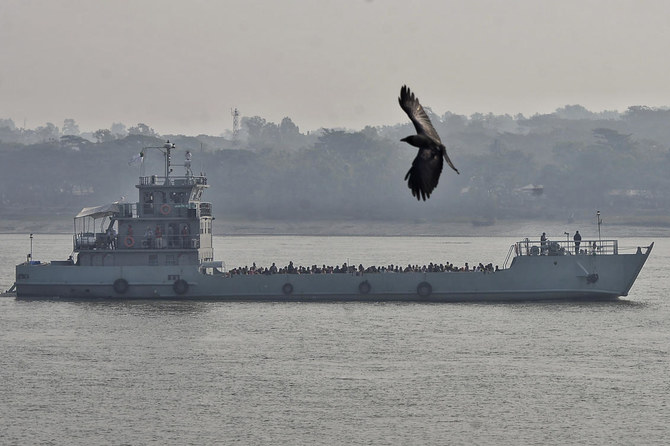
Rohingya refugees travel on a naval vessel to be relocated to to the island of Bhasan Char, in Chattogram, Bangladesh, Saturday, Jan. 30, 2021. (AP)
2 / 2
Rohingya refugees travel on a naval vessel to be relocated to to the island of Bhasan Char, in Chattogram, Bangladesh, Saturday, Jan. 30, 2021. (AP)
Short Url
Updated 30 January 2021
Follow

Bangladesh sends more Rohingya to island despite concerns

  • The 1,466 Rohingya who had been living in the sprawling refugee camps of Cox’s Bazar were sent Saturday to Bhasan Char
  • That follows 1,776 refugees who made the trip on Friday

DHAKA: Bangladesh's government sent a fourth group of Rohingya Muslim refugees to an island in the Bay of Bengal on Saturday, ignoring calls from human rights groups for a halt to the move.
The 1,466 Rohingya who had been living in the sprawling refugee camps of Cox’s Bazar were sent Saturday to Bhasan Char, an island specifically developed to accommodate 100,000 of the 1 million Rohingya who have fled from neighboring Myanmar. That follows 1,776 refugees who made the trip on Friday.
The relocations began in December and have been criticized by human rights groups, who say many of the refugees are being forced to move against their will.
Prime Minister Sheikh Hasina and her government have denied that and said the relocations will continue.
Bangladesh has said that ultimately it is up to Myanmar to take the refugees back and has called on the international community to put pressure on Myanmar's government to ensure their safe return.
More than 1 million Rohingya have fled waves of violent persecution in their native Myanmar and are currently living in overcrowded, squalid refugee camps in Cox’s Bazar district.
“My people and relatives came here earlier. They said it is better here. So, we came,” Aman Ullah, a Rohingya refugee, said Saturday after his arrival on Bhasan Char.
Another said he came voluntarily.
“We were asked to come. And we came here at our own will,” said Mohammed Nuruddin.
The island, located 21 miles (34 kilometers) from the mainland, surfaced only 20 years ago and was not previously inhabited. It was regularly submerged by monsoon rains but now has flood protection embankments, houses, hospitals and mosques built at a cost of more than $112 million by the Bangladesh navy.


35 million Nigerians ‘risk hunger after global funding collapse’

Updated 5 sec ago
Follow

35 million Nigerians ‘risk hunger after global funding collapse’

  • The UN can only aim to ‌deliver $516 million to provide lifesaving aid to 2.5 million people this year, down from 3.6 million in 2025, which in turn was about half the previous year’s level

ABUJA: Nearly 35 million Nigerians are at risk of hunger this year, including 3 million children facing severe malnutrition, ​the UN said, following the collapse of global aid budgets.
Speaking at the launch of the 2026 humanitarian plan in Abuja, UN Resident and Humanitarian Coordinator Mohammed Malick Fall said the long-dominant, foreign-led aid model in Nigeria is no longer sustainable and ‌that Nigeria’s ‌needs have grown. 
Conditions in ‌the conflict-hit ​northeast ‌are dire, Fall said, with civilians in Borno, Adamawa, and Yobe states facing rising violence. 

BACKGROUND

UN Resident and Humanitarian Coordinator Mohammed Malick Fall said the foreign-led aid model in Nigeria is no longer sustainable and ‌that the country’s needs have grown.

A surge in terror attacks killed more than 4,000 people in the first eight months of 2025, matching the toll for all of 2023, he said.
The UN can only aim to ‌deliver $516 million to provide lifesaving aid to 2.5 million people this year, down from 3.6 million in 2025, which in turn was about half the previous year’s level.
“These are not statistics. These numbers represent lives, futures, and Nigerians,” Fall said.
He also said ​the UN had no choice but to focus on “the most lifesaving” interventions given the drop in available funding. 
Shortfalls last year led the World Food Programme to also warn that millions could go hungry in Nigeria as its resources ran out in December and it was forced to cut support for more than 300,000 children. 
Fall said Nigeria was showing growing national ownership of the crisis response in recent months through measures such as local funding for ‌lean-season food support and early-warning action on flooding.