

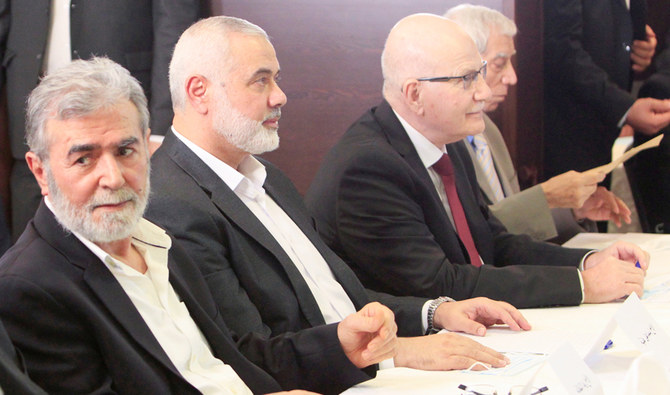
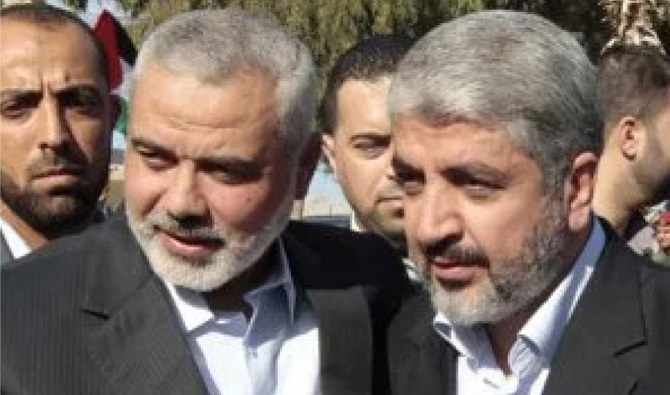

GAZA CITY: Secret Hamas internal elections have become the subject of a growing rift in the party amid calls for greater openness and representation ahead of Palestine’s general elections scheduled for May.
The General Shoura Council of Hamas rejected a request by the political leadership to postpone internal elections for one year in order for the party to devote time to legislative elections, in which Hamas can maximize its political clout.
Hamas, which will celebrate its 34th anniversary this year, is looking to new leadership to lead the party over the next four years, but internal disputes are surfacing, bucking the trend of secrecy and traditionalism within the movement.
An official Hamas source said that if the Cairo-hosted inter-Palestinian dialogue on general elections proves successful, Hamas will immediately begin internal elections, provided they finish in two months instead of six.
Hamas conducts its elections in complete secrecy in three regions — the Gaza Strip, the West Bank and the diaspora — once every four years in order to choose its leadership. Positions up for grabs range from leadership of sub-regions, Shoura Council spots and Political Bureau posts, which represent the highest “executive authority” in the movement.
The Political Bureau consists of 15 members, distributed evenly across Gaza, the West Bank and the diaspora. They are chosen by the Shoura, Hamas’ highest regulatory authority, which maintains an anonymous member count.
The last internal elections were held in 2017 and saw Ismail Haniyeh become head of the Political Bureau — the first time a Gaza-based leader was elected to an executive position.
According to widely circulated information, Haniyeh is not guaranteed to remain in his post for a second term in light of Turkish-Qatari support for the return of former chief Khaled Mashaal, who, according to procedural rules, can become president again.
Haniyeh, who comes from a refugee family, has lived abroad for more than a year, moving between Ankara and Doha, while Mashaal, who was born in Kuwait, has resided permanently in Doha since Hamas left Syria following disputes with the Bashar Assad regime.
Last month, Hamas held elections for new leadership of the High Commanding Authority in Israeli prisons. Salama Al-Qatawi, a detainee, was appointed chief, detainee Abdel Nasser Issa his deputy, while 13 other prisoners were granted membership of the movement.
The anonymous Hamas source told Arab News that Hamas prisoners are dissatisfied with the leadership positions and their perceived lack of power in decision-making.
The source added that the prisoners are calling for prisons to be adopted as a fourth region in elections, their leader made a member of the new Political Bureau, and his deputy made a member of the Shoura Council.
If their campaign proves successful, the prisoners will have a representative in the Political Bureau for the first time in years.
Wasfi Qabha, a prominent Hamas leader in the West Bank and former minister of prisoners, defended the right of the prisoners to be represented in the Political Bureau.
He expressed dissatisfaction with prisoner and West Bank representation in the last election, adding: “It is not acceptable for the prisoners not to have a representative, and those who represent the West Bank have members residing outside it.”
The West Bank is represented in the Political Bureau by exiled ex-prisoners and leaders who have settled in the region, which has led to accusations that its leadership lacks authenticity.
“The principle is that whoever leaves the West Bank is counted on the quota of abroad, and leaves the representation of the West Bank to its people. The West Bank is not a minor child in need of guardianship,” Qabha told Arab News.
West Bank elections are supervised by Saleh Al-Arouri, deputy head of the Political Bureau, who has lived abroad following his deportation in 2011 that came after his release from an Israeli prison as part of the Gilad Shalit prisoner exchange.
Hamas’ internal system relies on secrecy. It forbids members from directly running for any of its leadership bodies. Rather, it is based on the principle of endorsement, whereby figures are selected to compete for leadership vacancies — from the lower level to the upper.
Recently, new voices have emerged within Hamas calling for a change in the traditional pattern of elections to keep pace with developments and to face both internal and external challenges.
These include Ghazi Hamad, head of the Ministry of Social Development in Gaza, who wrote the article “Hamas elections — between traditional stereotypes and the required renewal,” in which he argued that it is time to “break the tradition and adopt change, frankness, boldness and qualitative action.”
Hamad addressed the Hamas base, saying that it is wrong to limit the elections of a great movement with a history, popularity and national presence to purely partisan walls.
He added that some people want elections to remain “traditional, stereotypical and secret,” denying members the ability to communicate and revise leadership, and limiting choices only to certain geographic areas.
Khalil Al-Hayya, a member of the Political Bureau, said in an interview with Hamas’ Aqsa TV that the movement took its decision to conduct internal elections as per the scheduled dates, adding that elections will be conducted “smoothly and in a friendly atmosphere.”


