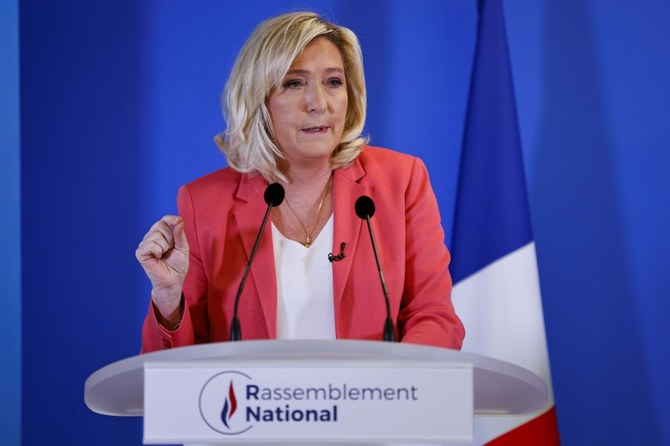
PARIS: French far-right leader Marine Le Pen proposed a ban on Muslim headscarves in all public places on Friday, seeking to build on a record recent poll putting her almost neck-and-neck with President Emmanuel Macron.
The hijab policy, which would be contested in court and almost certainly be ruled unconstitutional, saw the 53-year-old return to a familiar campaign theme 15 months from the country’s 2022 presidential election.
“I consider that the headscarf is an Islamist item of clothing,” Le Pen told reporters at a press conference where she proposed a new law to ban “Islamist ideologies” which she called “totalitarian and murderous.”
Since taking over France’s main far-right party from her father, Le Pen has run twice for the French presidency, losing badly in 2017 to political newcomer Macron in a defeat that she took months to recover from.
But recent polling shows her closer than ever to her ultimate prize and has led to a rash of new speculation about whether the anti-EU, anti-immigration populist could finally enter the Elysee Palace.
Despite recent setbacks for fellow ideologues such as Donald Trump, and Matteo Salvini in Italy, a survey reported earlier this week showed her within striking distance of Macron.
The poll conducted online by Harris Interactive suggested that if a final-round presidential run-off were held today Le Pen would garner 48 percent while Macron would be re-elected with 52 percent, Le Parisien newspaper reported.
“It’s a poll, it’s a snapshot of a moment, but what it shows is that the idea of me winning is credible, plausible even,” Le Pen said at the Friday press conference.
The prospect of a tight race set off alarm bells in the French political mainstream as the dual health and economic crises caused by the coronavirus pandemic sweep across the country.
“It’s the highest she has ever been at,” said Jean-Yves Camus, a French political scientist specialized in the far-right, while adding that it was “too early to take the polls at face value.”
He said Le Pen was benefiting from frustration and anger over the pandemic, with France on the verge of a third lockdown, but also the beheading of a French school teacher by an Islamist last October.
“It had a major impact on public opinion,” the expert from the Jean-Jaures Foundation told AFP. “And in this area, Marine Le Pen has an advantage: her party is well known for its position denouncing Islamism.”
The beheading of Samuel Paty in a town northwest of Paris rekindled bitter arguments in France about immigration and the threat of Islamism, while putting the country’s strict form of secularism under international scrutiny.
The secondary school teacher was attacked in the street by an 18-year-old extremist after he showed satirical cartoons of the Prophet Muhammad to pupils during a civics class on free speech.
In response to Paty’s death, Macron’s government shut a number of organizations deemed Islamist and drafted law legislation initially called “the anti-separatism bill” which cracks down on foreign funding for Islamic organizations.
If re-elected after a campaign that is expected to be centered on jobs, the pandemic and the place of Islam in France, 43-year-old Macron would be the first president since Jacques Chirac in 2002 to win a second term.
Under the presidential system, the top two candidates in a first round of voting progress to a second-round run-off where the winner must get more than 50 percent.
A Le Pen win “was improbable three and half years ago,” veteran political commentator Alain Duhamel told the BFM news channel this week.
“But today I wouldn’t say that it is probable, but I’d say, without any pleasure, that it seems to me to be possible.”
A re-run of the Macron-Le Pen contest of 2017, which all polls currently show as the most likely outcome, could increase the abstention rate and disillusionment with the French political system.
Turnout in the second round in 2017 was 74.6 percent, its lowest level since 1969, because many voters from the left declined to cast a ballot.


![]()

France’s Le Pen, at record high in polls, proposes hijab ban
Short Url
https://arab.news/j9pn6
France’s Le Pen, at record high in polls, proposes hijab ban
- Le Pen was rejected by the French public in her last election, but has since experienced a resurgence in popularity
- A string of terror attacks in France and the pandemic's health crisis have helped her in the polls


Latest updates


© 2026 SAUDI RESEARCH & PUBLISHING COMPANY, All Rights Reserved And subject to Terms of Use Agreement.