Timothy Collins at FII: ‘Survivors of this mess will provide great opportunities’

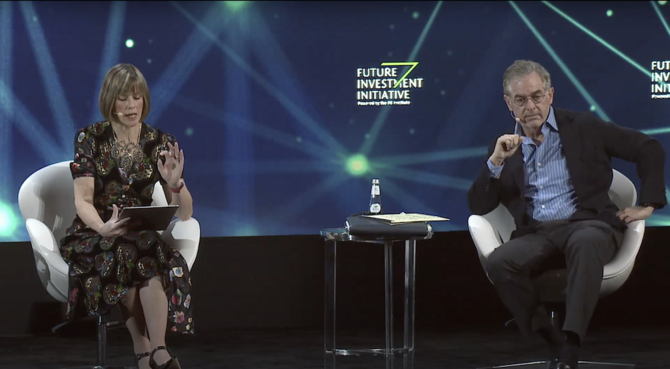
Companies have had to rely on innovation in order to survive amidst the coronavirus pandemic Timothy Collins, CEO and managing partner of New York-based private equity firm Ripplewood Advisors, speaks at the Future Investment Initiative (FII) in Riyadh, Saudi Arabia, on Thursday, Jan. 28, 2021. (Screengrab)
Short Url
Updated 28 January 2021
Follow

Timothy Collins at FII: ‘Survivors of this mess will provide great opportunities’

  • Companies have had to rely on innovation in order to survive amidst the coronavirus pandemic

RIYADH: Experimenting with digital technologies is a vital component for progress, with the world’s companies having had to rely on innovation in order to survive amidst the coronavirus disease (COVID-19) pandemic, speakers said at the Future Investment Initiative (FII) held in Riyadh on Thursday.
“Places like the Kingdom and the UAE have done a remarkable job of adapting,” said Timothy Collins, CEO and managing partner of New York-based private equity firm Ripplewood Advisers.
“Everyone has learned that we are more reliant on governments than we ever thought — in that regard, we have learned that competence may be more important than ideology,” he said.

“The world is unpredictable; real time iteration is something we did not do well in the beginning but something we are doing much better now … Having a distinct sense of purpose is becoming a main source of competitive advantage,” he added, saying that in seeking future successful investments, his company will look for “innovators and disruptors in the market.”
Dirk Hoke, CEO of Airbus Defense and Space, commented that adaptability in the business world, which saw “accelerated contracts” and “accelerated payment terms” was possible due to rapid digitalization.
In turning competition into partnerships, the “Franco-German-Spanish corporation” was established, which will create a strong European foundation to ensure a less fragmented defense strategy, he said.
Jeremy Weir, CEO and executive chairman of Trafigura, added that decarbonization is a goal for every company and as such “there will be a significant increase in the demand of metals needed” for decarbonization and further announced future investment plans in hydrogen.


Closing Bell: Saudi main index dips slightly to 10,912

Updated 5 sec ago
Follow

Closing Bell: Saudi main index dips slightly to 10,912

RIYADH: Saudi Arabia’s Tadawul All Share Index was broadly stable on Tuesday, as it shed just 4.61 points or 0.04 percent to close at 10,912.43.

The total trading turnover of the benchmark index stood at SR3.99 billion ($1.06 billion), with 68 of the listed stocks advancing, and 194 declining.

The Kingdom’s parallel market Nomu gained 0.68 points to close at 23,358.18.

The MSCI Tadawul Index also edged up by 0.03 points to 1,467.56.

The best-performing stock on the main market was Saudi Cable Co. The firm’s share price rose by 9.72 percent to SR161.40.

The share price of Almasane Alkobra Mining Co. advanced by 9.25 percent to SR108.70.

Al-Jouf Agricultural Development Co. also saw its stock price climb by 6.46 percent to SR48.10.

Conversely, the share price of Tabuk Agricultural Development Co. edged down by 3.67 percent to SR7.61.

On the announcements front, Dar Al Majed Real Estate Co. said that it signed a Shariah-compliant banking facilities agreement with the Arab National Bank valued at SR500 million.

In a Tadawul statement, the company revealed that the agreement is aimed at supporting the firm’s expansion plans and financing its future projects in line with its approved strategic plan.

The financing term extends for up to five years and includes a grace period of two years.

The share price of Dar Al Majed Real Estate Co. declined by 0.99 percent to SR9.

Saudi Paper Manufacturing Co. said it signed a credit facilities agreement with Kuwait Finance House Bahrain, which includes facilities allocated to finance working capital and medium-term facilities amounting to $40 million.

In a Tadawul statement, the company revealed that the working capital facilities extend for 12 months and are renewable.

The medium-term facilities last for 48 months, including a six-month grace period.

The credit facilities will be used to cover the company’s working capital for operational activities, plans and expansions in purchasing raw materials, in addition to restructuring medium-term debts to improve cash flows.

The share price of Saudi Paper Manufacturing Co. edged down by 1.09 percent to SR58.80.