Pakistan arrests 'most wanted' militant linked to Iran-backed Zainabiyoun Brigade

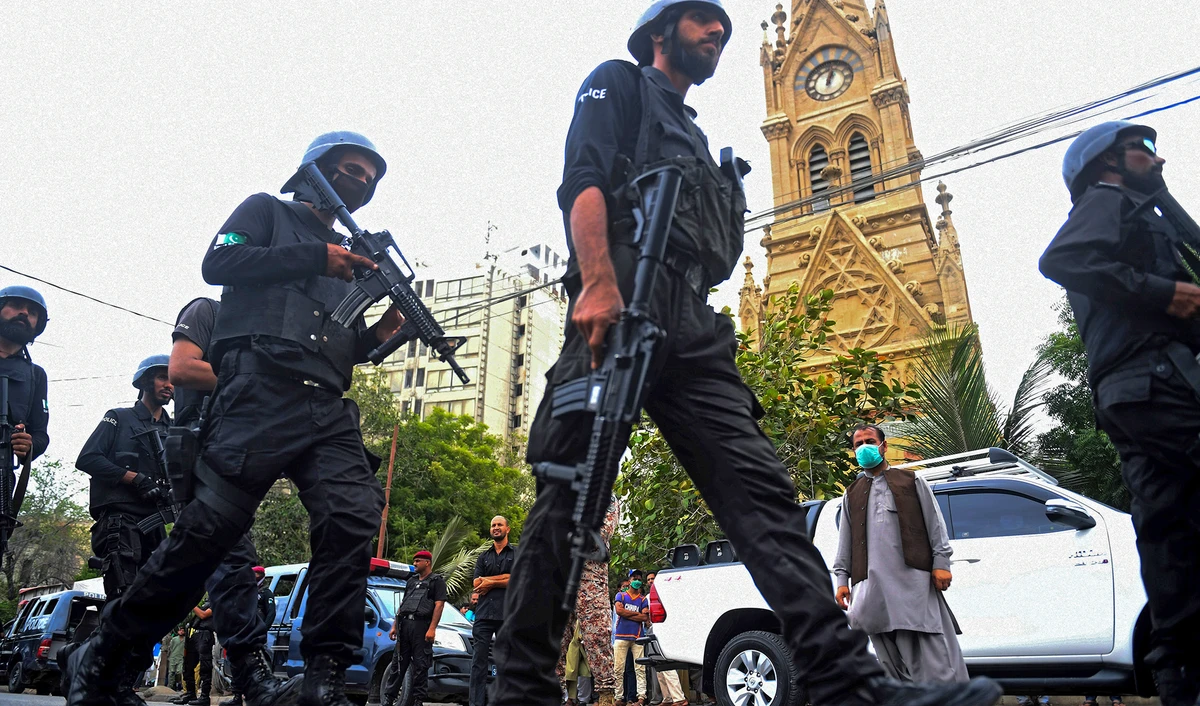
Police commandos patrol near the Pakistan Stock Exchange building in Karachi on June 29, 2020. (AFP/File)
Short Url
Updated 29 January 2021
Follow

Pakistan arrests 'most wanted' militant linked to Iran-backed Zainabiyoun Brigade

  • Counterterrorism police chief says Abbas Jafri received military training in neighboring Iran
  • Last December, police arrested two members of the same militant outfit from Karachi’s Korangi area

KARACHI: Pakistan has arrested a ‘most wanted’ militant it says is linked to the Zainabiyoun Brigade, with investigators saying on Thursday he had received military training in neighboring Iran.
The Zainabiyoun Brigade was placed on the US Treasury’s financial blacklist in January 2019 and is believed to have sent young members of the Pakistani Shiite community to fight in Syria. 
“The arrested terrorist, Abbas Jafri, is a close aide of another most-wanted terrorist, Yawar Abbas, and, much like other members of the Zainabiyoun Brigade, got his military training in neighboring Iran,” Omar Shahid, deputy inspector general (DIG) of the Counter Terrorism Department (CTD), said.
According to an official handout, Jafri, who was arrested in Karachi, was trained in 2014 and, among other skills, taught to perform intelligence operations and provide medical services.
“The arrested terrorist specialized in automatic weapons and received training from a neighboring country,” the handout added.

Press release and copy of FIR registered against the militant of Iran-backed Zainabiyoun Brigade arrested in Karachi on January 27, 2021. (Courtesy: Counter-Terrorism Department, Sindh Police)

Jafri, from whom weapons were confiscated, was also described as the right-hand man of Yawar Abbas and named in the “Red Book”, an official document on that lists  names and profiles of hardened militants.
According to the police, Jafri was involved in carrying out reconnaissance activities for militants.
The arrested man has been shifted to an undisclosed location for further investigation, police said.
Earlier in December, CTD said it had arrested two members of the Zainabiyoun Brigade from the Korangi area of Karachi in connection with a string of killings over the last six years. 
Tehran has not responded to the CTD’s claims.
On November 27, an AP report said that a group of Pakistanis was among 19 pro-Iran militia fighters killed in eastern Syria.
In March, a senior official told Arab News that up to 50 Pakistani fighters were killed by the Turkish army and Syrian forces in a major rebel stronghold in the northwest of the country.
US to cut tariffs on India to 18% as Delhi agrees to end Russian oil purchases

Updated 6 sec ago
Follow

US to cut tariffs on India to 18% as Delhi agrees to end Russian oil purchases

  • President Trump says New Delhi would now buy oil from the US and potentially Venezuela
  • White House hasn’t issued presidential proclamation, Federal Register notice on changes

WASHINGTON/NEW DELHI: US President Donald Trump on Monday announced a trade deal with India that slashes US tariffs on Indian goods to 18% from 50% in exchange for India halting Russian oil purchases and lowering trade barriers.

Trump announced the deal on social media following a call with Indian Prime Minister Narendra Modi, noting that India would now buy oil from the US and potentially Venezuela.

A White House official told Reuters that the US was rescinding a punitive 25% duty on all imports from India over its purchases of Russian oil that had stacked on top of a 25% “reciprocal” tariff rate.

US-listed shares of major Indian companies rallied on the news. IT consulting firm Infosys closed 4.3% higher, consultancy Wipro rose 6.8%, HDFC Bank gained 4.4 percent and the iShares MSCI India exchange-traded fund rallied 3%.

Trump’s announcement added to positive sentiment over semiconductor makers and artificial intelligence, lifting major indexes into positive territory on the day.

Modi also committed India to “BUY AMERICAN at a much higher level,” in addition to buying more than $500 billion worth of US energy, including coal, along with technology, agricultural and other products, Trump added.

“They will likewise move forward to reduce their Tariffs and Non Tariff Barriers against the United States, to ZERO,” Trump said of India.

Until Trump returned to office and raised US tariff rates to double-digit levels last year, India had some of the world’s highest tariffs, with a simple applied rate of 15.6% and an effective applied tariff of 8.2%, according to World Trade Organization data.

FEW DETAILS AVAILABLE

Trump’s Truth Social message provided few details, including on the start date for the lower tariff rates, the deadline for India to end Russian oil purchases, trade barrier reductions and which US products India had committed to purchasing.

As of late Monday afternoon, the White House had not issued a presidential proclamation nor a Federal Register notice required to make the changes official.

A White House spokesperson offered no further details, while India’s commerce and foreign ministries did not immediately respond to requests sent after working hours. Russia’s embassy in Washington also did not immediately respond to a request for comment.

Previous trade deals with other major Asian trading partners including Japan and South Korea have included commitments to invest hundreds of billions of dollars into US industries, but the India announcement did not mention any specific investments.

The deal brings India “broadly in line with its Asian peers on tariff rates” of 15% to 19%, said Madhavi Arora, economist at Emkay Global, adding that it would eliminate a disproportionate drag on India’s exports and its rupee currency.

Indian markets had been battered since the tariffs were levied by Washington, making it the worst-performing market among emerging nations in 2025, with record outflows of foreign investors.

US business groups reacted with caution and criticism. The US Chamber of Commerce, which has long advocated a market-opening trade deal with India, called Trump’s announcement progress toward that goal.

“We are optimistic that this is the first step toward a comprehensive trade agreement that will unlock even more private sector collaboration, and we look forward to reviewing the details of the deal,” Chamber CEO Suzanne Clark said in a statement.

A coalition of more than 800 small businesses called “We Pay the Tariffs” urged Americans not to celebrate the deal, which it called a “600% tax increase on American businesses compared to 2024.” The group noted that US tariffs on Indian imports were about 2% to 3% at that time but would now be 18 percent and could go higher if India does not fully wean itself off Russian oil.

‘BIG THANKS’ FROM MODI

“Wonderful to speak with my dear friend President Trump today. Delighted that Made in India products will now have a reduced tariff of 18%,” Modi said in a social media post on X. “Big thanks to President Trump on behalf of the 1.4 billion people of India for this wonderful announcement.”

India’s Trade Minister Piyush Goyal said the deal would draw the US and Indian economies closer together.

“This agreement unlocks unprecedented opportunities for farmers, MSMEs, entrepreneurs, and skilled workers to Make in India for the world, Design in India for the world, and Innovate in India for the world. It will help India get technology from the US,” Goyal said in a post on X.

The deal comes less than a week after India signed a long-awaited trade deal with the European Union that is expected to eliminate or reduce tariffs on 96.6% of traded goods by value. That deal excludes EU soybeans, beef, sugar, rice and dairy from tariff reductions.

The Trump administration has been racing to complete framework trade deals with major trading partners before the US Supreme Court rules on whether to strike down Trump’s “reciprocal” tariffs under the International Emergency Economic Powers Act.

Trump administration officials reached a deal with Taiwan last month and say such agreements are expected to continue no matter what the court rules, as they will reimpose tariffs under other authorities.

WESTERN HEMISPHERE OIL

On Saturday, Trump teased a potential deal for India to buy Venezuelan oil after the US seized Venezuelan President Nicolas Maduro in a military raid in early January.

The deal followed months of tense trade negotiations between the world’s two largest democracies.

Last August, Trump doubled duties on imports from India to 50% to pressure New Delhi to stop buying Russian oil, and earlier this month said the rate could rise again if it did not curb its purchases.

Purchases of Venezuelan oil would help replace some of the Russian oil bought by India, the world’s third-biggest oil importer.

India relies heavily on oil imports, covering around 90% of its needs, and importing cheaper Russian oil has helped lower its import costs since Moscow invaded Ukraine in 2022 and Western nations enacted sanctions on its energy exports.

Recently India has begun to slow its purchases from Russia. In January, they were around 1.2 million barrels per day, and are projected to decline to about 1 million bpd in February and 800,000 bpd in March, according to a Reuters report.