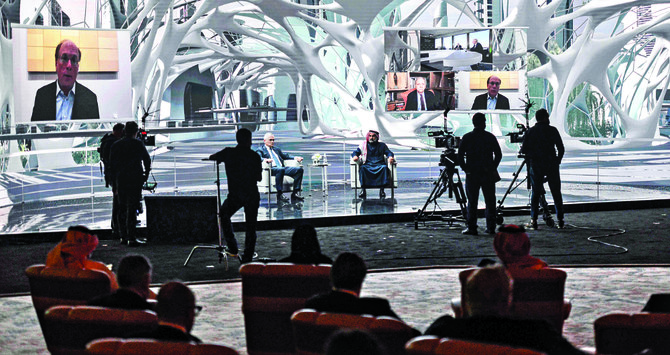
The Future Investment Initiative summit opened in Riyadh on Wednesday with a call for a “fundamental rethink” toward economic and social challenges in the pandemic era, and an invitation to take part in the big investment opportunities offered by Saudi Arabia’s transformation strategy.
Yasir Al-Rumayyan, governor of the Public Investment Fund, said the pandemic presented “an unprecedented opportunity for fresh thinking,” and urged the virtual global audience involved in the event “not to return to the status quo.”
He also invited financiers, bankers and business people to sample the “investment menu” in the Kingdom. “The variety of investments available in Saudi Arabia is really big — not just in the financial sector, but in the real economy,” he said.
The event had been postponed from last autumn because of travel restrictions from the pandemic, but went ahead as a “hybrid” forum with a physical venue in the Saudi capital supported by online hubs in Beijing, Mumbai, Paris and New York. The organizers said about 9,500 people attended either in person or virtually.
Al Rumayyan said: “This is not a normal event, but it is the opportunity to open a new chapter for humanity — the neo-renaissance,” which is the theme of the two-day gathering.
The PIF boss and other investment experts talked enthusiastically about the range of potential investments in the Kingdom under the second phase of the Vision 2030 strategy, but also warned that the global economic situation remained uncertain.
Al-Rumayyan said the division between “those with funds waiting on the sidelines and the working class” was a potential risk for economic recovery in 2021.
That caution was echoed by one of the big investment heavyweights at the opening session, the founder of investment firm Bridgewater Associates, Ray Dalio, who said: “I don’t think equities will be as ebullient as last year.”
Khalid Al-Falih, the Saudi investment minister, was more optimistic, pointing out that foreign investment had risen in the Kingdom in 2020 despite the economic recession caused by the virus.
He called on governments to take on more of the risk of setting up business, as the Saudi government has done. “We have looked at 400 different investment regulations and half of them have been revamped,” he said.
A major theme of the opening day, reinforced by virtually every speaker, was the move toward more sustainable investment, especially in the crucial energy sector.
Prince Abdul Aziz bin Salman, the Saudi energy minister, predicted that the Kingdom would make more progress in tackling climate change in the next decades than many other countries.
“We will enjoy being looked at as a reasonable and responsible international citizen because we will be doing more than most European countries by 2030,” he said.
He praised the Kingdom’s efforts in fighting the virus and in rebalancing global oil markets last year. “When the going got tough, the tough got going,” he said.


![]()

Saudi Arabia’s FII hears call for ‘new chapter for humanity’ in response to pandemic
Short Url
https://arab.news/5c7mj
Saudi Arabia’s FII hears call for ‘new chapter for humanity’ in response to pandemic
- Pandemic presents ‘an unprecedented opportunity for fresh thinking’


Latest updates


© 2026 SAUDI RESEARCH & PUBLISHING COMPANY, All Rights Reserved And subject to Terms of Use Agreement.