

Saudi Aramco uses technology to improve emissions, says CEO

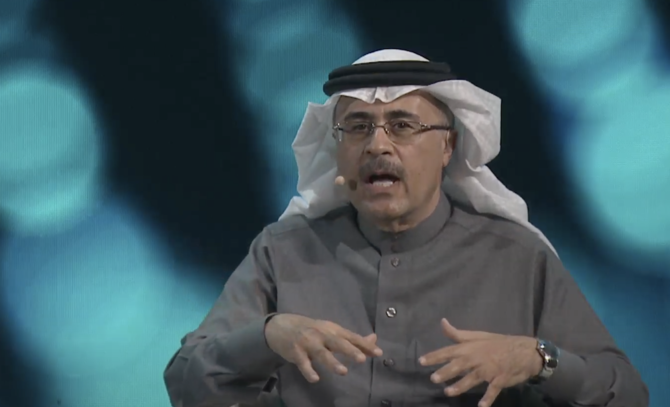
Saudi Aramco was able to reach a 70 percent recovery rate, all due to technology, according to Amin Nasser, the company’s president and CEO, who was speaking at the Future Investment Initiative. (Screenshot: FII Institute)
Short Url
Updated 28 January 2021
Follow

Saudi Aramco uses technology to improve emissions, says CEO

  • Amin Nasser was speaking on day one of Future Investment Initiative in Riyadh

JEDDAH: Saudi Aramco has been taking advantage of accelerated technology to build its reliability in the market as well as decreasing carbon emissions.

Using data analytics and simulation models to manage reservoirs has helped the company reach a 70 percent recovery rate, all due to technology, according to Amin Nasser, Saudi Aramco’s president and CEO.

“Our reliability for 2020 is 99.8 percent, one of the highest in the world in terms of delivery,” he told delegates during the fourth edition of the Future Investment Initiative (FII) forum, which is currently underway in Riyadh.

Saudi Arabia’s “agility and executional speed” to invest in technology has given the Kingdom the largest digital investment in the Middle East and North Africa, worth a billion dollars, the Saudi Minister of Communications and Information Technology, Eng. Abdullah Amer Al-Swaha, said during the panel, entitled “Cracking the Code: What is the future of global technology policy?”

The minister also announced a partnership with Babylon Health to use data and artificial intelligence (AI) to reduce the cost of health consultations to a dollar when delivered by a machine.

Saudi Finance Minister Mohammed Al-Jadaan encouraged investors to consider the vast industries within the Kingdom that offer ample investment opportunities through privatization, even during challenging times as a result of the COVID-19 pandemic.

With the ongoing restructure of laws and regulations, the Kingdom has worked hard to ramp up up investment and provide further business opportunities, while being transparent with its partners, the minister added.

“In addition to all of this, we’ve reformed the capital market both on the equity side and debt side, the latter market has grown up to 200 percent during 2020 and we’re likely to see further growth,” he concluded.


Saudi POS spending jumps 28% in final week of Jan: SAMA

Updated 06 February 2026
Follow

Saudi POS spending jumps 28% in final week of Jan: SAMA

RIYADH: Saudi Arabia’s point-of-sale spending climbed sharply in the final week of January, rising nearly 28 percent from the previous week as consumer outlays increased across almost all sectors. 

POS transactions reached SR16 billion ($4.27 billion) in the week ending Jan. 31, up 27.8 percent week on week, according to the Saudi Central Bank. Transaction volumes rose 16.5 percent to 248.8 million, reflecting stronger retail and service activity. 

Spending on jewelry saw the biggest uptick at 55.5 percent to SR613.69 million, followed by laundry services which saw a 44.4 percent increase to SR62.83 million. 

Expenditure on personal care rose 29.1 percent, while outlays on books and stationery increased 5.1 percent. Hotel spending climbed 7.4 percent to SR377.1 million. 

Further gains were recorded across other categories. Spending in pharmacies and medical supplies rose 33.4 percent to SR259.19 million, while medical services increased 13.7 percent to SR515.44 million. 

Food and beverage spending surged 38.6 percent to SR2.6 billion, accounting for the largest share of total POS value. Restaurants and cafes followed with a 20.4 percent increase to SR1.81 billion. Apparel and clothing spending rose 35.4 percent to SR1.33 billion, representing the third-largest share during the week. 

The Kingdom’s key urban centers mirrored the national surge. Riyadh, which accounted for the largest share of total POS spending, saw a 22 percent rise to SR5.44 billion from SR4.46 billion the previous week. The number of transactions in the capital reached 78.6 million, up 13.8 percent week on week. 

In Jeddah, transaction values increased 23.7 percent to SR2.16 billion, while Dammam reported a 22.2 percent rise to SR783.06 million. 

POS data, tracked weekly by SAMA, provides an indicator of consumer spending trends and the ongoing growth of digital payments in Saudi Arabia.  

The data also highlights the expanding reach of POS infrastructure, extending beyond major retail hubs to smaller cities and service sectors, supporting broader digital inclusion initiatives.  

The growth of digital payment technologies aligns with Saudi Arabia’s Vision 2030 objectives, promoting electronic transactions and contributing to the Kingdom’s broader digital economy.