

Fans spot Zayn Malik’s new tattoo of daughter’s name in Arabic

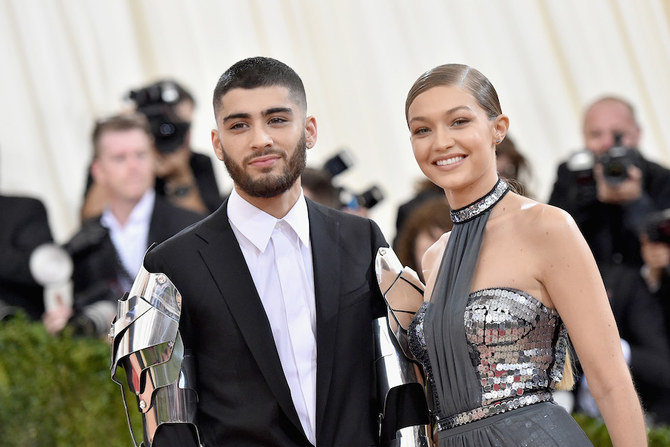
Zayn Malik and Gigi Hadid welcomed a baby girl together in September. File/AFP
Short Url
Updated 29 January 2021
Follow

Fans spot Zayn Malik’s new tattoo of daughter’s name in Arabic

DUBAI: Zayn Malik just added a new tattoo to his ink collection, and it might be his most thoughtful one yet: The name of his and Gigi Hadid’s baby daughter, Khai, written in Arabic on the inside of his wrist.

Eagle-eyed fans spotted the new ink on the former One Direction star during one of his Instagram Lives, which was recorded before their four-month-old daughter’s name was revealed.

Part-Palestinian Hadid revealed their baby girl’s unique name in an under-the-radar manner that saw her update her Instagram bio to say “Khai’s mom.” Though Hadid did not publicize the change, internet sleuths caught on quickly, and the news soon started trending on Twitter.

As it turns out, Malik is a fan of using tattoos to immortalize important people in his life.

For instance, the popstar has his grandfather's name in Arabic inked on his skin, as well as his father's own moniker. Other meaningful tattoos include Hadid’s eyes on his chest. 

The couple’s daughter’s name has been reported to be a nod to Hadid’s paternal grandmother named Khairiah.


A post shared by Zayn Malik (@zayn)

The pair have been relatively private when it comes to their daughter and have yet to share a picture of Khai with the public. However, the model often posts sweet snaps of her daughter’s tiny hand grasping her finger.

The couple welcomed their first child together in September. At the time, Malik announced the news by writing: “Our baby girl is here, healthy and beautiful. To try to put into words how I am feeling right now would be an impossible task. The love I feel for this tiny human is beyond my understanding. Grateful to know her, proud to call her mine, and thankful for the life we will have together.”

Arabic calligraphy: Ancient craft, modern art
For the Saudi Ministry of Culture's Year of Arabic Calligraphy in 2020/21, we take an in-depth look at how the craft has developed from ancient to modern times.

Enter


keywords

Review: ‘Sorry, Baby’ by Eva Victor

Eva Victor appears in Sorry, Baby by Eva Victor, an official selection of the 2025 Sundance Film Festival. (Supplied)
Updated 27 December 2025
Follow

Review: ‘Sorry, Baby’ by Eva Victor

  • Victor makes a deliberate narrative choice; we never witness the violence of what happens to her character

There is a bravery in “Sorry, Baby” that comes not from what the film shows, but from what it withholds. 

Written, directed by, and starring Eva Victor, it is one of the most talked-about indie films of the year, winning the Waldo Salt Screenwriting Award at Sundance and gathering momentum with nominations, including nods at the Golden Globes and Gotham Awards. 

The film is both incisive and tender in its exploration of trauma, friendship, and the long, winding road toward healing. It follows Agnes, a young professor of literature trying to pick up the pieces after a disturbing incident in grad school. 

Victor makes a deliberate narrative choice; we never witness the violence of what happens to her character. The story centers on Agnes’ perspective in her own words, even as she struggles to name it at various points in the film. 

There is a generosity to Victor’s storytelling and a refusal to reduce the narrative to trauma alone. Instead we witness the breadth of human experience, from heartbreak and loneliness to joy and the sustaining power of friendship. These themes are supported by dialogue and camerawork that incorporates silences and stillness as much as the power of words and movement. 

The film captures the messy, beautiful ways people care for one another. Supporting performances — particularly by “Mickey 17” actor Naomi Ackie who plays the best friend Lydia — and encounters with strangers and a kitten, reinforce the story’s celebration of solidarity and community. 

“Sorry, Baby” reminds us that human resilience is rarely entirely solitary; it is nurtured through acts of care, intimacy and tenderness.

A pivotal scene between Agnes and her friend’s newborn inspires the film’s title. A single, reassuring line gently speaks a pure and simple truth: “I know you’re scared … but you’re OK.” 

It is a reminder that in the end, no matter how dark life gets, it goes on, and so does the human capacity to love.