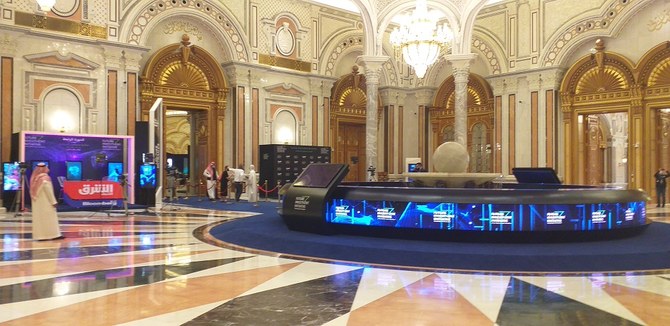
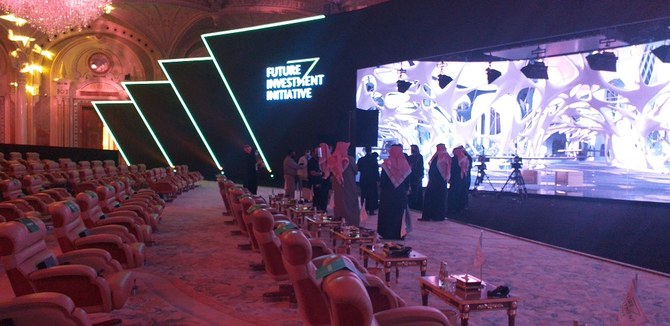
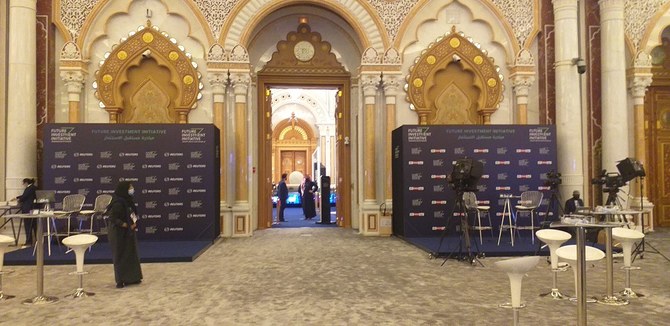


RIYADH: The fourth edition of the Future Investment Initiative (FII), Saudi Arabia’s flagship financial forum, is all set to launch on Wednesday at the King Abdul Aziz International Conference Center (KAICC) in Riyadh.
Yasir Al-Rumayyan, chairman of the FII Institute and governor of the Public Investment Fund (PIF), the Kingdom’s sovereign wealth fund, will deliver opening remarks to conference delegates.
Elaborate civil and security arrangements, including health precautions and guidelines, have been put in place at the KAICC and the adjoining luxurious Ritz-Carlton hotel, which is housing FII guests.
Guests and media participants attending the two-day event will have limited access as the annual forum this year is being staged during exceptional circumstances due to the coronavirus disease (COVID-19) pandemic. As a result, delegates are being taken to the FII venue and the Plenary Hall in shuttle buses departing from the meeting point at the Ritz-Carlton.
The FII will address the theme of “The Neo-Renaissance” and will use XR Studio, a pioneering, immersive technology, to link speakers at the multi-hub conference with audiences around the world.
The XR Studio has been installed at the KAICC to synchronize and render the conference in real time. By using a system of cameras and virtual sets, it will provide an immersive and inter-connected experience for more than 150 speakers attending in-person in Riyadh and from hubs in New York, Paris, Beijing, and Mumbai.
The virtual sets, created specifically for the occasion, offer futuristic 3-D environments dedicated to different themes.
The in-person and virtual style of the multi-hub conference is part of an effort by the FII Institute to introduce a new way for convening impact-oriented meeting events.
The forum will allow policy makers, tech pioneers, investors, and executives – 60 in-person in Riyadh and 90 virtually – to discuss how to shape a rebirth of the global economy amid the restrictions imposed by the COVID-19 pandemic.
Opinion
This section contains relevant reference points, placed in (Opinion field)
Richard Attias, CEO of the FII Institute, said: “We are narrowing the gap between the physical conferences of the past and the virtual events that have become the new normal during the pandemic.
“This format will mean that even though we can’t meet in person, we can still mobilize, interact, exchange ideas, and challenge current thinking. This is the future of events and conferences – and we are proud that the FII Institute is pioneering this new approach.”
The FII Institute was founded in Riyadh to bring together global leaders, tech pioneers, experts, and policy makers to enable concrete ideas that can solve today’s most pressing societal issues, while creating long-term platforms to reshape the future sustainably and create a positive impact on humanity.
The FII, which has become a fixture in the global investment calendar in the short time since its launch in 2017, has evolved from just an annual gathering to become a hub for building relationships.
In 2017, the participants were mainly from the Americas, Europe, and the Middle East. Today they come from Japan, China, India, and Russia and are all united in a spirit of collaboration.
The FII in its third session in 2019 brought together more than 250 ministers, CEOs, and industry experts to address issues ranging from sustainable development to the challenges in building an inclusive workplace.
The third forum hosted in excess of 4,000 attendees from more than 30 countries with a program focused on the key topics of investment models to support “people, profit, and planet,” policy frameworks to boost the tech industry’s growth, and cultural systems to inspire humanity in the modern age.
Dubbed “Davos in the desert” but held in the luxury of the Ritz-Carlton hotel and conference center for the past four years, the FII attracts thousands of participants from the biggest corporations and investment institutions in the world.