

Drawn from poverty: Pakistani canteen helper charts journey to becoming acclaimed printmaker 

Former canteen helper-turned-printmaker Abdul Muhammad, 32, shows Arab News his work at the Indus Valley School of Art and Architecture in Karachi, Pakistan, on January 23, 2020 (AN Photo)
Short Url
Updated 26 January 2021
Follow

Drawn from poverty: Pakistani canteen helper charts journey to becoming acclaimed printmaker 

  • Abdul Muhammad credits his success to the many women who came into his life in difficult times and encouraged him to pursue art
  • The former canteen helper has had solo shows in Pakistan, his work has been exhibited in the UK, China and Dubai

KARACHI: A former canteen helper at a prestigious art school in the port city of Karachi says it was the many women that came into his life at difficult moments who had encouraged him to pursue art and eventually, today, become a successful artist.
It all began in 2000, when Abdul Muhammad, 32, was a young boy collecting wood on a seashore and a group of girls from the Indus Valley School of Art and Architecture struck up a conversation with him. One of eleven children of a poor widow, Muhammad never expected what would come next: the girls got him a job as a helper at the canteen of their university where he went on to work for nine happy years, becoming a favorite of many teachers and students.
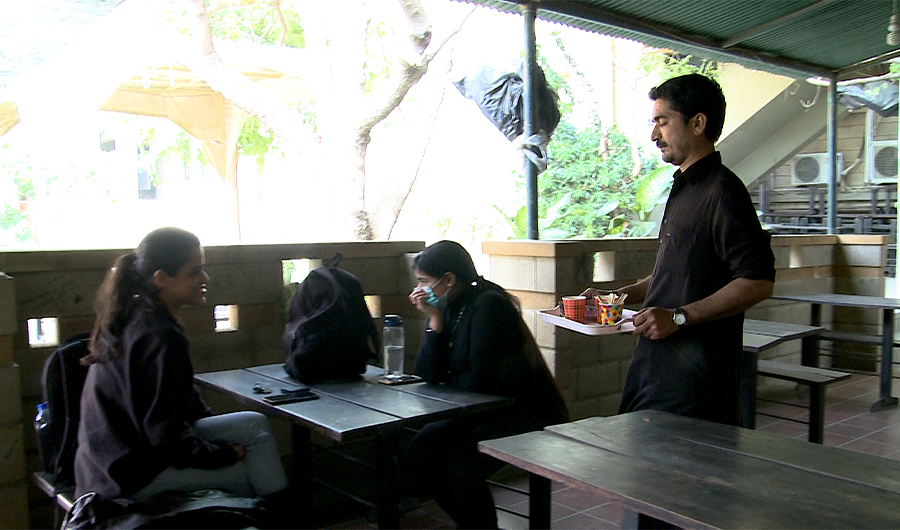


Former canteen helper-turned-printmaker Abdul Muhammad, 32, at the canteen at the Indus Valley School of Art and Architecture in Karachi, Pakistan, on January 23, 2020 (AN Photo)

But then things took a turn for the worst: Muhammad fell ill in 2008 and had to take a week off. When he arrived back at work, he was told someone else had been hired in his place.
“I had tears in my eyes, and I was crying,” Muhammad told Arab News in an interview last week, describing the moment when he walked himself out of the university after losing his job. A teacher, Adeela Suleman, saw him weeping and asked what had happened. 
When he said he had been fired, she hired him as a helper at her office and paid him out of her own pocket for four years. 
“Several women at different stages have helped shape my life,” Muhammad said. “Where I am today, it is because of the help extended by women who were not even related to me.” 
When an assistant’s position opened up at the university’s printmaking department, Suleman recommended Muhammad for it. That is where his life changed forever, he said, under the tutelage of another woman, his teacher Norria Sabah.
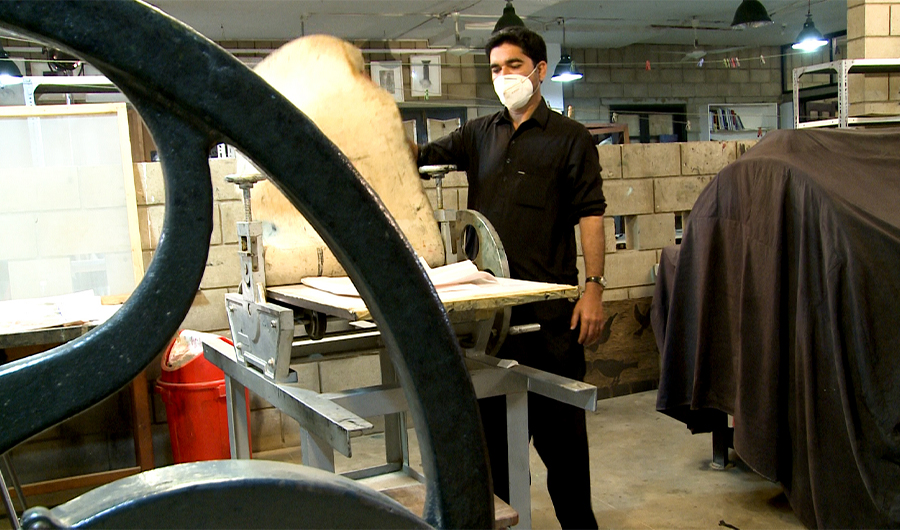


Former canteen helper-turned-printmaker Abdul Muhammad, 32, busy at work at the Indus Valley School of Art and Architecture in Karachi, Pakistan, on January 23, 2020 (AN Photo)

“I had animals at home, I had birds, hens and a goat, which I had been raising since my childhood and spent most of my time with,” Muhammad said, speaking about the inspiration behind his designs. “So, I made my animals part of my work.”
Then another woman, Scheherezade Junejo, a drawing teacher, purchased his work and told him he had six months to prepare for a solo show. In 2018, Muhammad took his mother to his first exhibition at Karachi’s Full Circle Gallery. With the money he earned from the show, he sent his mother to perform the Umrah pilgrimage in Saudi Arabia — a lifelong dream.
“My entire work was sold,” he said.
After the show, Suleman asked Muhammad how he felt. 
“‘Abdul, how happy do you feel today?’ I told her; I am very happy with my life and my work. See, Allah took me from where to where.”
Since then, Muhammad’s artwork has been displayed at shows in China, UK and UAE. But he never forgets his roots. Sometimes, he said, he still visits the Indus canteen where it all began. 
“My beginning was from here ... I have not forgotten those memories,” the artist said.
“I still sometimes come here and make myself tea and omelet,” he said as he took the last sip of his beverage and then got up to leave the canteen for the printmaking department.


Pakistan mulls 'Super App' for public services, document verification in major technology push

Updated 15 February 2026
Follow

Pakistan mulls 'Super App' for public services, document verification in major technology push

  • Pakistan has been urging technology adoption in public, private sectors as it seeks to become a key tech player globally
  • The country this month launched the Indus AI Week to harness technology for productivity, skills development and innovation

KARACHI: Pakistan is planning to launch a “Super App” to deliver public services and enable digital document verification, the country's information technology (IT) minister said on Sunday, amid a major push for technology adoption in public and private sectors.

Pakistan, a country of 240 million people, seeks to become a key participant in the global tech economy, amid growing interest from governments in the Global South to harness advanced technologies for productivity, skills development and innovation.

The country's information and communications technology (ICT) exports hit a record $437 million in Dec. last year, according to IT Minister Shaza Fatima Khawaja. This constituted a 23% increase month on month and a 26% increase year on year.

Pakistan's technology sector is also advancing in artificial intelligence (AI) and cloud computing, marked by the launch of Pakistan’s first sovereign AI cloud in November, designed to keep sensitive data domestic and support growth in the broader digital ecosystem.

“In developed countries, citizens can access all government services from a mobile phone,” Fatima said, announcing plans for the Super App at an event in Karachi where more than 7,000 students had gathered for an AI training entrance test as part of the ‘Indus AI Week.’

“We will strive to provide similar facilities in the coming years.”

Khawaja said the app will reduce the need for in-person visits to government offices such as the National Database and Registration Authority (NADRA) and the Higher Education Commission (HEC).

The Indus AI Week initiative, which ran from Feb. 9 till Feb. 15. was aimed at positioning Pakistan as a key future participant in the global AI revolution, according to the IT minister.

At the opening of the weeklong initiative, Prime Minister Shehbaz Sharif announced that Pakistan would invest $1 billion in AI by 2030 to modernize the South Asian nation’s digital economy.

“These initiatives aim to strengthen national AI infrastructure and make the best use of our human resource,” Khawaja said, urging young Pakistanis to become creators, inventors and innovators rather than just being the consumers of technology.