Jakarta tightens curbs as virus cases hit 1m

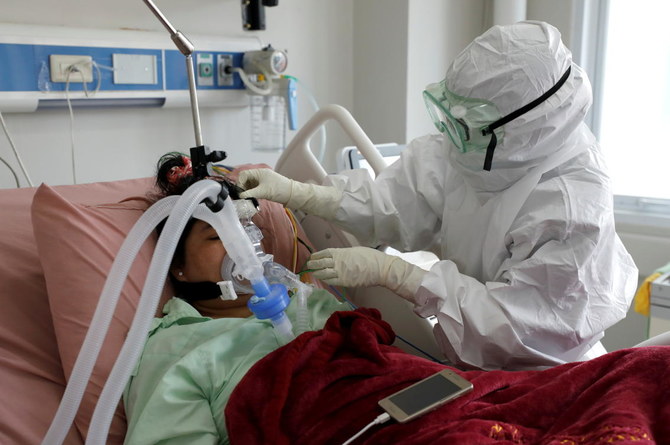
Indonesian health ministry data shows hospital capacity nationwide was at about 70 percent. (Reuters)
Short Url
Updated 26 January 2021
Follow

Jakarta tightens curbs as virus cases hit 1m

  • Indonesia is ranked 19th in the world on numbers of confirmed cases, according to figures released by Worldometer

JAKARTA: Indonesia’s coronavirus cases passed the million mark on Tuesday, almost 11 months after the outbreak was confirmed in the country, with hospitals in the worst-infected regions facing a dire shortage of beds to treat patients.

The national COVID-19 task force reported 13,094 new confirmed cases, raising the caseload to 1,012,350 as the number of deaths climbed to 28,468 out of a population of 270 million. The capital Jakarta remains the center of the outbreak, with more than 250,000 cases. 

“We are grieving for many of our fellow citizens, and for more than 600 health workers who have lost their lives in the fight against this pandemic,” Indonesia’s Health Minister, Budi Gunadi Sadikin, said in a live broadcast.

He urged the public to follow health protocols and work together with the government to eradicate the pandemic and “flatten the curve.”

But experts said the figure is hardly surprising as the world’s fourth-most-populous country struggles to contain the pandemic.

Prof. Zubairi Djoerban, head of the Indonesian Medical Association’s COVID-19 task force, told Arab News that “it was expected given the surge of confirmed cases.”

“But we still rank 19th in the world, and there are 18 countries above us with more cases, even though they have much less population,” Djoerban said.

Indonesia is ranked 19th in the world on numbers of confirmed cases, according to figures released by Worldometer.

However, Djoerban said: “Hospitals in Jakarta and the surrounding regions are full, and it is difficult to find available beds to treat patients.”

He called for stricter compliance with health protocols, a vaccination drive and improvements in hospital equipment, saying that curbs on public activities alone will not be enough to control the pandemic.

Wiku Adisasmito, a spokesman for the national COVID-19 task force, said the spike in cases was evident following the Christmas and New Year holiday, despite a two-week circuit breaker imposed before Christmas in the worst-hit islands of Java and Bali. 

The surge has prompted the government to extend the circuit breaker for two weeks. A ban on travelers entering the country except for ministerial-level officials has also been extended until Feb 8.

Despite the rise in coronavirus cases, President Joko Widodo has claimed that Indonesia has been able to manage the pandemic and the ensuing economic fallout.

“We are grateful that Indonesia is among the countries that have been able to control the two crises well,” he said.


Afghanistan launches retaliatory attacks on Pakistan as tensions escalate

Updated 5 sec ago
Follow

Afghanistan launches retaliatory attacks on Pakistan as tensions escalate

  • At least 66 Afghans have been killed by Pakistan’s strikes, Afghan authorities say
  • Afghanistan has called for dialogue while Pakistan ruled out any talks with Kabul 

KABUL: Afghanistan has launched new attacks on Pakistan’s military bases, the Afghan defense ministry said on Saturday, as cross-border clashes escalated between the neighbors after months of tension. 

The latest flare-up erupted after Pakistan’s airstrikes on Afghan territory last weekend triggered a retaliatory offensive from Afghanistan along the border on Thursday. 

The two countries have engaged in tit-for-tat attacks since, marking the most serious development in ongoing tensions between the two countries, which agreed to a ceasefire last October following a week of deadly clashes. 

Afghanistan’s Air Force has “once again launched airstrikes on Pakistani military bases” in Miranshah and Spinwam, the Afghan Ministry of National Defense said on X on Saturday, claiming that the strikes caused “severe damage and heavy casualties.”

“These successful operations were conducted in response to repeated aerial aggressions by the Pakistani military regime,” the ministry said. 

Afghan forces also launched similar strikes against military targets in Islamabad and Abbottabad on Friday, which the ministry said was in retaliation of aerial attacks by Pakistani forces in Kabul, Kandahar and Paktia.

At least 66 Afghan civilians, mostly women and children, have been killed in Pakistani strikes, with another 59 others wounded, according to Hamdullah Fitrat, deputy spokesman for the Afghan government. 

Pakistan has maintained that it is targeting only military targets to avoid any civilian casualties, in compliance with international law. 

Pakistani officials said its forces have killed more than 330 Afghan fighters and targeted 37 military locations across Afghanistan.

Zabihullah Mujahid, chief spokesperson for the Afghan government, earlier called for talks to resolve the crisis. 

“We have always emphasized peaceful resolution, and now too we want the issue to be resolved through dialogue,” he said on Friday. 

However, Pakistan has ruled out any talks with Kabul. 

“There won’t be any talks, there is nothing to talk about. There’s no negotiation. Terrorism from Afghanistan has to end,” Mosharraf Zaidi, spokesperson for Pakistan’s prime minister, said on Friday. 

Pakistan is accusing the Afghan Taliban of sheltering fighters from the banned Tehreek-e-Taliban Pakistan and allowing them to stage cross-border attacks — a charge Afghanistan denies, saying it does not allow its territory to be used against other countries. 

As international calls for mediation grow amid the escalating hostility, Afghans across the country are growing fearful of the violence. 

“Everyone heard the jets. This is the first time since the withdrawal of US invaders that we have heard such a horrible noise and news of damage. It is not good for us,” said Kandahar resident Shahid Zamari. 

“We had forgotten the US war and its bad impact on us, on our families, on our children. And now this has come upon us again — by Pakistan, and in the holy month of Ramadan.” 

When the strikes hit Kabul at around 1:30 a.m. on Friday, Saleema Wardak moved quickly to wake up her six children and escape outside, assuming the strong jolt that shook her house was an earthquake. 

“While standing in the yard, my husband told me it was not an earthquake but an explosion. Then we heard the crazy sounds of planes, and shooting from the mountains against the planes,” she told Arab News. 

“We hid inside, worried another bomb would fall on us. People say Pakistan is targeting civilians on purpose to increase pressure on the Taliban. So we hid … The world is unjust … They do not value the blood of the poor.” 

For Sabawoon, a 23-year-old student from eastern Kunar province’s Asadabad city, the coming days are filled with uncertainties. 

“What to do? Where to go? We have to stay and find our way to survive,” he told Arab News. “God willing, nothing bad will happen to us. If they are bombing us, what can we do?”