Indonesia allocates $1 million to global coalition for COVID-19 vaccine

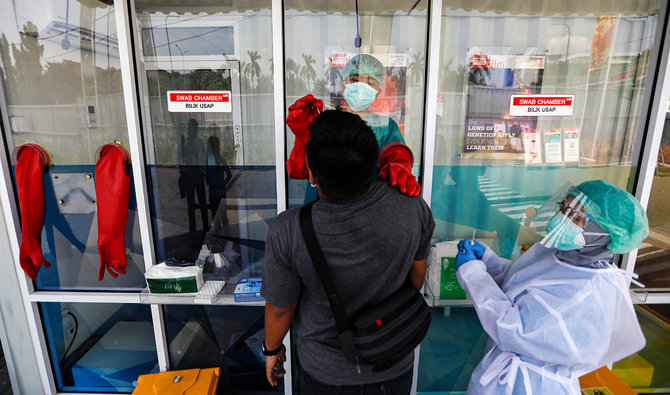
Medical workers wearing personal protective equipments (PPE) utilize a swab chamber as they collect a swab sample from a man to be tested for the coronavirus disease (COVID-19), as the outbreak continues in Jakarta, Indonesia, Indonesia, November 24, 2020. (Reuters)
Short Url
Updated 25 November 2020
Follow

Indonesia allocates $1 million to global coalition for COVID-19 vaccine

  • Indonesia has also been keeping with its commitment to the G20 Action Plan in response to the COVID-19 pandemic by lifting some of its export restrictions on PPE

JAKARTA: Indonesia on Tuesday committed $1 million to the Oslo-based Coalition for Epidemic Preparedness Innovations (CEPI) to develop vaccines for various diseases that could develop into pandemics.

Indonesia’s Minister of Foreign Affairs Retno Marsudi and CEPI officials made the announcement during a virtual signing of the bilateral contribution agreement earlier today. 

In her remarks, Marsudi said that recent news on the progress of vaccine development was very encouraging, but that a lot more remains to be done.

“Indonesia chooses to walk the talk and contribute within its capacity to vaccine multilateralism to protect its people and the world,” she said.

She added that the agreement enables Indonesia to make a concrete contribution to a vaccine for all, reiterating the nation’s position since the beginning of the pandemic — that all countries deserve fair, affordable and equitable access to a vaccine for the coronavirus disease (COVID-19).

“Without it, developing and less developed countries are at risk of being left behind,” Marsudi said.

Richard J. Hatchett, CEO of CEPI, said in his remarks that the coalition was “delighted to welcome Indonesia” to its ranks. 

“We can work together to support our shared goals to develop a safe, effective and globally accessible vaccine,” he said.

Hatchett added that since the CEPI had invested in nine of the world’s COVID-19 vaccine candidates, with eight of them entering clinical trials out of 48 globally, two of them had reported positive outcomes in the third phase of clinical trials.  

“But we must remember, it is not a vaccine that saves lives but vaccination. A vaccine must be administered to have any value at all,” Hatchett said, adding that the challenge ahead would be the manufacturing and delivery of those vaccines, which would require an unprecedented global effort.

During a recent press conference with the Ministry of Trade, Yose Rizal Damuri, Indonesia’s G20 scholar and a senior economist at the Jakarta-based think tank Center for Strategic and International Studies said that “the battleground has shifted to vaccines” now that Indonesia and other countries had loosened restrictions on personal protective equipment (PPE) and medical devices.

State-owned vaccine manufacturer Bio Farma has boosted its production capacity to produce up to 250 million doses next year of a potential COVID-19 vaccine developed by Chinese company Sinovac, whose vaccine is undergoing the third phase of its clinical trial in Bandung, and another vaccine being jointly developed by Abu Dhabi-based G42 Healthcare and China’s vaccine manufacturer Sinopharm.

In his remarks during a G20 trade ministers’ meeting on Sept. 22, Minister of Trade Agus Suparmanto said that easy access and affordability of medical supplies, especially a vaccine, was crucial to the group’s joint efforts to combat the pandemic.

“The G20 should seek to prevent irresponsible commercialization practices in pandemic times by supporting the flexibility to exercise intellectual property rights under international agreements,” the minister said.

Indonesia has also been keeping with its commitment to the G20 Action Plan in response to the COVID-19 pandemic by lifting some of its export restrictions on PPE and other goods related to measures in controlling disease, a trade ministry official said.

Indonesia has also started exporting these goods to fellow economic bloc members, Ministry of Trade’s Director-General for International Trade Negotiations Iman Pambagyo said, responding to a question from Arab News in a virtual press conference. 

“We have been gradually loosening restrictions and exporting goods to South Korea, while also maintaining a sufficient domestic supply,” Pambagyo said.

“We make adjustments on export restrictions from time to time as we prioritize our fellow citizens,” he added.

Suparmanto, for his part, reiterated Indonesia’s commitment to several G20 members’ short and long-term collective actions in the trade and investment sector to mitigate the impact of the pandemic, maintain an open market and take the necessary steps to facilitate trade.

“Indonesia has issued policies in line with the G20 Action Plan, such as removing a number of export and import barriers,” he said.


African Union rejects ‘any recognition of Somaliland’ after Israel declaration

A man holds a flag of Somaliland in front of the Hargeisa War Memorial monument in Hargeisa on November 7, 2024. (AFP)
Updated 27 December 2025
Follow

African Union rejects ‘any recognition of Somaliland’ after Israel declaration

  • Egypt’s foreign ministry said its top diplomat had spoken with his counterparts from Turkiye, Somalia and Djibouti, who together condemned the move and emphasized “their full support for the unity, sovereignty and territorial integrity of Somalia”
  • Israel repeatedly hit targets in Yemen after the Gaza war broke out in October 2023, in response to Houthi attacks on Israel that the rebels said were in solidarity with Palestinians in the Gaza Strip

NAIROBI: The African Union on Friday said it “rejects any recognition of Somaliland” after Israel declared it viewed the breakaway Somali territory as a sovereign state.
In a statement issued by its head, Mahamoud Ali Youssouf, the AU called for African borders to be respected and said: “Any attempt to undermine the unity, sovereignty, and territorial integrity of Somalia... risks setting a dangerous precedent with far-reaching implications for peace and stability across the continent.”
The chief of the pan-African body, which counts Somalia as a member, said he “firmly rejects any initiative or action aimed at recognizing Somaliland as an independent entity” and stating that Somaliland “remains an integral part of the Federal Republic of Somalia.”

While, Somalia reacted angrily on Friday after Israel formally recognized its northern region of Somaliland as an “independent and sovereign state” — the first country to do so.
Somaliland, which declared independence from Somalia in 1991, has for decades pushed for international recognition, which has been the key priority for president Abdirahman Mohamed Abdullahi since he took office last year.
But a Somali foreign ministry statement warned that the decision was “deliberate attack” on its sovereignty that would undermine peace in the region. Several other countries also condemned Israel’s decision.
Israeli Prime Minister Benjamin Netanyahu’s office said he announced “the official recognition of the Republic of Somaliland as an independent and sovereign state,” making Israel the first country to do so.
“The declaration is in the spirit of the Abraham Accords,” Netanyahu’s office said, referring to several agreements between Israel and Arab countries brokered by US President Donald Trump during his first presidency to normalize ties with Israel.
It said Netanyahu had invited Abdullahi to visit.
Hailing Israel’s decision, Abdullahi said in a post on X that it marked the beginning of a “strategic partnership.”
“This is a historic moment as we warmly welcome” he said, affirming “Somaliland’s readiness to join the Abraham Accords,” he added.
In Hargeisa, the capital of Somaliland, crowds of people took to the streets to celebrate, many carrying the flag of the breakaway state, said sources.

- ‘Illegitimate actions’ -

Somalia’s foreign ministry said: “Illegitimate actions of this nature seriously undermine regional peace and stability, exacerbate political and security tensions, in the Horn of Africa, the Red Sea and Gulf of Aden, the Middle East and the wider region.”
Turkiye, a close ally of Somalia, also condemned the move.
“This initiative by Israel, which aligns with its expansionist policy... constitutes overt interference in Somalia’s domestic affairs,” it said in a foreign ministry statement.
Egypt’s foreign ministry said its top diplomat had spoken with his counterparts from Turkiye, Somalia and Djibouti, who together condemned the move and emphasized “their full support for the unity, sovereignty and territorial integrity of Somalia.”
In video showing Netanyahu speaking to Abdullahi by telephone, the Israeli leader said: “I want you to know that I am signing now as we speak Israel’s official recognition of the Somaliland,” adding that the new relationship would offer economic opportunities.
“I am very, very happy and I am very proud of this day and I want to wish you and the people of Somaliland the very, very best,” he said.
Netanyahu also said that he would communicate to Trump Abdullahi’s “willingness and desire to join the Abraham accords.”
A self-proclaimed republic, Somaliland enjoys a strategic position on the Gulf of Aden, has its own money, passports and army. But since its unilateral declaration of independence in 1991, it has grappled with decades of isolation.

- Strategic -

Analysts say matters of strategy were behind Israel’s drive to recognize Somaliland.
“Israel requires allies in the Red Sea region for many strategic reasons, among them the possibility of a future campaign against the Houthis,” said the Institute for National Security Studies in a paper last month, referring to Yemen’s Iran-backed rebels.
“Somaliland is an ideal candidate for such cooperation as it could offer Israel potential access to an operational area close to the conflict zone,” it said, adding there were also economic motives.
Israel repeatedly hit targets in Yemen after the Gaza war broke out in October 2023, in response to Houthi attacks on Israel that the rebels said were in solidarity with Palestinians in the Gaza Strip.
The Houthis have halted their attacks since a fragile truce began in Gaza in October.
Somaliland’s lack of international recognition has hampered access to foreign loans, aid and investment, and the territory remains deeply impoverished.
A deal between landlocked Ethiopia and Somaliland last year to lease a stretch of coastline for a port and military base enraged Somalia.
Israel has been trying to bolster relations with countries in the Middle East and Africa.
Historic agreements struck late in Trump’s first term in 2020 saw several countries including Muslim-majority United Arab Emirates and Morocco normalize relations with Israel, but wars that have stoked Arab anger, particularly in Gaza, have hampered recent efforts.