Mohammed bin Salman announces new 5-year strategy for Saudi Arabia’s economy

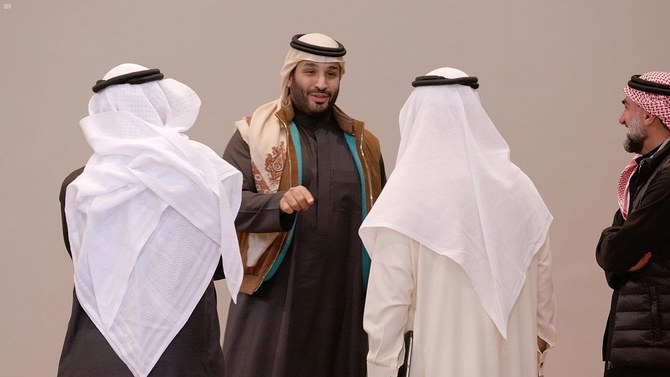
Saudi Arabia's Crown Prince Mohammed bin Salman gave a speech outlining the Public Investment Fund's (PIF) strategy for the next five years. (SPA)
Short Url
Updated 28 January 2021
Follow

Mohammed bin Salman announces new 5-year strategy for Saudi Arabia’s economy

  • Crown prince pledges 1.8 million new jobs
  • Kingdom's sovereign wealth fund to invest $40 billion a year until 2025

JEDDAH: Saudi Crown Prince Mohammed bin Salman on Sunday launched a new five-year strategy for the Kingdom’s sovereign wealth fund as Saudi Arabia drives toward achieving its Vision 2030 goal to diversify the economy away from dependence on oil.

The Public Investment Fund (PIF) will pump at least $40 billion a year into the local economy, double its assets to $1.07 trillion, contribute $320 billion to non-oil GDP and create 1.8 million jobs by 2025, said the crown prince, the fund’s chairman.

“We’ve launched many vital sectors and investment projects in Saudi Arabia and the private sector is a strategic partner for the PIF,” he said.

“The new strategy comes to represent a major pillar in achieving the aspirations of our country and aims to achieve the concept of comprehensive development.”

The 2021-2025 strategy will focus on launching new sectors, empowering the private sector, developing the PIF’s portfolio, achieving effective long-term investments, supporting the localization of sectors and building strategic economic partnerships.

“Our goal is to make our country a pioneer for the new human civilization,” the crown prince said. The PIF would “contribute to supporting development and economic diversification efforts in the Kingdom, in addition to consolidating its position as the preferred global investment partner.”

PIF governor Yasir Al-Rumayyan said: “Over the past four years, PIF has demonstrated its important role in contributing to the Kingdom’s economy, in line with the ambitions of Vision 2030. Up to the end of 2020, we tripled assets under management to nearly $400 billion, created 10 new sectors and generated 331,000 direct and indirect jobs.

“And as part of our strategy, we will continue to drive the economic transformation of Saudi Arabia and enable the private sector. We also partner with innovative, transformative and disruptive companies around the world to consistently serve as an important catalyst for the development of the industries and opportunities of the future.

“Core to our strategy is our focus on funding new human futures by improving quality of life, driving environmental and economic sustainability, and developing new sectors and jobs.”

Meanwhile Fahad Al-Mubarak was appointed governor of the Saudi Central Bank (SAMA) on Sunday, replacing  Ahmed Al-Kholifey, who becomes an adviser at the royal court.


Saudi Arabia champions AI and sustainable growth at UN tourism meeting in Kuwait

Updated 12 February 2026
Follow

Saudi Arabia champions AI and sustainable growth at UN tourism meeting in Kuwait

  • Saudi Tourism Minister says tourism today accounts for approximately 10 percent of the world economy, contributing about $10 trillion to global GDP 

KUWAIT CITY: Saudi Arabia’s Tourism Minister Ahmed Al-Khateeb has called for stronger international cooperation to build a tourism ecosystem that is integrated, resilient, and future-ready, the Saudi Press Agency reported Thursday.

In a opening address at the 52nd UN Tourism Regional Commission for the Middle East in Kuwait City, he noted that tourism is “no longer a peripheral activity but a massive engine of economic development.”

“With an estimated contribution exceeding $10 trillion to global GDP, tourism today accounts for approximately 10 percent of the world economy,” said Al-Khateeb, speaking as president of the 26th UN Tourism General Assembly. The three-day conference opened on Feb. 10.

He pointed to the Middle East’s exceptional recovery, which recorded a 39 percent increase in international arrivals in 2025 compared to 2019, welcoming nearly 100 million visitors last year.

The minister highlighted Saudi Arabia’s driving force behind these regional statistics, noting that the Kingdom now represents approximately 30% of the Middle East tourism market in both visitor numbers and spending.

“We are proud that Saudi tourism’s uninterrupted growth has become a driving force for regional tourism, and we look forward to continuing our close cooperation with UN Tourism to share our expertise with the world,” he said.

Focus on AI

Addressing the meeting’s central theme of Artificial Intelligence (AI), Al-Khateeb emphasized the need for responsible innovation. He described AI as a key enabler for growth but stressed that the “human touch” defining the hospitality sector must be maintained and the workforce protected.

On the sidelines of the regional commission, the minister met with counterparts from across the region to explore ways to promote regional cooperation and alignment to enhance resilience and build tourism industries that can drive inclusive economic and social development.

Al-Khateeb also met with leading investors from Kuwait to discuss investments in the Kingdom’s tourism sector and explore new opportunities to leverage Saudi Arabia’s integrated investment ecosystem, designed to enable regional and international investors to achieve sustainable, long-term value.

The 52nd UN Tourism Regional Commission for the Middle East is the first held in the region since the 26th UN Tourism General Assembly, hosted in Riyadh last November. 

That assembly resulted in the historic “Riyadh Declaration on the Future of Tourism,” which established a global consensus on sustainability, inclusive growth, and the responsible adoption of human-centric AI for the next fifty years.