Lebanon MPs accuse Aoun of ‘acting as a party’

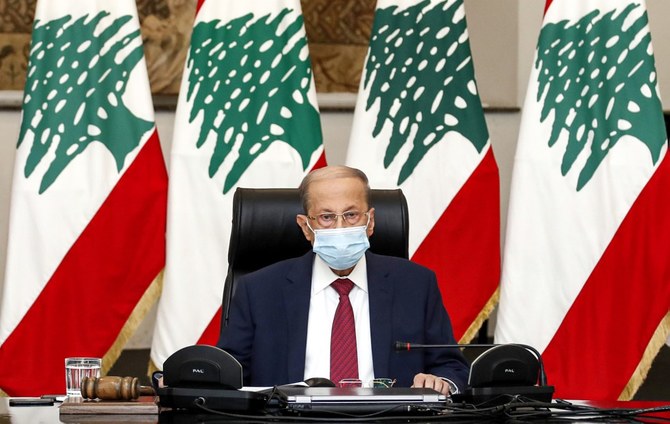
Deputies in the Lebanese Parliament have accused President Michel Aoun of acting “as a party, not as a president entrusted with the constitution.” (AFP/File Photo)
Short Url
Updated 23 January 2021
Follow

Lebanon MPs accuse Aoun of ‘acting as a party’

  • Aoun defended himself against accusations of blocking the formation of government
  • Forming of opposition against Lebanese president depends on Christian bloc

BEIRUT: Deputies in the Lebanese Parliament have accused President Michel Aoun of acting “as a party, not as a president entrusted with the constitution.”

On Saturday, MP Anwar Al-Khalil said that Aoun’s media office’s statement on Friday “undermines the Lebanese people’s minds and destroys the hope of forming an important government. It is also a digression from obstinacy and stubbornness.”

Friday’s statement said Aoun was a “partner in choosing ministers and distributing ministerial portfolios.”

Al-Khalil reminded Aoun that “the constitution named you as president, a symbol of national unity and a protector of the constitution.”

“Your advisers are making you one team. Enough bickering! Support the whole country and save it from collapse,” Al-Khalil said.

Aoun defended himself and the head of the Free Patriotic Movement (FPM), MP Gebran Bassil, against the accusation of obstructing the formation of a government, which raised tension between him and Prime Minister-designate, Saad Hariri.

MP Hadi Abu Al-Hassan said: “Hariri is faced with a crippling process in order to force him to resign.” He added that the president and the FPM “do not want the return of Hariri as prime minister without Bassil in the government.”

He criticized Aoun, saying: “The covenant is unconscious. It lives somewhere else, as attested to by all, and through his practices, he wants to monopolize everything.”

“The problem in the country is the non-presence of a conscious central authority that is aware of what is happening. It is absent and today, we are reaping what was sown,” he said.

Former MP Mustafa Alloush, who is also the Future Movement’s vice president, said the president’s objective was “to make Bassil afloat again and move the presidency to his son-in-law. It is not the rescue of the republic.”

Alloush said that the new government should “lend a helping hand to establishments and countries. Lebanon might be able to convince the International Monetary Fund (IMF) to have a loan, however, if that is not followed by CEDRE (Conference for Economic Development and Reform through Enterprises) and aid from the Gulf and the US, we will have increased our debt to the IMF.”

He said the other team, specifically Hezbollah, was not interested in the rescue operation. “Aoun and the FPM rely on Hezbollah to justify their stubbornness to obstruct the formation of the government, with the aim of making Bassil president.” He said Bassil was subjected to US and personal sanctions that were neither accepted by the Gulf nor internationally and “they are trying to impose a de facto government.”

On the calls to form an opposition against Aoun and his political team, Alloush said: “There is a lot of talk, but if these parties agree on the idea, they disagree on the details.”

Abdel-Sattar Al-Laz, adviser to former prime minister, Tammam Salam, told Arab News: “A meeting was held a while ago at Salam’s house. It included former heads of government, leader of the Progressive Socialist Party, Walid Jumblatt, and addressed the possible scenarios to solve the stalemate in the country.”

Forming an opposition was difficult at the moment, Al-Laz said. “Any new opposition needs Christian and Shiite participation and cannot be limited to Sunni forces and a Druze party. There is a need for a Christian team such as the Lebanese Forces and Kataeb, and those have their personal agendas. The opposition cannot be formed of independent people. It is required to have driving forces with a real representation.”

“The ball is in the court of the Christian partner. Can they form an opposition against the president to ask for his removal or pressure him to resign? Such opposition should be headed by the Maronite Patriarch Bechara Al-Rai, and I rule out its formation since it will affect the position of the Maronite presidency. In that light, there is no hope except to wait for change in the region, otherwise, we are facing a dead end.”


US presses missile issue as new Iran talks to open in Geneva

Updated 59 min 9 sec ago
Follow

US presses missile issue as new Iran talks to open in Geneva

  • New round of negotiations in Geneva comes after the US carried out a massive military build-up in the region
  • The dispute between the countries mostly revolves around Iran’s nuclear program

GENEVA: The United States and Iran are set to hold indirect talks in Switzerland on Thursday aiming to strike a deal to avert fresh conflict and bring an end to weeks of threats.
The new round of negotiations in Geneva comes after the US carried out a massive military build-up in the region and President Donald Trump repeatedly threatened to strike Iran if a deal is not reached.
In his State of the Union address on Tuesday, Trump accused Iran of “pursuing sinister nuclear ambitions.”
He also claimed Tehran had “already developed missiles that can threaten Europe and our bases overseas, and they’re working to build missiles that will soon reach the United States of America.”
The Iranian foreign ministry called these claims “big lies.”
The maximum range of Iran’s missiles is 2,000 kilometers (1,200 miles) according to what Tehran has publicly disclosed. However the US Congressional Research Service estimates they top out at about 3,000 kilometers — less than a third of the distance to the continental United States.
The dispute between the countries mostly revolves around Iran’s nuclear program, which the West believes is aimed at building an atomic bomb but Tehran insists is peaceful.
However the US has also been pushing to discuss Iran’s ballistic missile program, as well as Tehran’s support for armed groups hostile toward Israel.
Secretary of State Marco Rubio warned that Iran must also negotiate on its missile program, calling Tehran’s refusal to discuss ballistic weapons “a big, big problem” on the eve of the talks.
He followed up by saying “the president wants diplomatic solutions.”
Iran has taken anything beyond the nuclear issue off the negotiating table and has demanded that the US sanctions crippling its economy be part of any agreement.
‘Neither war nor peace’
Iranian President Masoud Pezeshkian said on Wednesday he had a “favorable outlook for the negotiations” that could finally “move beyond this ‘neither war nor peace’ situation.”
Foreign Minister Abbas Araghchi, who is leading the Iranian delegation at the talks, has called them “a historic opportunity,” adding that a deal was “within reach.”
In a foreign ministry statement that followed a meeting with his Oman counterpart, Araghchi said the success of the US negotiations depend “on the seriousness of the other side and its avoidance of contradictory behavior and positions.”
The US will be represented by envoy Steve Witkoff and Jared Kushner, who is married to Trump’s daughter Ivanka.
The two countries held talks earlier this month in Oman, which is mediating the negotiations, then gathered for a second round in Geneva last week.
A previous attempt at negotiations collapsed when Israel launched surprise strikes on Iran last June, beginning a 12-day war that Washington briefly joined to bomb Iranian nuclear sites.
In January, fresh tensions between the US and Iran emerged after Tehran engaged in a bloody crackdown on widespread protests that have posed one of the greatest challenges to the Islamic republic since its inception.
Trump has threatened several times to intervene to “help” the Iranian people.
Emile Hokayem, senior fellow for Middle East security at the International Institute for Strategic Studies, said that “the region seems to expect a war at this point.”
In January, there was “a big push by a number of Middle Eastern states to convince the US not to” strike Iran.
“But there’s a lot of apprehension at this point, because the expectation is that this time” a war would be “bigger” than the one in June.
Tehran residents who spoke to AFP were divided as to whether there would be renewed conflict.
Homemaker Tayebeh noted that Trump had “said that war would be very bad for Iran.”
“There would be famine and people would suffer a lot. People are suffering now, but at least with war, our fate might be clear,” the 60-year-old said.