

Oxford University to test potential COVID-19 ‘wonder drug’ Ivermectin

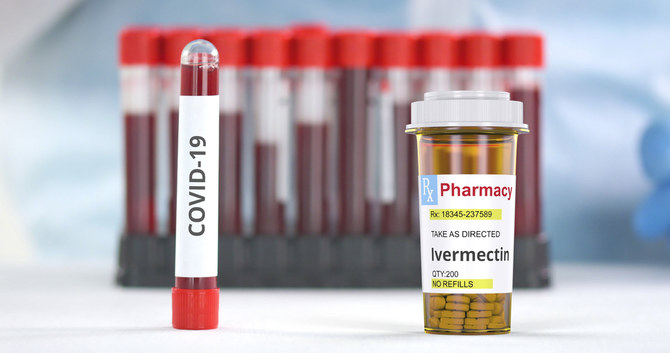
The trial is assessing Ivermectin, a medicine used on livestock and people who have been infected by parasitic worms, which has been hailed by some as a “wonder drug” with the potential to save thousands of lives. (Shutterstock/File Photo)
Short Url
Updated 23 January 2021
Follow

Oxford University to test potential COVID-19 ‘wonder drug’ Ivermectin

  • Medicine used for parasitic worm infections
  • Other scientists said the drug had not been assessed properly

LONDON: Oxford University researchers are planning to trial a drug that has shown signs of reducing COVID-19 deaths in developing countries.

The Principle trial is aiming to find a drug that works soon after virus symptoms appear in a patient, and one that is most effective during the primary stages of the illness, The Times reported.

The trial is assessing Ivermectin, a medicine used on livestock and people who have been infected by parasitic worms, which has been hailed by some as a “wonder drug” with the potential to save thousands of lives, the report added.

Other scientists said the drug had not been assessed properly and that the full extent of its efficacy was not yet known.

“It has potential antiviral properties and anti-inflammatory properties and there have been quite a few smaller trials conducted in low and middle- income countries, showing that it speeds recovery, reduces inflammation and reduces hospitalisation,” said Chris Butler, professor of primary care at Oxford and co-chief of the Principle trial. “But there’s a gap in the data. There’s not been a really rigorous trial.”

The medicine works by blocking the entry of a protein into a cell’s nuclei, limiting the replication capacity of the virus, and initial analysis from the World Health Organization has shown promising signs.

“It could save thousands of lives a day,” said Paul Marik, from the Eastern Virginia Medical School. “The data is compelling: across Mexico, India and South America, mortality has fallen.”

Peter Horby, the Oxford University professor who helped to set up the UK’s largest COVID-19 trials, said this month the latest data was “interesting, perhaps encouraging, but not yet convincing.”

Most breakthroughs in coronavirus treatments to date work on patients who are already suffering in the later stages of the illness, but Butler and his team are hoping to find a medicine that can prevent the virus from taking hold within its host.

The trial is looking for people aged 65 and over, or those aged over 50 who have underlying health conditions, through general practitioners, online, and through the UK’s NHS Test and Trace system, The Times said.


EU parliament approves 90-bn-euro loan for Ukraine amid US cuts

Updated 5 sec ago
Follow

EU parliament approves 90-bn-euro loan for Ukraine amid US cuts

  • awmakers voted by 458 to 140 in favor of the loan, intended to cover two-thirds of Ukraine’s financial needs for 2026 and 2027

The EU parliament on Wednesday approved a 90-billion-euro loan for Ukraine, providing a financial lifeline to cash-strapped Kyiv four years into Russia’s invasion.
Lawmakers voted by 458 to 140 in favor of the loan, intended to cover two-thirds of Ukraine’s financial needs for 2026 and 2027 and backed by the EU’s common budget — after plans to tap frozen Russian central bank assets fell by the wayside.

Military aid to Ukraine hit its lowest level in 2025 as the US pulled funding, leaving Europe almost alone in footing the bill and averting a complete collapse, the Kiel Institute said Wednesday.
Kyiv's allies allocated 36 billion euros ($42.9 billion) in military aid in 2025, down 14 percent from 41.1 billion euros the previous year, according to Kiel, which tracks military, financial and humanitarian assistance pledged and delivered to Ukraine since Russia's full-scale invasion.
Military aid in 2025 was even lower than in 2022, despite the invasion not taking place until February 24 that year.
US aid came to a complete halt with President Donald Trump's return to the White House in early 2025.
Washington provided roughly half of all military assistance between 2022 and 2024.
European countries have thus made a significant effort to plug the gap, increasing their collective allocation by 67 percent in 2025 compared with the 2022-2024 average.
Without that effort, the US cuts could have been even more damaging, the institute argued.
However, the think tank points to "growing disparities" among European contributors, with Northern and Western European countries accounting for around 95 percent of military aid.
The institute calculated that Northern European countries (Denmark, Estonia, Finland, Iceland, Latvia, Lithuania, Norway, and Sweden) provided 33 percent of European military aid in 2025, despite accounting for only eight percent of the combined GDP of European donor countries.
Southern Europe, which accounts for 19 percent of the combined GDP of European donors, contributed just three percent.
To help fill the gap left by the United States, NATO launched the PURL programme, under which European donors purchased US weapons for Ukraine, worth 3.7 billion euros in 2025.
Kiel called the initiative a "notable development", which had enabled the acquisition of Patriot air-defense batteries and HIMARS multiple-launch rocket systems.
European allies are also increasingly placing orders with Ukraine's own defence industry, following a trend started by Denmark in 2024.
War-torn Ukraine's defence production capacity has "grown by a factor of 35" since 2022, according to Kiel, but Kyiv lacks the funds to procure enough weapons to keep its factories working at full capacity.
Orders from 11 European donor countries helped bridge that gap last year.
In the second half of 2025, 22 percent of weapons purchases for Ukraine were procured domestically, a record high.