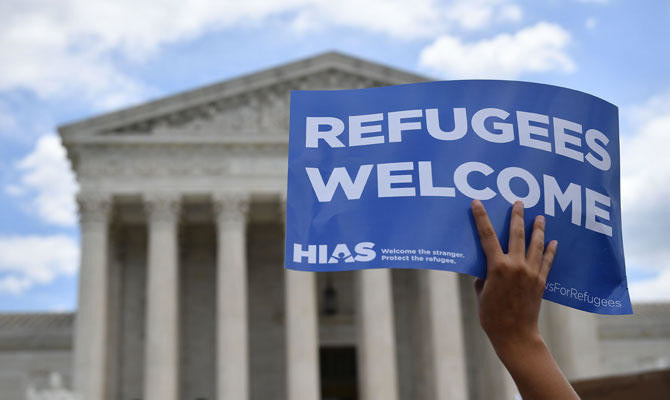
ISLAMABAD: Pakistan on Friday praised President Joe Biden’s decision to reverse the travel restrictions on several Muslim-majority countries that were imposed by the Trump administration in 2017.
“We welcome the US administration’s plan to end travel ban on a list of Muslim majority countries,” said the foreign office spokesperson, Zahid Hafeez Chaudhri, while talking to Arab News. “Prime Minister Imran Khan has emphasized the importance of addressing Islamophobia in the world. We hope that such measures by major countries will help achieve that objective.”
Trump introduced the ban by issuing an executive order, citing attempts by “terrorists” to enter the US from Muslim countries and several African nations.
“This is a very good step that President Joe Biden has taken and we hope and pray that the new US administration will treat Muslims equally like all other people,” Senator Abdul Qayyum, who is part of the Parliamentary Friendship Group with the United States, told Arab News.
He added that people expected the US to abide by the United Nations charter and follow its old traditions which kept that country open to the whole world.
“Imposing such travel bans on Muslim states can promote racist tendencies against the followers of Islam,” he continued. “We don't expect that from the United States since Americans believe in practicing high moral values and take pride in them.”
The senator also expressed optimism that the Biden administration would pay attention to the Kashmir and Palestine disputes.
“We hope and pray that President Biden will be absolutely fair and transparent while dealing with Kashmir and Palestine,” he said. “If he emphasizes the importance of implementing the United Nations resolutions on these two issues, we are likely to have a more peaceful world.”
ISLAMABAD: On this International Women’s Day, Abia Akram has a message for young women with disabilities: do not hide.
Born with a physical mobility impairment, the 40-year-old Pakistani activist has spent more than two decades advocating for the rights of women with disabilities while working with governments and international organizations to push for greater inclusion and a rights-based approach to disability.
For Akram, International Women’s Day is also an opportunity to challenge stigma and encourage women with disabilities to speak openly about their identities and experiences.
“I would say disability is nothing to worry about, and it’s not an issue that we need to address,” she said. “It’s just a thing to celebrate it, with all its diversity and impact. There’s no need to worry about disability, just enjoy life with it.”
Akram’s advocacy journey began in 1997, when public perceptions of disability in the region were often shaped by stereotypes representing two extremes.
“They are very close to Allah, so we have to respect them,” she said, recalling one such view. “Or on the other extreme, people were thinking they are a punishment.”
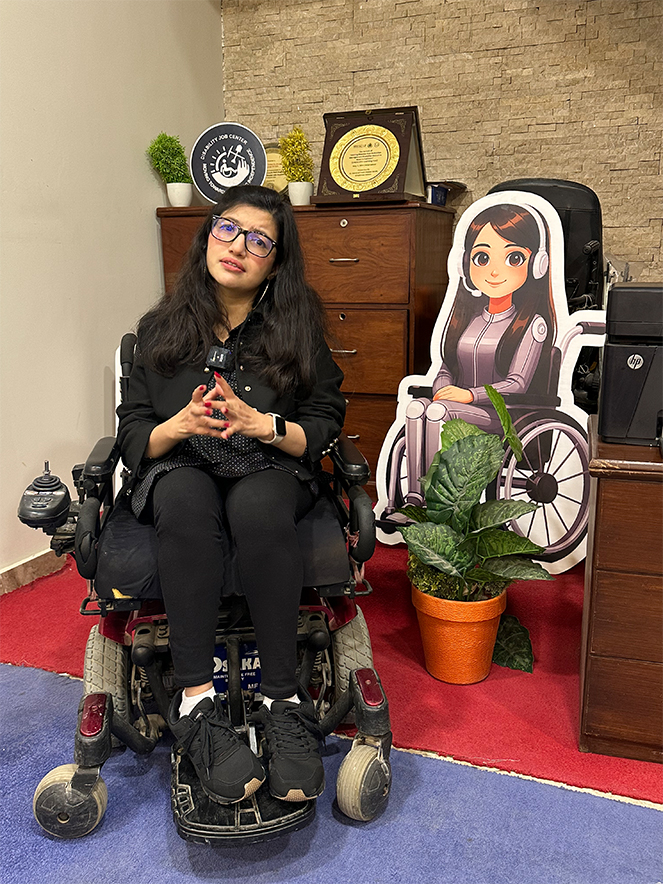
Activist Abia Akram speak to Arab News in Islamabad, Pakistan, on March 7, 2026. (AN photo)
As a woman from a developing country without a “strong background,” she said the fight for recognition and rights came with its own challenges.
In 2009, she founded the National Forum of Women with Disabilities, an initiative that helped bring attention to the challenges faced by women and girls with disabilities who were often overlooked even within their own families.
“Many parents used to pray that their daughters die before them, because there was no support system available,” she said.
Her own experience, however, was different. She credits her parents for encouraging her education and independence from an early age.
“My parents were really supportive because they were telling me like education is the most important thing. If you are qualified, if you are educated, then you have the world to contribute to.”
Today, Akram’s work extends beyond Pakistan. She serves as chair of the Global Forum on the Leadership of Women with Disabilities and is a trustee for Sightsavers, working with organizations including the UK’s Foreign, Commonwealth &
Development Office (FCDO) and humanitarian groups to promote a shift from a medical model of disability to a rights-based approach.
She is also currently chair of the Aging Disability Diversity Task Force, chief executive of the National Forum of Women with Disabilities and an executive member of the Commonwealth Disability Forum.
Akram says women with disabilities often face multiple layers of discrimination — within their families, in education, in employment and in public life.
According to advocacy data she cited, women with disabilities experience four times greater gender-based violence (GBV) and sexual harassment than women without disabilities.
Her work includes training programs that address systemic barriers and collaboration with government institutions such as Pakistan’s National Assembly, the Ministry of Human Rights and the National Commission on the Status of Women.
In recent years, Akram has also focused on using technology to address these challenges.
Last month at the Zero Project Conference in Vienna, she received a global award for “Noor AI,” an accessible mobile application designed to assist women with disabilities who are survivors of gender-based violence.
Akram argues that the difficulties often associated with disability arise not from individuals themselves but from environments that fail to accommodate different needs.
She illustrates the point with an analogy comparing wheelchairs to cars.
“Are you using a wheelchair? But you came in a car, which has the wheels and the chair. So, you are also using the wheelchair, but you park your wheelchair outside and mine is inside,” she said.
“It’s just about the diversity, accepting the diversity, not fixing the person.”
In Pakistan, she says there has been legislative progress in protecting the rights of persons with disabilities, pointing to the Rights of Persons with Disabilities Act 2020 in Islamabad and similar laws in Sindh and Balochistan.
However, she believes more work is needed in regions such as Azad Jammu and Kashmir and Khyber Pakhtunkhwa to strengthen legal protections and implementation.
Despite receiving international recognition, including the Zero Project Award and the Human Rights Award, Akram says such honors mainly reinforce her sense of responsibility.
She remains particularly focused on addressing what she describes as “double discrimination,” where women with disabilities are sometimes overlooked both within mainstream women’s movements and within male-dominated disability advocacy spaces.
As the world marks International Women’s Day, Akram says the goal must remain justice, empowerment and equality that includes everyone.
“Disability is my identity and I’m very proud of it. It’s about how we take that identity in a positive way, in a dignified way,” she said.
“It’s not about just celebrating, but also taking that positive initiative, the commitment, like how we can change the life of other people.”