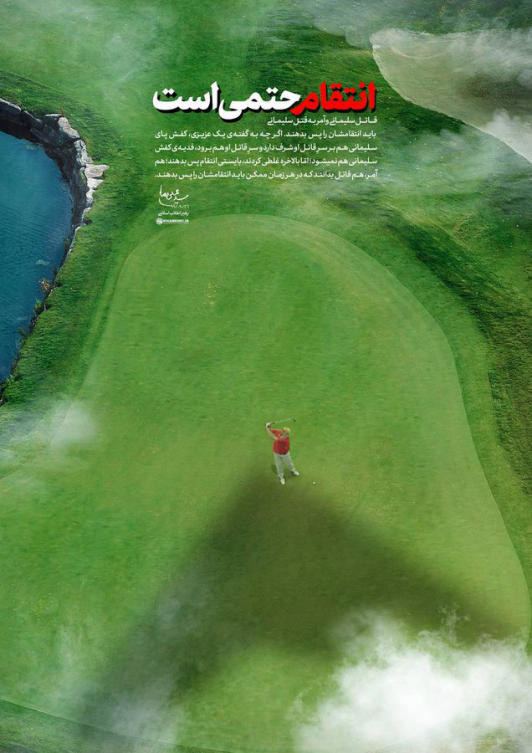
Twitter suspends Khamenei-linked account after posting Trump-like golfer ‘revenge’ image

This image posted by Iran's Ayatollah Khamenei on Twitter shows a figure of former US President Donald Trump playing golf. (Twitter photo)
Short Url
Updated 26 March 2021
Follow

Twitter suspends Khamenei-linked account after posting Trump-like golfer ‘revenge’ image

  • Another account attributed to Iran’s leader still active
  • Earlier this month, Twitter removed a tweet by Khamenei saying US and UK-made vaccines were unreliable

DUBAI: Twitter suspended an account linked to Iran’s Supreme leader on Friday after his office posted an image of a golfer resembling former US President Donald Trump under the shadow of a warplane alongside a pledge to avenge a deadly 2020 drone strike the former president ordered.

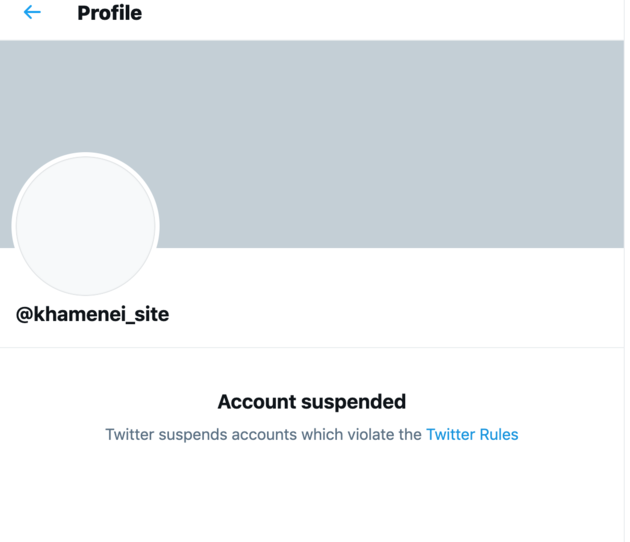
The account was suspended for violating Twitter’s rules, but another account attributed to Iran’s leader with more than 800,000 followers, was still active.
The post in question carried the text of remarks by Ayatollah Ali Khamenei in December, in which he said “Revenge is certain,” renewing a vow of vengeance ahead of the first anniversary of the killing of top military commander General Qassem Soleimani in the attack in Iraq.

“Those who ordered the murder of General Soleimani as well as those who carried this out should be punished. This revenge will certainly happen at the right time,” Khamenei tweeted on December 16, without naming Trump, who had ordered the strike.

READ MORE: Does Twitter’s Trump ban expose a dangerous double standard?

Earlier this month, Twitter removed a tweet by Khamenei in which he said US and British-made vaccines were unreliable and may be intended to “contaminate other nations.” The platform said the tweet violated its rules against misinformation.

There was no apparent immediate action by Twitter over the Persian-language tweet on Friday by Khamenei, Iran’s highest authority.

READ MORE: Twitter deletes Iran’s Khamenei tweet criticizing US, UK COVID-19 vaccines

Tensions rapidly grew between Tehran and Washington since 2018, when Trump exited a 2015 deal between Iran and six world powers that sought to curb Tehran’s nuclear program. Washington reimposed sanctions that have crippled Iran’s economy.

Iran called for action and “not just words” shortly after Joe Biden was sworn in as US president on Wednesday. Biden has said Washington will rejoin the nuclear deal if Iran resumes strict compliance.

* With Reuters


Paris exhibition marks 200 years of Le Figaro and the enduring power of the press

Updated 17 January 2026
Follow

Paris exhibition marks 200 years of Le Figaro and the enduring power of the press

  • The exhibition celebrated the bicentennial of Le Figaro, offering visitors a rare opportunity to step inside the newspaper’s vast historical archive

PARIS: One of France’s most influential newspapers marked a major milestone this month with a landmark exhibition beneath the soaring glass nave of the Grand Palais, tracing two centuries of journalism, literature and political debate.
Titled 1826–2026: 200 years of freedom, the exhibition celebrated the bicentennial of Le Figaro, offering visitors a rare opportunity to step inside the newspaper’s vast historical archive. Held over three days in mid-January, the free exhibition drew large crowds eager to explore how the title has both chronicled and shaped modern French history.
More than 300 original items were displayed, including historic front pages, photographs, illustrations and handwritten manuscripts. Together, they charted Le Figaro’s evolution from a 19th-century satirical publication into a leading national daily, reflecting eras of revolution, war, cultural change and technological disruption.
The exhibition unfolded across a series of thematic spaces, guiding visitors through defining moments in the paper’s past — from its literary golden age to its role in political debate and its transition into the digital era. Particular attention was paid to the newspaper’s long association with prominent writers and intellectuals, underscoring the close relationship between journalism and cultural life in France.
Beyond the displays, the program extended into live journalism. Public editorial meetings, panel discussions and film screenings invited audiences to engage directly with editors, writers and media figures, turning the exhibition into a forum for debate about the future of the press and freedom of expression.
Hosted at the Grand Palais, the setting itself reinforced the exhibition’s ambition: to place journalism firmly within the country’s cultural heritage. While the exhibition has now concluded, the bicentennial celebrations continue through special publications and broadcasts, reaffirming Le Figaro’s place in France’s public life — and the enduring relevance of a free and questioning press in an age of rapid change.