

Massive opposition rally says no Pakistani will ever allow diplomatic recognition of Israel

1 / 2
Thousands participate in an anti-Israel rally organized by the Jamiat-e-Ulama-e-Islam (JUI-F) party in Karachi on Thursday, Jan. 21, 2021. (AN Photo/S.A. Babar)
2 / 2
Short Url
Updated 21 January 2021
Follow

Massive opposition rally says no Pakistani will ever allow diplomatic recognition of Israel

  • Pakistani media reported last November that the government was under international pressure to recognize the Jewish state
  • The opposition rally was addressed by the Grand Mufti of Jerusalem and a former Palestinian prime minister via video link

KARACHI: Thousands of opposition activists in Pakistan criticized any possibility of extending diplomatic recognition to Israel on Thursday, saying that the people of their country would not allow that to happen until the creation of Palestine and the return of its displaced people to their native land. 

Organized by the Jamiat-e-Ulama-e-Islam (JUI-F) party, the rally was also attended by leaders of the Pakistan Muslim League-Nawaz (PML-N), Pakistan Peoples Party (PPP) and other opposition factions who are part of the Pakistan Democratic Movement (PDM) that seeks to bring down Prime Minister Imran Khan’s government. 

The Pakistani media reported last November that the government was under pressure to recognize the Jewish state, though officials in Islamabad, including the prime minister, strongly ruled out the possibility of any normalization with Israel. 

Speaking to a local news channel, Prime Minister Khan said last month that Pakistan would refuse to recognize Israel until it guaranteed Palestinian rights. “Pakistan is a democratic society — and our entire nation stands with Palestinians,” he said. 
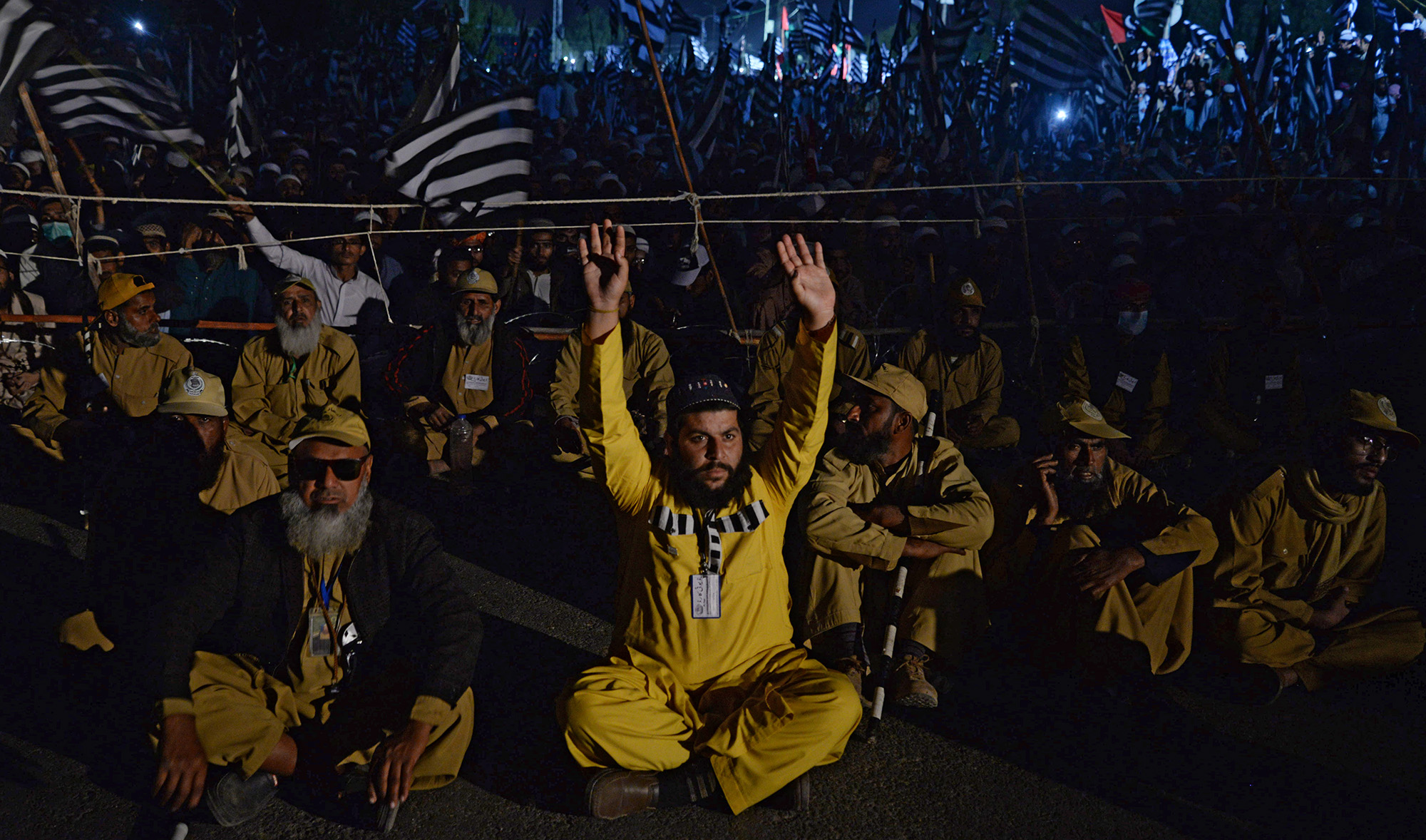


Supporters of opposition taking part in an anti-Israel rally organized by the Jamiat-e-Ulama-e-Islam (JUI-F) party in Karachi on Thursday, Jan. 21, 2021. (AN Photo/S.A. Babar)

The country’s opposition, however, blamed the ruling Pakistan Tehreek-e-Insaf (PTI) administration for generating debate over the issue. 

“A narrative is being built that Israel’s recognition is in Pakistan’s interest. The PML-N and PDM strongly reject this discourse,” former prime minister Shahid Khaqqan Abbasi said while addressing the rally. 

“This is not a matter of interests. It’s matter of ideology. There are more than 200 countries in the world, but only Pakistan’s passport stops its citizens from visiting Israel. How can we compromise on ideology for the sake interests?” he asked. 

“This gathering aims to tell those at the helm of affairs that this can never happen. Our 220 million are united that Pakistan cannot compromise on Palestine and Kashmir. The PDM is united on this, and Pakistan is united as well,” Abbasi added. 
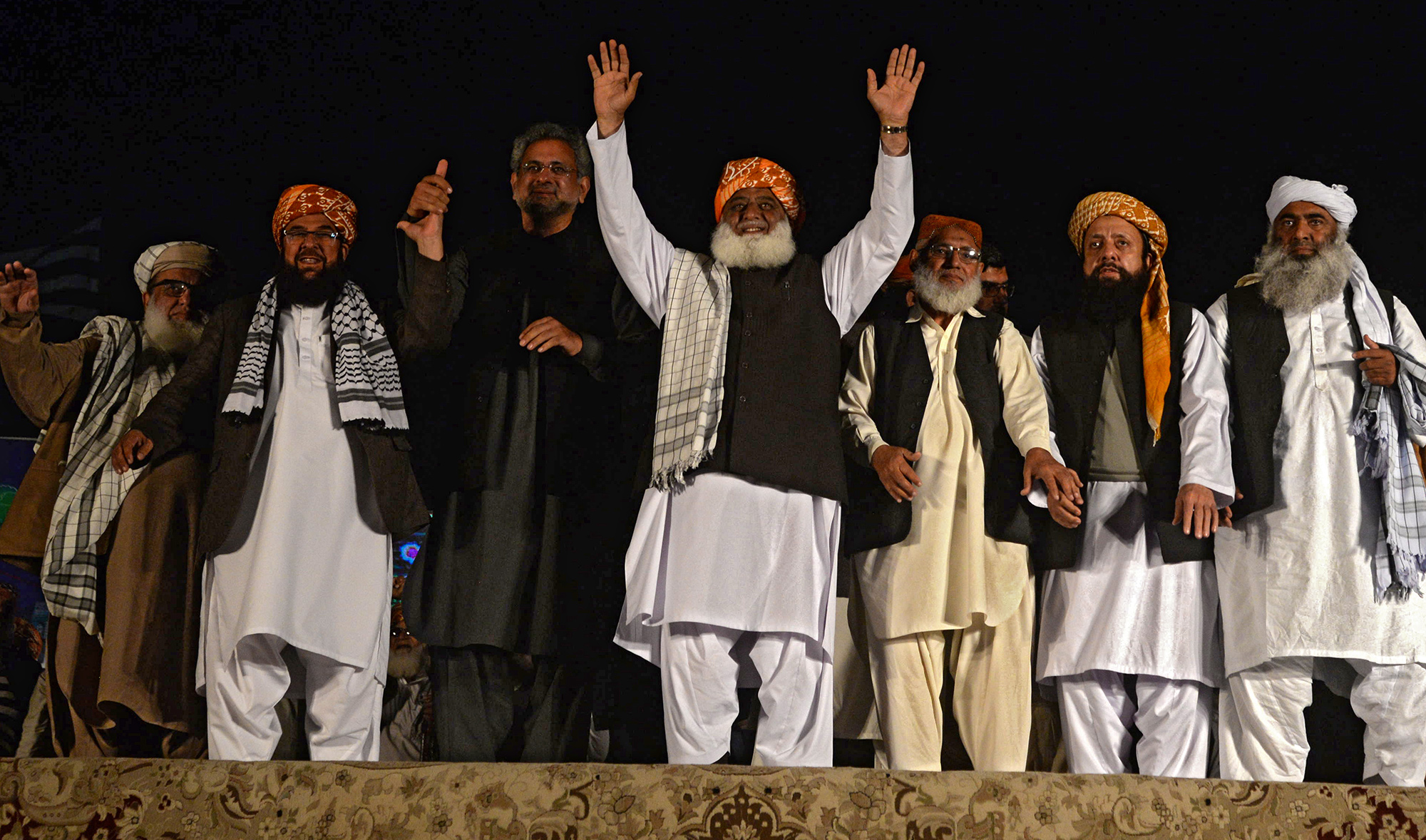


Opposition leaders during a rally organized by the Jamiat-e-Ulama-e-Islam (JUI-F) party in Karachi on Thursday, Jan. 21, 2021. (AN Photo/S.A. Babar)

The chief of the opposition PDM alliance, Maulana Fazlur Rehman, said that Pakistanis supported the people of Palestine in their struggle for an independent country. 

“I want to convey a clear message to our Palestinian brothers that Pakistani nation will support you till their last drop of blood. We will stand by you until Palestine is free,” Rehman said. “The founder of Pakistan said that his country would never recognize Israel since it had stabbed Palestinians. The Muslim ummah has not forgotten these words.” 

Senator Saeed Ghani, a senior PPP leader, said that his party shared the stance of JUIF on the issue. 

“No matter how much differences we have or which party we belong to, we are all united [against the idea of recognizing Israel],” he said. 

Jerusalem’s Grand Mufti Muhammad Ahmad Hussein and former prime minister of the Palestinian National Authority Ismail Haniyeh also spoke to the rally via video link.


Pakistan launches final nationwide polio drive of 2025 to vaccinate 45 million children

Updated 4 sec ago
Follow

Pakistan launches final nationwide polio drive of 2025 to vaccinate 45 million children

  • Campaign comes as Pakistan records 30 polio cases this year, one of only two countries where virus is endemic
  • Health minister urges parents to welcome vaccinators as insecurity, misinformation hinder eradication efforts

ISLAMABAD: Pakistan on Thursday launched its final polio vaccination campaign of the year, with Health Minister Mustafa Kamal administering drops to children under five as part of a nationwide effort to reach 45 million children, the country’s polio program said.

The Dec. 15–21 drive is part of Pakistan’s decades-long struggle to eliminate wild poliovirus. Pakistan and neighboring Afghanistan are the only two countries where the virus remains endemic, keeping global eradication efforts at risk.

Pakistan has reported 30 polio cases so far this year. The incurable and highly infectious virus can cause lifelong paralysis and can only be prevented through repeated oral vaccinations and routine immunization, health officials say.

“I want to take this opportunity to speak directly to parents and caregivers. When our polio vaccinator knocks at your door, I urge you to welcome them in and ensure that every child under five in your house receives two drops of this essential vaccine,” the polio program quoted Health Minister Kamal as saying.

“I also urge you to advocate for vaccination in your families and communities and create a welcoming environment for our vaccinators.”

The new campaign comes days after Pakistan conducted a nationwide measles, rubella and polio vaccination drive from Nov. 17–29, which targeted 22.9 million children across 89 high-risk districts.

Pakistan recorded 74 polio cases in 2024, a steep rise from six in 2023 and just one in 2021, underscoring the volatility of eradication efforts in a country where misinformation, vaccine hesitancy and political instability have repeatedly disrupted progress.

Violence has also hampered the program. Polio teams and their security escorts have been attacked frequently by militants and religious hard-liners in parts of northwestern Khyber Pakhtunkhwa and southwestern Balochistan. Officials say continued security threats, coupled with natural disasters such as recent flooding, pose major obstacles to reaching every child.

Pakistan has drastically reduced polio prevalence since the 1990s, when annual cases exceeded 20,000. By 2018, the number had fallen to eight. But health authorities warn that without consistent access to children, particularly in high-risk, underserved region, eradication will remain out of reach.