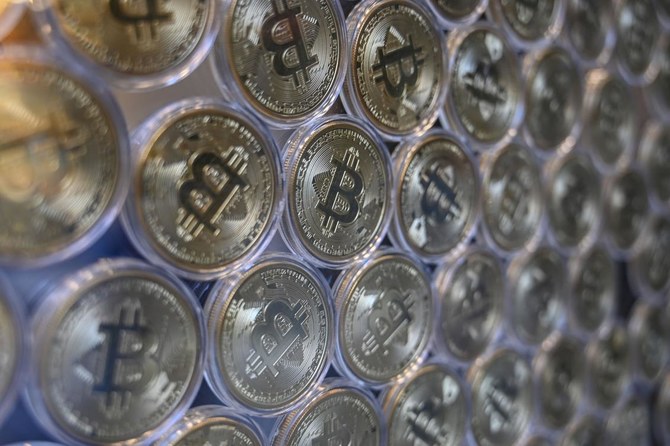
LONDON: Bitcoin slumped 10 percent on Thursday to a 10-day low, retreating further from record highs, with traders citing fears of tighter US regulation.
The world’s most popular cryptocurrency Bitcoin was last down 7.5 percent at $32,779 after falling as low as $31,977. It has lost nearly a quarter since touching a record $42,000 on Jan. 8.
The pullback comes amid growing concerns that bitcoin is one of a number of financial market price bubbles.
Fears that US President Joe Biden’s administration could attempt to regulate cryptocurrencies have also weighed on sentiment, traders said.
During a Senate hearing on Tuesday Janet Yellen, Biden’s pick to head the US Treasury, expressed concerns that cryptocurrencies could be used to finance illegal activities.
“I think many are used, at least in a transactions sense, mainly for illicit financing, and I think we really need to examine ways in which we can curtail their use and make sure that money laundering does not occur through these channels,” said the former chair of the US Federal Reserve.
Joseph Edwards of cryptocurrency broker Enigma Securities said these comments had a substantial impact.
“The action over the last 36 hours or so has largely been rippling outwards from the Janet Yellen comments on crypto,” he said, adding that it was still unclear exactly what, if any, moves the Biden administration would take.
“We do think it’s probably still just a lapse in momentum rather than a sea change, though.”

Bitcoin slumps 10% as pullback from record high gathers pace
https://arab.news/v2xx3
Bitcoin slumps 10% as pullback from record high gathers pace
- Pullback comes amid growing concerns that bitcoin is one of a number of financial market price bubbles
Egypt inflation slows to 10.1% in January: CAPMAS
JEDDAH: Egypt’s annual inflation eased to 10.1 percent in January from 10.3 percent a month earlier, while consumer prices rose sharply on a monthly basis, highlighting persistent pressure on household costs.
The consumer price index climbed to 268.1 points in January from 264.2 in December, the Central Agency for Public Mobilization and Statistics, also known as CAPMAS, said. Monthly inflation accelerated to 1.5 percent, compared with 0.1 percent in December.
The government has stressed measures to contain inflation, with directives from President Abdel Fattah El-Sisi calling for coordination between the Central Bank of Egypt and the Ministry of Finance.
Earlier, Prime Minister Mostafa Madbouli said these efforts aim to curb inflation pressures, support economic stability and encourage private sector growth.
In its latest report, CAPMAS stated: “Among the most important indicators in price changes.... an increase in the prices of the grains and bread group by 0.1 percent, the meat and poultry group by 5.1 percent, the fish and seafood group by 1.7 percent, the dairy, cheese, and eggs group by 0.5 percent, the oils, and fats group by 0.2 percent.”
Price movements in January contrasted with patterns seen in December 2025. Essential food and beverage categories recorded significant increases after some declines in the previous month. The meat and poultry group rose 5.1 percent in January following a 1.1 percent decline in December.
Vegetables increased by 8.5 percent after falling 2 percent in December, while coffee, tea, and cocoa rose by 6.7 percent, up from 0.1 percent. Fish and seafood increased by 1.7 percent, dairy, cheese, and eggs by 0.5 percent, grains and bread by 0.1 percent, and tobacco and oils and fats rose by 0.7 percent and 0.2 percent, respectively.
Housing-related costs continued to rise, with actual rents up 1.6 percent, imputed rents up 1.9 percent, and housing maintenance and repair up 0.8 percent.
The report also showed hospital services increased by 3.4 percent, while outpatient clinic services rose by 1.0 percent, compared with December increases of 1.8 percent and 1.0 percent, respectively.
Other consumer categories recorded moderate increases. Clothing and accessories rose by 1.4 percent, ready-made clothing by 1.1 percent, footwear by 0.4 percent, and cleaning, repair, and clothing rental by 1.0 percent.
Personal care increased by 0.6 percent and transport services rose 0.3 percent, while household items and equipment rose between 0.2 percent and 0.7 percent.
On the other hand, fruit prices decreased by 2.5 percent, and home appliances declined by 0.4 percent, continuing trends from December in some sectors.


