

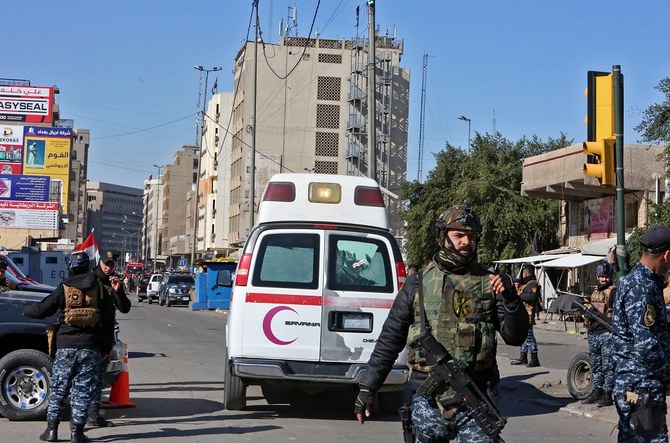
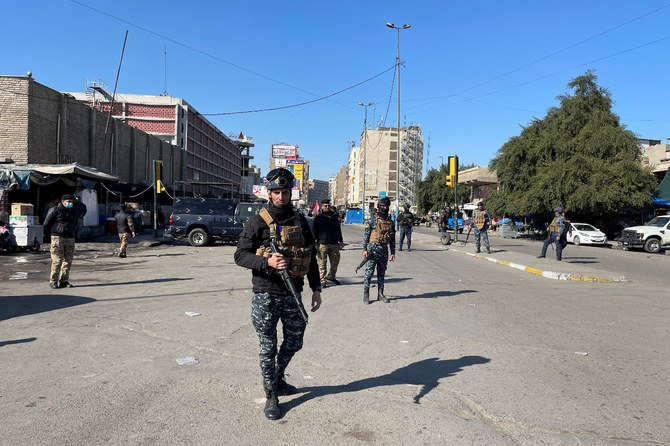
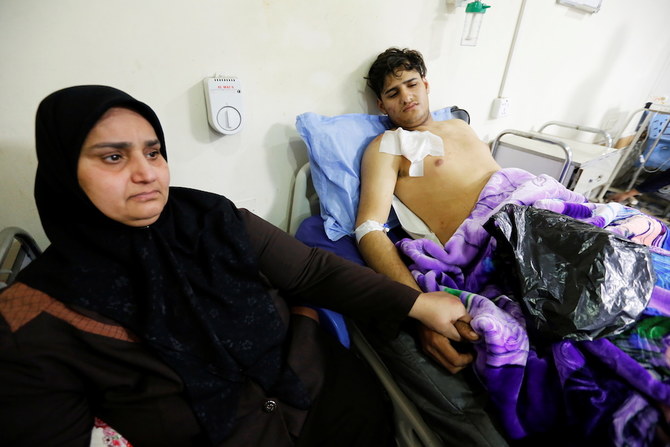

JEDDAH: Twin suicide bombings ripped through a busy market in the Iraqi capital on Thursday, killing at least 32 people and wounding dozens, officials said in what was the first massive bombing in years, harkening back to darker days of rampant militant attacks.
The rare suicide bombing hit the Bab Al-Sharqi commercial area in central Baghdad amid heightened political tensions over planned early elections and a severe economic crisis. Blood was splattered on the pavement of the busy market amid piles of clothes and shoes as survivors took stock of the disarray in the aftermath.The Health Ministry announced that all of its hospitals in the capital were mobilized to treat the wounded.
Saudi Arabia’s Foreign Ministry said the Kingdom rejects all forms of terrorism and stands by Iraq against anything that threatens its security or stability. It expressed condolences to the families of the victims and the government and people of Iraq, wishing the injured a speedy recovery.
Condemning the attack, the Gulf Cooperation Council (GCC) expressed solidarity with Iraq in combating terrorism and enhancing its security and stability.
Nayef Falah Mubarak Al-Hajraf, GCC secretary-general, sent condolences to the families of the victims and wished the injured a speedy recovery.
At the Vatican, Pope Francis denounced the terror strike as a “senseless act of brutality” and urged Iraqis to keep working to replace violence with fraternity and peace. The telegram of condolences sent to the Iraqi president was particularly heartfelt, given Francis is due to visit Iraq in early March to try to encourage the country’s Christian communities that have been devastated by Daesh persecution, reported The Associated Press.
No one immediately claimed responsibility for the attack, but Iraqi military officials said it was the work of Daesh terrorists.
Iraq’s Health Minister Hassan Mohammed Al-Tamimi said at least 32 people were killed and 110 were wounded in the attack.
He said some of the wounded were in serious condition. Iraq’s military previously put the number of dead at 28. The Health Ministry announced that all of its hospitals in the capital were mobilized to treat the wounded.
Maj. Gen. Tahsin Al-Khafaji, spokesman for the Joint Operations Command, which includes an array of Iraqi forces, said the first suicide bomber cried out loudly that he was ill in the middle of the bustling market, prompting a crowd to gather around him — and that’s when he detonated his explosive belt.
The second detonated his belt shortly after, he said. “This is a terrorist act perpetrated by a sleeper cell of Daesh,” Al-Khafaji said. He said Daesh “wanted to prove its existence” after suffering many blows in military operations to root out the militants.
The style of Thursday’s assault was similar to those Daesh has conducted in the past. But the group has rarely been able to penetrate the capital since being dislodged by Iraqi forces and the US-led coalition in 2017. For some, it brought back painful memories from the height of Iraq’s sectarian street wars, when suicide bombings were a near-daily occurrence.
The twin bombings Thursday came days after Iraq’s government unanimously agreed to hold early elections in October. Prime Minister Mustafa Al-Kadhimi had announced in July that early polls would be held to meet the demands of anti-government protesters.
Iraq is also grappling with a severe economic crisis brought on by low oil prices that has led the government to borrow internally and risk depleting its foreign currency reserves. The Central Bank of Iraq devalued Iraq’s dinar by nearly 20 percent last year to meet spending obligations.
Iraqi security forces are frequently ambushed and targeted with IEDs in rural areas of Kirkuk and Diyala. An increase in attacks was seen last summer as militants took advantage of the government's focus on tackling the coronavirus pandemic.
The twin bombings Thursday came days after Iraq's government unanimously agreed to hold early elections in October. Prime Minister Mustafa Al-Kadhimi had announced in July that early polls would be held to meet the demands of anti-government protesters.
Demonstrators took to the streets in the tens of thousands last year to demand political change, and an end to rampant corruption and poor services. More than 500 people were killed in mass demonstrations as security forces used live rounds and tear gas to disperse crowds.
Iraq is also grappling with a severe economic crisis brought on by low oil prices that has led the government to borrow internally and risk depleting its foreign currency reserves. The Central Bank of Iraq devalued Iraq's dinar by nearly 20% last year to meet spending obligations.


