BAGHDAD: Mariam Khaled squinted her eyes, drew in her sail against the wind and set her white dinghy toward a point on the riverbank: Adhamiya, to be precise, in central Baghdad.
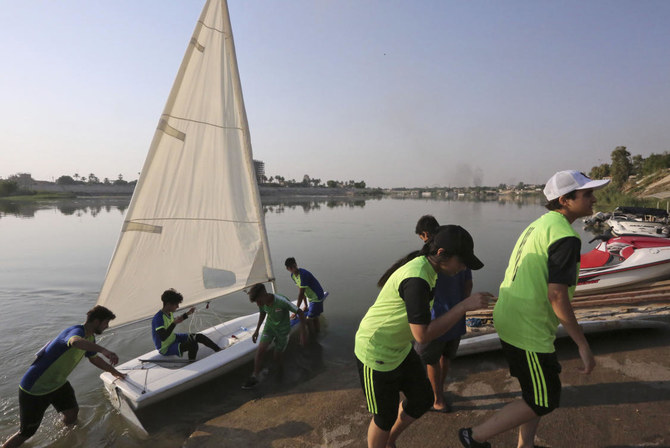
With the orange sunset saturating the sky, a cluster of mostly teenage sailors, windsurfers and jet-skiers were making waves along the river Tigris.
“It’s a difficult sport that requires a lot of effort, and plenty of patience and perseverance,” 16-year-old Khaled, a former junior swimming champion, told AFP.
“But I want to show everyone that we, Iraqi women, can succeed,” she added, after pulling her dinghy up the muddy bank.
The water sports are also revolutionizing how Iraqis interact with the historic Tigris and Euphrates, which gave the country its byname of the “land between the two rivers” millennia ago.
Water levels in the twin rivers have dropped by half because of dams upstream in neighboring Turkey and Iran.
One year in Baghdad, the levels drew so low that residents could squelch between the banks of the Tigris on foot.
Following the US-led invasion that toppled Saddam Hussein in 2003, Adhamiya became the heart of a Sunni insurrection and one of the most dangerous places in Baghdad.
The dark years of Iraq’s sectarian fighting from 2006 until 2008 pitted it against the Shiite district of Kadhimiya, just across the Tigris.
The remains of victims who were thrown into the river back then still sometimes wash ashore — but today, Baghdad’s river bends see much more life than death.
Along the waterfront, restaurants and small funfairs are teeming with families who gaze out at the young athletes.
“It’s now a place of leisure and relaxation,” said Ghazi Al-Shayaa, a sports journalist.
“It’s a joy to see Baghdadis gathering here nearly every day to watch the swimmers or the boats go by,” he said.
The latest major round of violence in Iraq ended in 2017, when the government declared victory in its years-long fight against the Islamic State jihadist group.
The next year, Ahmad Mazlum came up with a crazy idea: setting up Iraq’s first water sports federation.
Its riverside headquarters in Adhamiya is identifiable by the rows of white dinghies and bright windsurfing sails.
Half of the 10 dinghies are Iraqi-made, at around $600 each.
“An (imported) sailboat can cost $10,000. So we had to build our own in a workshop we set up with the club members,” said Mazlum, the federation’s deputy head.
The around 100 mostly teenage members — eight of them girls — wear matching fluorescent athletics clothes, as bathing suits would likely contravene Iraq’s widely conservative norms.
Boys and girls train together under Anmar Salman, a regional rowing champion who recruited from fellow rowers and Iraqi swimmers to launch the sailing club.
Aboard a motorized boat one late afternoon, he advised the young sailors on how to tack and deal with wind conditions.
“Turn now!” called out the instructor with the neatly-trimmed beard.
The stretch of river where they practice has surprisingly robust winds of up to 15 knots, likely because the buildings on either side create a tunnel.
Salman is planning to take his young trainees to qualifiers next year in Abu Dhabi for the Tokyo Olympics.
But since they can only train up and down the river, they may not have the same versatility as sea sailors.
The team also suffers from a lack of funding, Salman said.
“The problem is that athletic institutions in the country aren’t interested in sailing — but the Olympic Committee has backed us with some meagre means,” he told AFP.
Still, the federation is proud to nurture a culture of sailing in Iraq, where navigating the Tigris and Euphrates has been done for several millennia — but usually on circular “quffa” rowboats.
For the youth in Adhamiya, the spirit of camaraderie and discovery seems to be enough, Salman said.
“Luckily, our athletes adore the sport and like to train for the joy of doing it, without demanding much else.”


![]()

Sailing Baghdad’s river bends, young Iraqis rock the boat
Short Url
https://arab.news/4cvfs
Sailing Baghdad’s river bends, young Iraqis rock the boat
- The water sports are also revolutionizing how Iraqis interact with the historic Tigris and Euphrates


Latest updates


© 2026 SAUDI RESEARCH & PUBLISHING COMPANY, All Rights Reserved And subject to Terms of Use Agreement.