WASHINGTON/CHICAGO: Joe Biden pledged on Wednesday to reunite his divided country and restore America’s role as a beacon of hope to the world.In his inaugural address after being sworn in as the 46th US president, Biden vowed to confront the challenges of a battered economy and a coronavirus pandemic that has killed more than 400,000 Americans.
With the US Capitol encircled by thousands of armed troops two weeks after a mob laid siege to it, Biden took the oath of office administered by US Chief Justice John Roberts and became the oldest US president in history at age 78.
“To overcome these challenges to restore the soul and secure the future of America requires so much more than words. It requires the most elusive of all things in a democracy — unity,” he said in his inauguration speech.
“We must end this uncivil war that pits red against blue, rural versus urban, conservative versus liberal. We can do this, if we open our souls instead of hardening our hearts.”
Biden spoke on the steps of the Capitol, where two weeks ago protesters tried to overturn the presidential election result in an attack that left five people dead and shocked the world.
Opinion
This section contains relevant reference points, placed in (Opinion field)
The violence prompted the Democratic-controlled US House of Representatives to impeach Trump last week for an unprecedented second time, accusing him of incitement after he exhorted his backers to march on the building amid false claims of election fraud.
“Here we stand, just days after a riotous mob thought they could use violence to silence the will of the people, to stop the work on our democracy, to drive us from this sacred ground,” Biden said. “It did not happen, it will never happen, not today, not tomorrow, not ever.”
*********
READ MORE:
LIVE: Joe Biden becomes 46th US President
Biden plans immediate end to Trump’s ‘travel ban’ on Muslim majority states
World leaders react to Joe Biden’s inauguration
*********
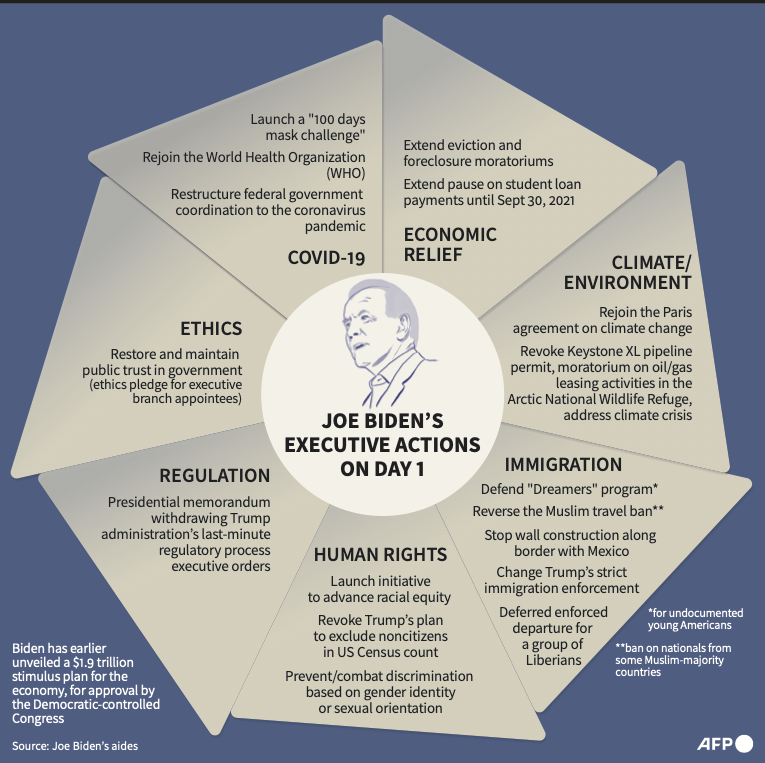
Among Biden’s first acts as president, he signed a flurry of executive orders reversing the travel ban from Muslim-majority countries, re-engaging with the World Health Organization, extending COVID-19 protections to the poor prohibiting home evictions, rejoining the Paris Agreement on Climate Change, recognizing rights for undocumented immigrants, and stopping the construction of the wall along the Mexican border.
Biden also delivered legislation to remove restrictions allowing immigrations an “earned roadmap” for citizenship and to support asylum seekers from all countries.
Biden’s running mate, Kamala Harris, the daughter of immigrants from Jamaica and India, became the first Black person, first woman and first Asian American to serve as vice president after she was sworn in by US Supreme Court Justice Sonia Sotomayor, the court’s first Latina member.
The norm-defying Trump flouted one last convention on his way out of the White House when he refused to meet with Biden or attend his successor’s inauguration, breaking with a political tradition seen as affirming the peaceful transfer of power.
Trump, who never conceded the Nov. 3 election, did not mention Biden by name in his final remarks as president on Wednesday morning, when he touted his administration’s record and promised to be back “in some form.” He then boarded Air Force One for the last time and flew to his Mar-a-Lago retreat in Florida.
Top Republicans, including Vice President Mike Pence and the party’s congressional leaders, attended Biden’s inauguration, along with former US Presidents Barack Obama, George W. Bush and Bill Clinton.
Biden takes office at a time of deep national unease, with the country facing what his advisers have described as four compounding crises: the pandemic, the economic downturn, climate change and racial inequality. He has promised immediate action, including a raft of executive orders on his first day in office.
After a bitter campaign marked by Trump’s baseless allegations of election fraud, Biden struck a conciliatory tone rarely heard from his predecessor, asking Americans who did not vote for him to give him a chance.
“I pledge this to you: I will be a president for all Americans,” he said. “And I promise you I will fight as hard for those who did not support me as for those who did.”
Although his remarks were directed primarily at problems at home, Biden delivered what he called a message to those beyond America’s borders, promising to repair alliances frayed by Trump, lead and be a strong and trusted partner for peace, progress and security. He made no specific mention of high-stakes disputes with North Korea, Iran and China.
Biden’s inauguration is the zenith of a five-decade career in public service that included more than three decades in the US Senate and two terms as vice president under Obama.
But he faces calamities that would challenge even the most experienced politician.
The pandemic in the United States reached a pair of grim milestones on Trump’s final full day in office on Tuesday, reaching 400,000 US deaths and 24 million infections — the highest of any country. Millions of Americans are out of work because of pandemic-related shutdowns and restrictions.
Biden has vowed to bring the full weight of the federal government to bear on the crisis. His top priority is a $1.9 trillion plan that would enhance jobless benefits and provide direct cash payments to households.
But it will require approval from a deeply divided Congress, where Democrats hold slim advantages in both the House and Senate. Harris was scheduled to swear in three new Democratic senators late on Wednesday, creating a 50-50 split in the chamber with herself as the tie-breaking vote.
Biden will waste little time trying to turn the page on the Trump era, advisers said, signing 15 executive actions on Wednesday on issues ranging from the pandemic to the economy to climate change.
The orders will include mandating masks on federal property, rejoining the Paris climate accord and ending Trump’s travel ban on some Muslim-majority countries.
Although Biden has laid out a packed agenda for his first 100 days, including delivering 100 million COVID-19 vaccinations, the Senate could be consumed by Trump’s upcoming impeachment trial, which will move ahead even though he has left office.
The trial could serve as an early test of Biden’s promise to foster a renewed sense of bipartisanship in Washington.
Trump issued more than 140 pardons and commutations in his final hours in office, including a pardon for his former political adviser, Steve Bannon, who has pleaded not guilty to charges that he swindled Trump supporters as part of an effort to raise private funds for a Mexico border wall.
But Trump did not issue preemptive pardons for himself or members of his family, after speculation that he might do so.
(With Agencies)