Looking forward to future ‘high-level’ engagements with UAE — Pakistani FM

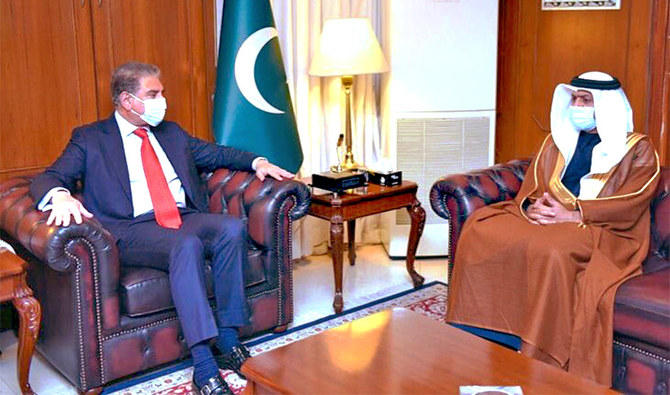
Ambassador of the UAE to Pakistan, Hamad Obaid Ibrahim Salem Al Zaabi (right), calls on Pakistan's Foreign Minister, Shah Mahmood Qureshi (left), in Islamabad, Pakistan, on January 20, 2020. (Photo courtesy: UAE Embassy Pakistan/Twitter)
Short Url
Updated 20 January 2021
Follow

Looking forward to future ‘high-level’ engagements with UAE — Pakistani FM

  • Foreign minister Qureshi meets UAE ambassador, appreciates support for Pakistan’s Expo 2020 pavilion covering 3,500 square meters
  • UAE ambassador reaffirms desire for ties with Pakistan based on “mutual respect, understanding and common interests”

ISLAMABAD: Pakistani Foreign Minister Shah Mahmood Qureshi received the ambassador of the UAE to Pakistan, Hamad Obaid Ibrahim Salem Al Zaabi, at the Ministry of Foreign Affairs on Wednesday and conveyed his hope for enhanced “high-level” engagements between the two nations in the future.
The UAE is Pakistan’s largest trading partner in the Middle East and has supported Pakistan in the areas of education, health, energy and infrastructure development over several decades. It is home to more than 1.6 million Pakistanis — the second largest Pakistani expatriate community abroad.
Recalling his successful visit to the UAE in December 2020, Qureshi underscored the importance of frequent high-level visits from both sides, “which serve to continually provide impetus toward deepening and diversifying bilateral relations.”
“He looked forward to enhanced high-level engagements with the UAE, as soon as the global health situation improved,” the foreign office said in a statement, quoting the foreign minister referring to the ongoing coronavirus pandemic.
Qureshi paid tribute to late Sheikh Zayed bin Sultan Al Nahyan who he said had “contributed immensely toward strengthening bilateral ties between the two countries.”
He acknowledged that the UAE and its leadership had “steadfastly” stood by Pakistan in its times of need.
“He stressed that the relationship benefitted from the warm sentiments between the leadership of the two countries, as well as the strong people-to-people linkages rooted in shared faith, values and culture,” the foreign office said.
Qureshi also appreciated the UAE’s support for Pakistan’s pavilion at the Expo 2020, a world expo to be hosted by Dubai originally scheduled for 20 October 2020-10 April 2021 but postponed due to the COVID-19 pandemic. Organizers have kept the name Expo 2020 for marketing and branding purposes.
Pakistan’s pavilion at the Expo will cover an approximate area of 3,500 square meters and exhibit Pakistani culture, investment opportunities and tourism potential in the largest exhibition ever staged in the Arab world in which 190 countries and 25 million people are expected to participate.
The UAE ambassador “hailed the strong UAE-Pakistan relations and pledged to work toward further strengthening and diversifying them in all sectors for the benefit of the two countries and their peoples. He acknowledged the positive contribution made by Pakistani Diaspora toward the progress and development of the UAE.”
The ambassador reaffirmed the UAE’s desire to develop bilateral ties with Pakistan on “the basis of mutual respect, understanding, and common interests.”


Pakistan increases Reko Diq investment to $244 million as Barrick reviews project

Updated 5 sec ago
Follow

Pakistan increases Reko Diq investment to $244 million as Barrick reviews project

  • State-owned PPL injects $50.2 million more in special purpose vehicle formed to manage Islamabad’s 25 percent stake in copper-gold mine
  • Canadian operator Barrick Mining Corporation this month ordered project’s review following deadly separatist attacks in Balochistan province

KARACHI: The state-run Pakistan Petroleum Limited (PPL) has invested an additional Rs14 billion ($50.2 million) equity in the multi-billion-dollar Reko Diq copper-gold mine, the company said in its latest financial report on Thursday, as the project’s Canadian operator reviews the project following recently deadly attacks. 

Canada’s Barrick Mining Corporation owns a 50 percent share in Reko Diq in the southwestern Balochistan province, along with three Pakistani federal state-owned enterprises including PPL that own 25 percent, while the Balochistan government has the remaining 25 percent share in the project.

The Canadian company announced earlier this month it planned to “immediately” begin a comprehensive review of all aspects of the Reko Diq project following coordinated attacks in Balochistan on Jan. 30-31 that killed 36 civilians and 22 security forces personnel. 

“With respect to the Reko Diq project, the company has made further equity investment in Pakistan Minerals Private Limited (PMPL) during the period amounting to Rs14,025 million ($50.2m),” PPL told its shareholders in its financial statement for the half year ending at Dec. 31.

The additional equity has increased PPL’s total cost of investment in the PMPL to Rs68.1 billion ($243.6 million), it added. 

The PMPL is a special purpose vehicle formed to manage the federal government’s 25 percent stake in the Reko Diq project. It is a consortium of three state-owned enterprises (SOEs) namely the PPL, the Oil & Gas Development Company Limited (OGDCL) and Government Holdings (Private) Limited (GHPL) which is responsible for handling financing, equity contributions and strategic, legal or technical dealings with partners like Barrick.

“The project continued to advance site works during the period (July-December FY26),” the PPL said. “The operator (Barrick) is undertaking a review of all aspects of the project, including with respect to the project’s security arrangements, development timetable and capital budget.” 

This week, Balochistan Chief Minister Sarfraz Bugti assured investors that Pakistan has the “capacity and capability” to secure the Reko Diq project amid surging militancy. 

The PPL explores, drills, and produces oil and natural gas. Its current portfolio, together with its subsidiaries and associates, consists of 47 exploratory blocks that include one offshore Block-5 in Abu Dhabi and one onshore block in Yemen.

In December, PPL signed a strategic Deed of Assignment under which it assigned 25 percent of its participating interest (PI) and operatorship of Eastern Offshore Indus C block to Turkish Petroleum Overseas Company, a unit of state-owned Türkiye Petrolleri Anonim Ortaklığı.

Assigning 20 percent PI each to OGDCL and Mari Energies Limited, the company has retained the remaining 35 percent PI to play a key role in the block’s development.