

Pakistani province to set up Braille printing press for the visually impaired

A group of visiting officials inspect a class at the Government Institute for the Blind in Peshawar as visually impaired students read their textbooks on October 20, 2020. (Photo courtesy: Government Institute for the Blind, Peshawar)
Short Url
Updated 18 January 2021
Follow

Pakistani province to set up Braille printing press for the visually impaired

  • The province has earmarked Rs40.3 million for the project and hopes to establish the facility within a month
  • Customised software for the printing press developed in both the Urdu and Pashto languages

PESHAWAR: Pakistan’s northwestern Khyber Pakhtunkhwa province plans to set up its first printing press for Braille to help visually impaired people across the province, said a minister while talking to Arab News on Friday. 

Braille printers are impact devices that are used to create tactile dots on special paper, making written documents accessible to sightless individuals. 

“We have done our homework and set aside Rs40.3 million to launch the printing press within a month,” said Minister for Social Welfare, Dr. Hisham Inamullah Khan. 
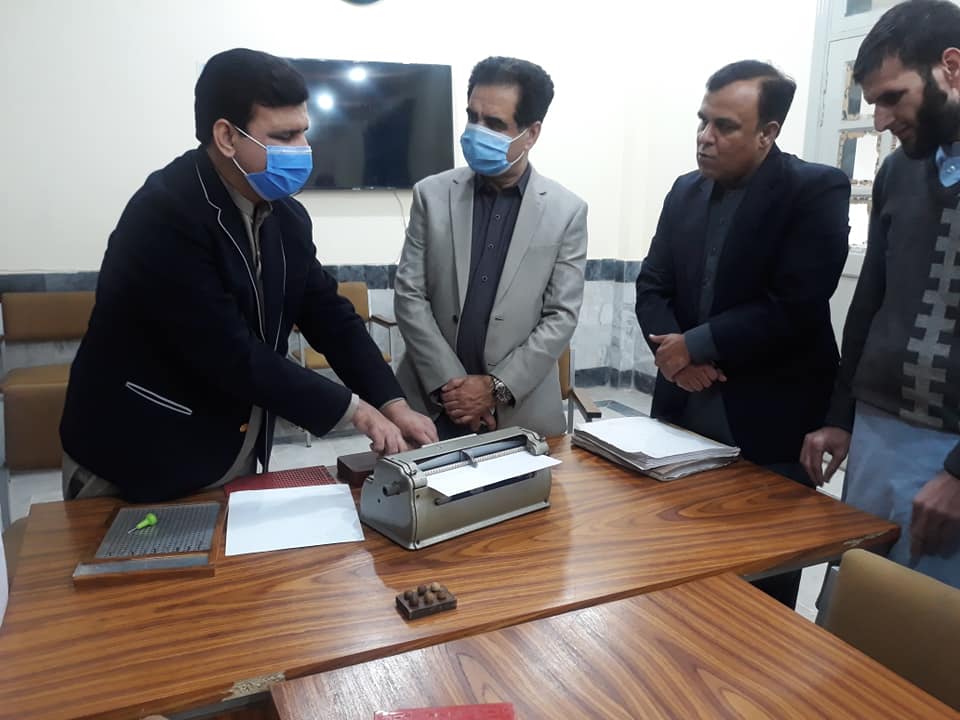


Awais Alam, a visually impaired person, types on a machine as other people watch, at the Government Institute for the Blind in Peshawar on November 19, 2020. (Photo courtesy: Government Institute for the Blind, Peshawar) 

Habib Khan Afridi, director social welfare, special education and women empowerment, told Arab News that the province lacked the facility and relied heavily on a printing press in Lahore.

“We have developed customized software in Urdu and Pashtu languages that will make writing material more use-friendly to blind persons,” Afridi said. 

“While the number of unregistered Persons with Disabilities [PWDs] may be higher, about 148,000 of them are in the provincial database,” he continued. “These not only include people with visual, hearing and physical impairments but also individuals with intellectual disabilities.”

Afridi said that PWDs were entitled to certain benefits, such as two percent quota in all government jobs and Rs3,000 monthly mobility allowance after getting employed.
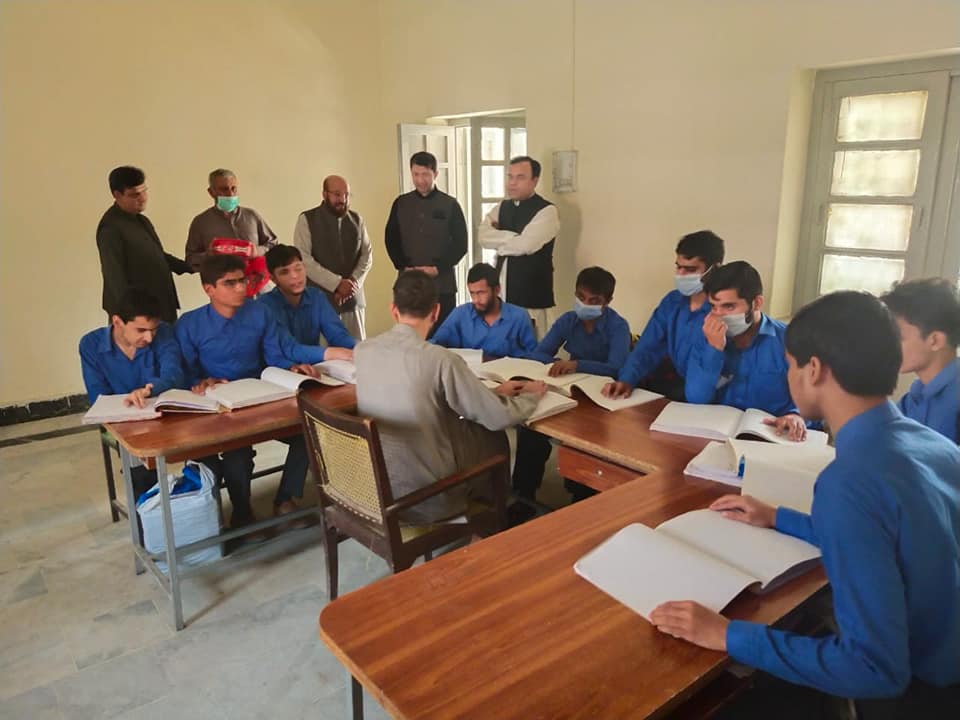


A group of visiting officials inspect a class at the Government Institute for the Blind in Peshawar as visually impaired students read their textbooks on October 20, 2020. (Photo courtesy: Government Institute for the Blind, Peshawar) 

Awais Alam, a visually impaired teacher at Peshawar’s Government Institute for the Blind, lauded the initiative, calling it a “huge favor” for thousands of people. 

“According to my estimate, there are more than 10,000 sightless people in this province,” he said. “We import curriculum books from Punjab and Sindh. In fact, some of us had to move to other provinces due to the unavailability of textbooks and other facilities. This should change now since the new initiative will help resolve one of our pressing problems.” 

Alam, who is also pursuing his MPhil degree in political science, urged parents not to ignore their differently abled children and focus on their education.

“I want to request parents to bring their visually impaired children to blind schools where they can be educated and turned into useful citizens,” he said. 


Arif Habib-led group plans to buy remaining 25 percent stakes in Pakistan International Airlines

Updated 4 sec ago
Follow

Arif Habib-led group plans to buy remaining 25 percent stakes in Pakistan International Airlines

  • Consortium bought 75 percent stake in Pakistan International Airlines in December 2025 for $482 million
  • Group will have to pay government $161 million by April 2027 for 25 percent stakes, says Arif Habib Ltd. CEO

ISLAMABAD: The Pakistani consortium led by Arif Habib Ltd. which bought a 75 percent stake in the Pakistan International Airlines (PIA) plans to secure full control of the airline, a senior official of the firm confirmed on Sunday. 

In December 2025, the consortium headed by Arif Habib Group secured a 75 percent stake in the PIA for Rs135 billion ($482 million) after several rounds of bidding, valuing the airline at Rs180 billion ($643 million). Pakistan had previously attempted to reform the debt-ridden airline, which had accumulated more than $2.8 billion in financial losses over the years. 

Arif Habib Ltd. CEO Shahid Habib told Arab News that since the PIA’s privatization documents were signed in January, the group will formally take over the airline at the end of April. He said as per the by-laws, the group will have to notify the government whether it intends to buy the remaining 25 percent stake in the airline or “leave it with the government.”

“At present, their [Arif Habib-led group’s] stated position is that they intend to acquire the 25 percent from the government,” Habib said.

He said once the group conveys its decision to buy the remaining 25 percent stakes in the airline, it will have 12 months to complete the payment.

“This means that from April to the following April [in 2027], they must pay the Government of Pakistan Rs45 billion [$161 million] more for the additional stake,” Habib said. 

Habib said beyond ownership, the group intends to improve service for customers. This would include strengthening overall safety and security standards, enhancing staff performance and upgrading the airline’s ticketing system. 

He said the group intends to increase the frequency of flights on commercially viable routes.

“For example, routes that currently operate only two flights every two weeks could be expanded to as many as six flights per week,” Habib said.

“This would significantly improve passenger convenience and availability.”

Habib said currently, PIA has 18 operational aircraft, adding that some of them require capital expenditure (CAPEX) for upgrades and improvements. He said six to seven aircraft could be made operational with additional CAPEX.

“The medium-term goal is to expand the fleet from 18 to 38 aircraft over the coming years,” Habib said.

“While the exact timeline has not been specified, the intention is to achieve this within a defined multi-year framework.”

Habib shared leasing brand new aircraft would require time, adding that current delivery slots that are being offered for them are for 2030, 2031 and 2032.

He said that as an interim solution, relatively newer aircraft — around eight to ten years old — can be acquired for the airline.

“If orders are placed now, Boeing or comparable models, as well as Airbus aircraft in the seven-to-ten-year range, could be secured to stabilize and expand short-term operations,” he said. 

Once considered among Asia’s leading airlines, PIA struggled with chronic mismanagement, political interference, overstaffing, mounting debt and operational issues that led to a 2020 ban on flights to the European Union, UK and the US after a pilot licensing scandal.

The EU and the UK lifted the bans, providing fresh momentum to the carrier.