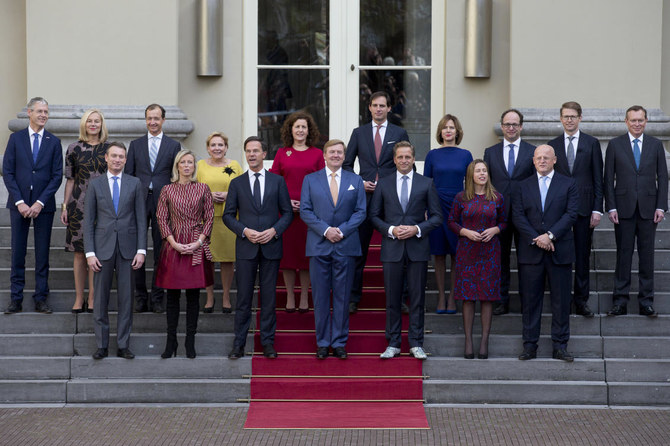
THE HAGUE: Dutch Prime Minister Mark Rutte’s government resigned on Friday over a child benefits scandal, media reported, threatening political turmoil as the country battles the coronavirus pandemic.
Thousands of parents were wrongly accused by Dutch authorities of fraudulently claiming child allowance, with many of them forced to pay back large amounts of money and ending up in financial ruin.
The fact that some parents were targeted for investigation by tax officials because they had dual nationality also underscored long-standing criticisms of systemic racism in the Netherlands.
Dutch media said Rutte was due to give a statement at 1315 GMT about the resignation of his four-party coalition cabinet, which comes just two months before the Netherlands is due to hold a general election on March 17.
A hard-hitting parliamentary investigation in December said civil servants cut off benefits to thousands of families wrongly accused of fraud between 2013 and 2019.
The row threatens to leave the Netherlands without a government in the midst of a surge in cases of a new Covid-19 variant that first emerged in Britain.
Rutte had opposed the cabinet’s resignation, saying the country needs leadership during the pandemic.
He had however said that if it resigned he could be authorized to lead a caretaker government until elections — in which polls say his Freedom and Democracy Party would likely come first.
Other parties in the coalition had pushed for the government to take responsibility for the scandal, which Dutch media said some 26,000 people had been affected.
They could have also faced a confidence vote in parliament next week.
Pressure mounted on the government after opposition Labour party chief Lodewijk Asscher, who was social affairs minister in Rutte’s previous cabinet, resigned on Thursday over the scandal.
Victims also lodged a legal complaint Tuesday against three serving ministers and two former ministers including Asscher.
Many were required to pay back benefits totalling tens of thousands of euros (dollars).
Tax officials were also revealed to have carried out “racial profiling” of 11,00 people based on their dual nationality, including some of those hit by the false benefit fraud accusations.
The Dutch government announced at least 30,000 euros in compensation for each parent who was wrongly accused but it has not been enough to silence the growing clamour over the scandal.
Rutte has led three coalition governments since 2010, most recently winning elections in 2017 despite strong opposition from far-right leader Geert Wilders.
Polls say he is likely to win a fourth term in the next election, with public opinion still largely backing his handling of the coronavirus crisis.


Dutch government collapses over benefits scandal
https://arab.news/wy9cs
Dutch government collapses over benefits scandal

- Parents being targeted for investigation because they had dual nationality also underscored long-standing criticisms of systemic racism in the Netherlands
- The row threatens to leave the Netherlands without a government in the midst of a surge in cases of a new Covid-19 variant


Philippines eyes closer cooperation on advanced defense tech with UAE
- Philippine-UAE defense agreement is Manila’s first with a Gulf country
- Philippines says new deal will also help modernize the Philippine military
MANILA: The Philippines is seeking stronger cooperation with the UAE on advanced defense technologies under their new defense pact — its first such deal with a Gulf country — the Department of National Defense said on Friday.
The Memorandum of Understanding on Defense Cooperation was signed during President Ferdinand Marcos Jr.’s visit to Abu Dhabi earlier this week, which also saw the Philippines and the UAE signing a comprehensive economic partnership agreement, marking Manila’s first free trade pact with a Middle Eastern nation.
The Philippines-UAE defense agreement “seeks to deepen cooperation on advanced defense technologies and strengthen the security relations” between the two countries, DND spokesperson Assistant Secretary Arsenio Andolong said in a statement.
The MoU “will serve as a platform for collaboration on unmanned aerial systems, electronic warfare, and naval systems, in line with the ongoing capability development and modernization of the Armed Forces of the Philippines,” he added.
It is also expected to further military relations through education and training, intelligence and security sharing, and cooperation in the fields of anti-terrorism, maritime security, and peacekeeping operations.
The UAE’s Ministry of Foreign Affairs has described security and defense as “very promising fields” in Philippine-UAE ties, pointing to Abu Dhabi being the location of Manila’s first defense attache office in the Middle East.
The UAE is the latest in a growing list of countries with defense and security deals with the Philippines, which also signed a new defense pact with Japan this week.
“I would argue that this is more significant than it looks on first read, precisely because it’s the Philippines’ first formal defense cooperation agreement with a Gulf state. It signals diversification,” Rikard Jalkebro, associate professor at the Anwar Gargash Diplomatic Academy in Abu Dhabi, told Arab News.
“Manila is widening its security partnerships beyond its traditional circles at a time when strategic pressure is rising in the South China Sea, and the global security environment is (volatile) across regions.”
Though the MoU is not an alliance and does not create mutual defense obligations, it provides a “framework for the practical stuff that matters,” including access, training pathways, procurement discussions and structured channels” for security cooperation, he added.
“For the UAE, the timing also makes sense, seeing that Abu Dhabi is no longer only a defense buyer; it’s increasingly a producer and exporter, particularly in areas like UAS (unmanned aerial systems) and enabling technologies. That opens a new lane for Manila to explore capability-building, technology transfer, and industry-to-industry links,” Jalkebro said.
The defense deal also matters geopolitically, as events in the Middle East and the Indo-Pacific region have ripple effects on global stability and commerce.
“So, a Philippines–UAE defense framework can be read as a pragmatic hedge, strengthening resilience and options without formally taking sides,” Jalkebro said.


