

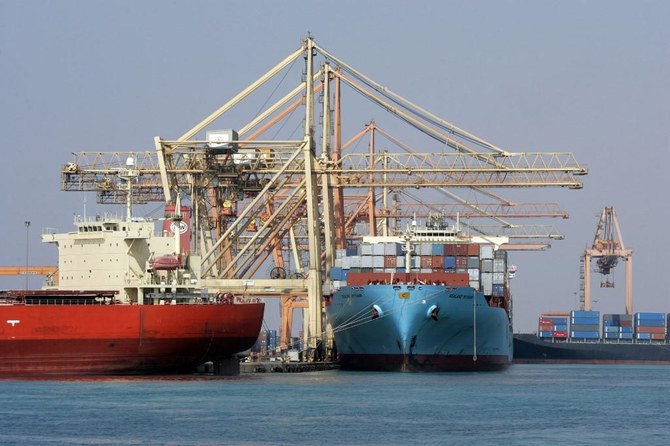
Jeddah Islamic Port saw 12% rise in container traffic last year

Jeddah Islamic Port (JIP) saw a 12 percent year-on-year increase in the number of transshipment containers processed in 2020. (File/AFP)
Short Url
Updated 14 January 2021
Follow

Jeddah Islamic Port saw 12% rise in container traffic last year

  • Saudi Arabia’s ports handle around 20 percent of the transshipment market in the region
  • Authorities are aiming to raise this to 50 percent by 2030

RIYADH: Jeddah Islamic Port (JIP) saw a 12 percent year-on-year increase in the number of transshipment containers processed in 2020, despite the global slowdown in trade due to the pandemic.
The port processed an extra 2.5 million standard containers last year, in line with the Kingdom’s ambition to become a global logistics center, the Saudi Press Agency reported. 
More than 13 percent of the volume of international maritime trade passes through the port, which is considered a link between Asia, Europe and Africa.

BACKGROUND

Jeddah Islamic Port handles more than 70 percent of the goods exported and imported through Saudi ports and is ranked first among the Red Sea ports.

JIP handles more than 70 percent of the goods exported and imported through Saudi ports and is ranked first among the Red Sea ports.
Saudi Arabia’s ports handle around 20 percent of the transshipment market in the region, but authorities are aiming to raise this to 50 percent by 2030. 
The Saudi Ports Authority is raising the competitiveness of JIP operations by re-engineering transshipment procedures. 
It canceled loading permits and restructured storage fees in order to stimulate shipping lines. It also increased the period of storage free time from 20 days to 30.


‘The age of electricity’: WEF panel says geopolitics is redefining global energy security

Updated 20 January 2026
Follow

‘The age of electricity’: WEF panel says geopolitics is redefining global energy security

  • Surging demand, critical minerals, US-China rivalry reshaping energy security as nations compete for influence, infrastructure, control over world’s energy future

LONDON: Electricity is rapidly replacing oil as the world’s most strategic energy commodity, and nations are racing to secure reliable supply and influence in a changing energy landscape.

Global electricity demand is growing nearly three times faster than overall energy consumption, driven by artificial intelligence, electric vehicles, and rising use of air-conditioning in a warming world.

“We are entering the age of electricity,” said Fatih Birol, the executive director of the International Energy Agency, during a panel discussion titled “Who is Winning on Energy Security?” at the World Economic Forum in Davos on Tuesday.

Unlike oil, electricity cannot be stockpiled at scale, forcing governments and companies to prioritize generation, transmission, and storage, making regions with stable infrastructure increasingly important on the global stage.

US-China rivalry

Energy security is increasingly about control and influence, not just supply. The rivalry between the US and China now extends beyond oil to critical minerals, energy infrastructure, and long-term energy partnerships.

“The contrast between the US approach and China’s is stark,” said Meghan O’Sullivan, director of Harvard University’s Belfer Center. “The US, until recently, focused on access, not control. China flips that, seeking long-term influence and making producers more dependent on them.”

O’Sullivan highlighted China’s Belt and Road Initiative, which invests in energy infrastructure and critical minerals across Africa, Latin America, and Asia to secure influence over production and supply chains.

“It’s not just the desire to control oil production itself, but to control who develops resources,” she said, citing Venezuela as an example. The South American nation holds some of the world’s largest crude oil reserves, giving it outsized geopolitical importance. Recent US moves to expand influence over Venezuelan oil flows illustrate the broader trend that great powers are competing to shape who benefits from energy resources, not just the resources themselves.

“There’s no question that the intensified geopolitical competition between great powers is playing out in more competition for energy resources, particularly as the energy system becomes more complex,” O’Sullivan added.

Global drivers of the electricity era

The rise of electricity as a strategic commodity is also transforming global supply chains. Copper, lithium, and other minerals have become essential to modern energy systems.

“A new ‘energy commodity’ is copper,” said Mike Henry, CEO of BHP. “Electricity demand is growing three times faster than primary energy, and copper is essential for wires, data centers, and renewable energy. We expect a near doubling, about a 70 percent increase in copper demand over 25 years.”

Yet deposits are harder to access, refining is concentrated in a few countries, and supply chains are politically exposed.

“The world’s ability to generate electricity reliably will increasingly depend on materials and infrastructure outside traditional oil and gas markets,” Birol said.

AI and digital technologies amplify the challenge with large-scale data centers consuming enormous amounts of electricity. 

The Middle East’s strategic relevance 

While the global focus is on electricity demand and great-power rivalry, the Middle East illustrates how traditional energy hubs are adapting.

Majid Jafar, the CEO of Crescent Petroleum, highlighted the region’s enduring advantages: abundant reserves, low-carbon potential, and strategic geography.

“Geopolitical instability reinforces, if anything, the Middle East’s role as a supplier with scale, affordability, availability, and some of the lowest carbon reserves,” he said.

Jafar emphasized the region’s ability to navigate the growing US-China rivalry.

“Amid US-China global friction, the Middle East has managed to remain on good terms with both sides,” he said, noting that flexible policy and engagement help preserve influence while balancing competing interests.

The region is also adapting to the electricity-driven era. AI data centers and digital technologies are multiplying power needs. Jafar said: “One minute of video consumes roughly an hour’s electricity for an average Western household. Multiply that across millions of servers and billions of people and the scale is staggering.”

Infrastructure investments further strengthen the Middle East’s strategic position. In the Kurdistan Region of Iraq, the Runaki Project has expanded natural gas–fueled power plants to provide 24/7 electricity to millions of residents and businesses, reducing reliance on diesel generators and supporting economic growth.

According to Jafar, the combination of energy resources, capital, leadership, and agile policymaking gives the Middle East a competitive edge in meeting global electricity demand and navigating the complex geopolitics of energy.

While the panel highlighted the Middle East as one example, in the age of electricity, energy security is defined as much by influence and infrastructure as by barrels of oil, with the US-China rivalry determining who gains and who is left behind.