Pakistan army says 37% fencing work on Iran border completed

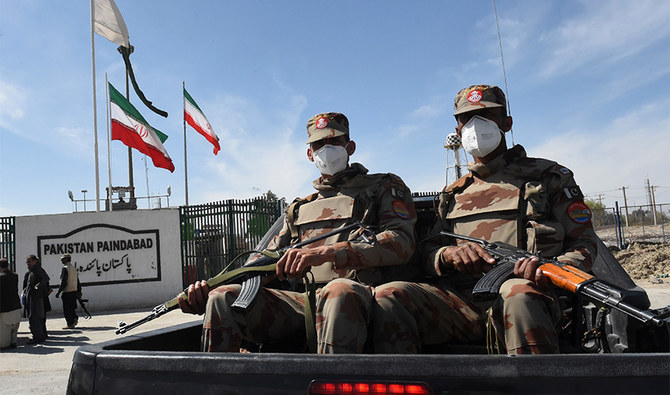
Pakistani soldiers wearing facemasks patrol near the closed Pakistan-Iran border in Taftan on February 25, 2020. (AFP/File)
Short Url
Updated 12 January 2021
Follow

Pakistan army says 37% fencing work on Iran border completed

  • Pakistan has set aside nearly $20 million to fence its frontier with Iran
  • Ties strained in recent years over accusations militants allegedly sheltering on both sides of shared border

ISLAMABAD: Pakistan’s army spokesman said on Monday nearly 37 percent fencing work along the country’s 900-kilometer border with Iran had been completed.
The Pak-Iran border begins at the Koh-i-Malik Salih mountain and ends at Gwadar Bay in the Gulf of Oman, passing through a diverse landscape of mountain ridges, seasonal streams and rivers.
In recent years, relations between Iran and Pakistan have been strained with both sides accusing each other of not doing enough to stamp out militants allegedly sheltering across the border.
“More than 37 percent of the Pak-Iran border has been fenced and we hope it will be completed in a year,” the spokesperson for the Pakistani military, Major General Babar Iftikhar, told reporters, adding that nearly 83 precent of Pakistan’s over 2,600-kilometer-long border with Afghan had also been fenced and work on it would be completed by mid-2021.
In 2019, Iran and Pakistan said they would form a joint quick reaction force to combat militant activity on their shared border. Pakistan has set aside nearly $20 million to fence its frontier with Iran.


At Gulfood expo, minister urges Pakistani firms to boost exports to end reliance on foreign debt

Updated 10 sec ago
Follow

At Gulfood expo, minister urges Pakistani firms to boost exports to end reliance on foreign debt

  • The Dubai expo brought together more than 8,500 exhibitors from 195 countries, showcasing over 1.5 million food and beverage products
  • Planning Minister Ahsan Iqbal says Islamabad is committed to promoting productivity, quality and innovation within the private sector 

ISLAMABAD: Planning Minister Ahsan Iqbal on Thursday urged Pakistani companies participating in the Gulfood food and beverage exhibition in Dubai to expand exports and focus on value-added products, saying it was the only way for Pakistan to end reliance on foreign debt.

Gulfood’s 31st edition, being held in Dubai from Jan. 26 till Jan. 30, has brought together more than 8,500 exhibitors from 195 countries, showcasing over 1.5 million food and beverage products across 12 sectors, making it one of the most influential platforms for global agri-food trade.

Pakistan has made its largest-ever showing at the world’s leading food and beverage trade exhibition, with a total of 142 Pakistani companies participating in the 2026 edition, according to a statement from the Ministry of Information released this week.

On Thursday, Iqbal visited toured various stalls and interacted with exhibitors at Pakistan Pavilion at the exhibition and encouraging them to focus on enhancing exports and value-addition, Pakistan’s Press Information Department (PID) said.

“If we are to permanently free ourselves from reliance on the IMF (International Monetary Fund) and foreign debt, there is only one way forward, promoting and expanding our exports,” he was quoted as saying. “I am particularly encouraged to see that Pakistani exporters are now focusing on value added products.”

Pakistan has struggled with boom-bust cycles for decades and secured 22 IMF bailouts since 1958. The country is currently navigating a long, tricky path to economic recovery under a $7 billion IMF program secured in Sept. 2024.

Pakistan has been increasingly using global trade exhibitions to promote value-added food exports, particularly to Gulf and Middle Eastern markets, which remain among the country’s largest destinations for rice, meat and processed food products.

Of the 142 Pakistani firms, 67 companies are participating under the Trade Development Authority of Pakistan (TDAP), while 75 companies are taking part independently, across four specialized pavilions covering rice, pulses and grains, world food, beverages, and meat and poultry. Notably, 30 rice exporters are participating under TDAP, underlining Pakistan’s position as one of the world’s leading rice suppliers.

Iqbal visited the Biryani Festival stall at Pakistan Pavilion and appreciated the initiative to showcase and promote Pakistani Basmati rice.
“We are committed to promoting productivity, quality, and innovation within the private sector so that ‘Made in Pakistan’ becomes a global symbol of quality, and Pakistani products are visible on every stall, in every shop, and on every shelf across international markets,” he said.