

Israeli rights group, UN expert decry impending Palestinian evictions

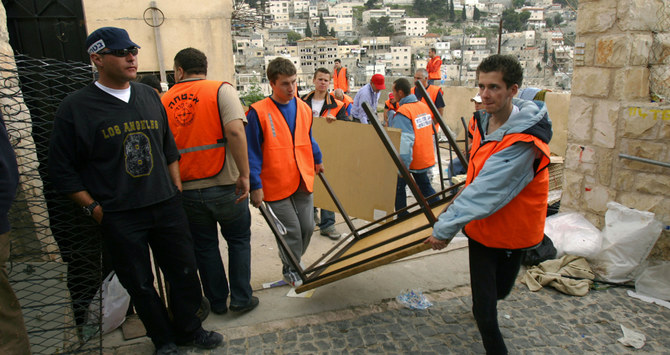
The plans are illegal under international law but are able to pass through the “narrow” Israeli courts. (AFP/File)
Short Url
Updated 11 January 2021
Follow

Israeli rights group, UN expert decry impending Palestinian evictions

  • 16 families face removal from their homes in East Jerusalem
  • Policy of evictions, demolitions ‘immoral and illegal,’ Israeli rights group tells Arab News

LONDON: An Israeli rights group and a UN expert have condemned Israel’s planned evictions of 16 Palestinian families from East Jerusalem.

Israeli courts have in the last few months upheld eviction orders to force 16 Palestinian families from their homes in the Sheikh Jarrah and Silwan neighborhoods of East Jerusalem, which Israel illegally annexed in 1980.

Linda Ramsden, director of the Israeli Committee Against Housing Demolitions, called the policy of evictions and demolitions “immoral and illegal.”

She told Arab News: “These evictions are just another example of the Israeli policy to reduce East Jerusalem’s Palestinian population, ‘Judaizing’ the city — the term used by Israeli academics and politicians.”

She added: “This action sits alongside other displacements and the seemingly unstoppable rise of illegal West Bank settlements, forcing out Palestinians to make way for Jewish settlers.”

Ramsden said the plans are illegal under international law but are able to pass through the “narrow” Israeli courts.

“Given the ineffectiveness of applying international law, it’s incumbent on us as members of civil society to speak out and pressure our governments to end this illegal and immoral policy,” she added.

Michael Lynk, UN special rapporteur on the situation of human rights in the Palestinian territory occupied since 1967, said the impending evictions, if carried out, would violate the fourth Geneva Convention.

“These evictions are extremely alarming, and appear to be part of a broader pattern of forcing Jerusalemite Palestinian families from their homes to clear the way for more illegal Israeli settlements,” he added.

“The eviction orders are not random but appear to be strategically focused on an area in East Jerusalem known as the Historic Basin,” he said.

“They seem to be aimed at clearing the way for the establishment of more illegal Israeli settlements in the area and physically segregating and fragmenting East Jerusalem from the rest of the West Bank.”

According to the UN, 877 people, including 391 children, are currently at risk of eviction due to requests from settler organizations. Hundreds of families have already been evicted from their homes in the city.

Organizations such as Nahalat Shimon and Ateret Cohanim, Lynk said, “function as both land ownership companies and settler associations.”

They bring lawsuits to evict Palestinian families, he added, in order to create a Jewish majority in East Jerusalem, and from there “establish demographic facts on the ground that would confirm the illegal Israeli annexation over that part of the city.”


Military drone attack on Sudan oil field kills dozens and threatens South Sudan’s economic lifeline

Updated 10 December 2025
Follow

Military drone attack on Sudan oil field kills dozens and threatens South Sudan’s economic lifeline

  • RSF said the oil field in Heglig was attacked a day after they seized the facility near the border with South Sudan
  • South Sudanese soldiers were among the dead in the attack by an Akinci drone

JUBA: Dozens of people were killed Tuesday evening in a drone strike near Sudan’s largest oil processing facility carried out by the Sudanese Armed Forces, according to the paramilitary Rapid Support Forces.
The RSF, which has been fighting Sudan’s military since 2023, said the oil field in Heglig was attacked a day after the RSF seized the facility near the border with South Sudan.
Both sides told The Associated Press that the exact number of dead and wounded could not immediately be confirmed. Local news outlets reported seven tribal leaders and “dozens” of RSF troopers were killed.
South Sudanese soldiers were among the dead in the attack by an Akinci drone, according to the RSF, which condemned the attack as a violation of international law.
Two Sudanese military officials confirmed the drone strike, which they said targeted RSF fighters.
The government of South Sudan’s Unity State confirmed three South Sudanese soldiers were killed. A South Sudanese solider, who witnessed the strike and spoke on condition of anonymity because he was not authorized to speak, estimated 25 people were killed.
South Sudanese commander Johnson Olony said in a statement that South Sudanese forces may have been sent to secure Heglig after its capture. South Sudan’s military spokesperson declined to comment.
South Sudan relies entirely on Sudanese pipelines to export its oil and has seen production repeatedly disrupted by the conflict, worsening its economic crisis.
Sudanese soldiers and oil workers began evacuating Heglig on Monday and the RSF took control of the facility without resistance. By Tuesday, about 3,900 Sudanese soldiers had surrendered their weapons to South Sudanese forces after crossing into Rubkona County, according to Unity State’s information ministry.
Video from South Sudan’s state broadcaster showed tanks, armored personnel carriers and artillery among the weapons handed over.
Thousands of civilians from Sudan began crossing the border into South Sudan on Sunday and were still arriving Wednesday, the South Sudan government said, adding that the exact number was not yet known. South Sudan insists it remains neutral in the conflict despite accusations of siding with the RSF.
Heglig’s capture is the latest in a string of RSF territorial gains, including the October fall of el-Fasher, the capital of North Darfur and the Sudanese army’s last stronghold in Darfur. The war, which began in April 2023, has killed an estimated 150,000 people, displaced millions and triggered multiple famines. Both sides face allegations of atrocities.
The capture of Heglig, a vital state asset, could be a significant bargaining chip for the RSF, analysts said. But the opaque nature of oil finances makes it difficult to determine how much the SAF, RSF or South Sudan will be impacted economically over the short term.