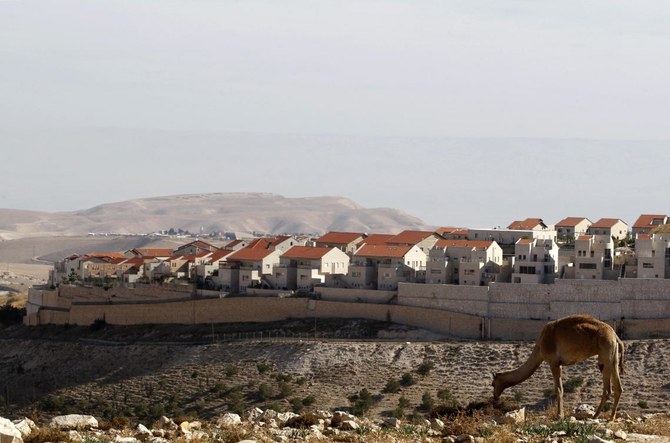
JERUSALEM: Israel’s prime minister on Monday directed authorities to approve construction of 800 new homes for Jewish settlers in the occupied West Bank days before President Donald Trump’s pro-Israel administration leaves office.
“Prime Minister Benjamin Netanyahu has directed that plans be advanced for the construction of about 800 units in Judea and Samaria,” a statement from the premier’s office said, using biblical terms for the West Bank.
President-elect Joe Biden, who will be sworn in next week, has indicated that his administration will restore US policy opposing settlement expansion in the occupied Palestinian Territories.
Trump’s administration gave unprecedented US support to settler groups, highlighted by a declaration from Secretary of State Mike Pompeo in 2019 that Washington no longer viewed settlements as being in violation of international law.
Pompeo in November also became the first top US diplomat to visit a settlement in the West Bank, which Israel has occupied since the 1967 Six-Day War.
Netanyahu is facing re-election on March 23, Israel’s fourth vote in just under two years.
A series of recent of polls indicate the veteran prime minister is facing a strong right-wing challenge from pro-settler candidate Gideon Saar, who defected from Netanyahu’s Likud party last month to run against the premier.
Netanyahu is widely expected to make a series of plays for right-wing votes, including by bolstering his pro-settlement credentials, before the vote, according to Israeli political analysts.
The statement from Netanyahu’s office said that 100 of the new units were to be built in the Tal Menashe settlement, where French-Israeli Esther Horgen was murdered last month.
Israel’s security services have said the settler was murdered by Palestinian Mohammed Cabha, claiming he had political motives for her killing related to the occupation.
Netanyahu’s order to advance settlement construction is not final, with the process having to clear several bureaucratic phases and possible legal challenges from anti-occupation groups before any construction begins.
There are currently some 450,000 Jewish settlers in the West Bank, living amid an estimated 2.8 million Palestinians.
All Jewish settlements in the West Bank are regarded as illegal by much of the international community.


![]()

Netanyahu orders advancement of West Bank settler housing projects
Short Url
https://arab.news/mcdwq
Netanyahu orders advancement of West Bank settler housing projects

Latest updates


© 2026 SAUDI RESEARCH & PUBLISHING COMPANY, All Rights Reserved And subject to Terms of Use Agreement.