Pakistan hit by nationwide power blackout 

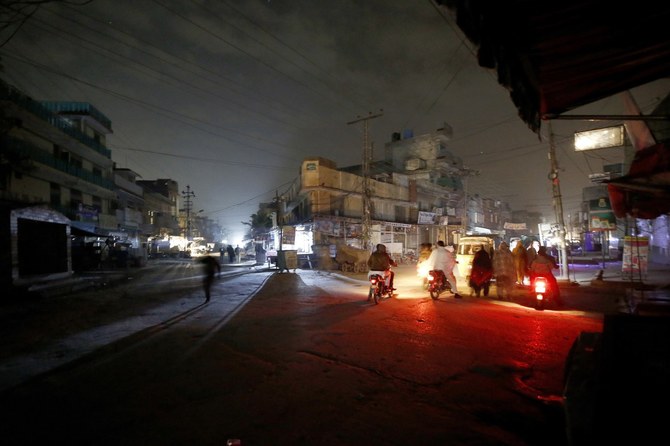
People are silhouetted on vehicles headlights on a dark street during widespread power outages in Rawalpindi, Pakistan, Sunday, Jan. 10, 2021. Pakistan's national power grid experienced a major breakdown late night on Saturday, leaving millions of people in darkness, local media reported. (AP)
Short Url
Updated 10 January 2021
Follow

Pakistan hit by nationwide power blackout 

  • Problem in one section of the grid can lead to cascading breakdowns countrywide, says minister   
  • This was Pakistan’s second major power breakdown in less than three years   

ISLAMABAD: Power was gradually being restored to major cities across Pakistan Sunday after it was hit by a massive electricity blackout, officials said.
The electricity distribution system in the nation of more than 210 million people is a complex — and delicate — web, and a problem in one section of the grid can lead to cascading breakdowns countrywide.
The latest blackout was caused by “an engineering fault” in southern Pakistan at 11:41 p.m. local time on Saturday (1841 GMT), which tripped the system and caused power plants to shut down, power minister Omar Ayub Khan told a press conference in Islamabad.
“Our experts are trying to determine the exact location of fault, which we have not been able to find out.”
Khan said that will take “another few hours as the area is still covered in dense fog,” and that power supply had been partially restored in most areas of Punjab, the most populous province, as well as the economic hub Karachi in the south.
The blackout had plunged all of Pakistan’s major cities into darkness, including the capital Islamabad, economic hub Karachi and the second-largest city Lahore.
There were no immediate reports of disruption at hospitals, which can often rely on back-up generators.
A water and power ministry spokesman said electricity had been restored to some parts of the country but many areas in Lahore, Pakistan’s second-largest city, and Karachi were still waiting.
Netblocks, which monitors Internet outages, said Internet connectivity in the country “collapsed” as a result of the blackout.
Connectivity was at “62 percent of ordinary levels,” it said in a tweet.
This was Pakistan’s second major power breakdown in less than three years. In May 2018, power supply was partially disrupted for more than nine hours.
In 2015, an apparent rebel attack on a key power line plunged around 80 percent of Pakistan into darkness.
That blackout, one of the worst in Pakistan’s history, caused electricity to be cut in major cities nationwide, including Islamabad, and even affected one of the country’s international airports. 


Azad Kashmir President Sultan Mahmood Chaudhry dies at 71

Updated 6 sec ago
Follow

Azad Kashmir President Sultan Mahmood Chaudhry dies at 71

  • Pakistan prime minister praises Chaudhry’s advocacy for the Kashmir cause
  • AJK Presidential Office says he died in Islamabad after a prolonged illness

ISLAMABAD: Barrister Sultan Mahmood Chaudhry, the president of Azad Jammu and Kashmir (AJK) and a veteran Kashmiri politician, died in Islamabad on Saturday after a prolonged illness, according to an official statement from the AJK Presidential Office. He was 71.

His funeral prayers will be held on Sunday at 4 p.m. at the Mirpur Cricket Stadium, the statement said.
Chaudhry, who served multiple times as prime minister and opposition leader in AJK before becoming president in 2021, was one of the region’s most prominent political figures and a long-time advocate of the Kashmir cause at international forums.

Prime Minister Shehbaz Sharif expressed deep sorrow over Chaudhry’s death in a statement.
“Barrister Sultan Mahmood Chaudhry was a farsighted political leader who spent his entire life in the service of the people of Azad Jammu and Kashmir,” Sharif said in a statement issued by his office.

Born on August 9, 1955, in Chichian, Mirpur, Chaudhry received his early education in his native village, completed his matriculation from Cantonment Public School Rawalpindi and graduated from Gordon College Rawalpindi before traveling to Britain, where he earned a law degree from Lincoln’s Inn. He returned to Pakistan in 1983 and entered active politics.

Over his political career, Chaudhry was elected nine times from his Mirpur constituency and held several senior positions, including prime minister of AJK in 1996 and opposition leader in the legislative assembly in 2001. He also led multiple political parties in AJK, including the Muslim Conference, the Peoples Party AJK chapter and the Pakistan Tehreek-e-Insaf AJK chapter.

The AJK Presidential Office said Chaudhry played a central role in raising the Kashmir issue globally, addressing international institutions, foreign governments and parliaments, and leading protests and demonstrations in cities including London, New York, Brussels and Berlin. It said he was the only AJK leader to have been permitted to visit Indian-administered Kashmir, where he addressed a public gathering at Srinagar’s Lal Chowk and met senior Kashmiri leaders.

Sharif said Chaudhry “raised a strong voice against Indian oppression of the Kashmiri people and in support of the Kashmir cause.”

“His service to the Kashmiri people and his struggle for the Kashmir cause will always be remembered in history,” he added.