

Egypt-based equestrians make it a mission to stamp out animal cruelty

Jill Barton and her husband Warren setup Egypt Equine Aid (EEA), a non-profit organization that rescues horses, donkeys and mules from maltreatment and gives them a better life. (Supplied)
Short Url
Updated 09 January 2021
Follow

Egypt-based equestrians make it a mission to stamp out animal cruelty

  • Jill and Warren Barton founded Egypt Equine Aid (EEA) in 2014 to care for maltreated horses, donkeys and mules 
  • The non-profit treats sick and injured animals while offering locals training in farriery, medical care and equestrian skills 

CAIRO: When Jill Barton and her husband first came to Cairo seven years ago to volunteer at a horse and donkey sanctuary, they had little inkling they would end up moving to Egypt permanently to care for rescued animals.

Originally from Australia, Barton and her husband Warren share a great love of horses. It is perhaps no surprise, then, that during a visit to Egypt in December 2013, the couple were moved by the suffering of the local horses and donkeys put to work in deprived rural areas.

The owners of these animals often cannot afford veterinary care, nor do they have the luxury of giving the animals time off to recover.

There are an estimated three million working horses and donkeys in Egypt used for transport, agriculture and tourism. According to Barton, many of them are the descendants of Australian “war horses” left behind after the First World War.

In mid-2014, Barton and her husband sold up their family home in Australia and almost all of their possessions before moving to Abu Sir on the outskirts of Cairo. They rented a property with nearby stables in close proximity to the region's famous archaeological sites, where horseback riding is popular.
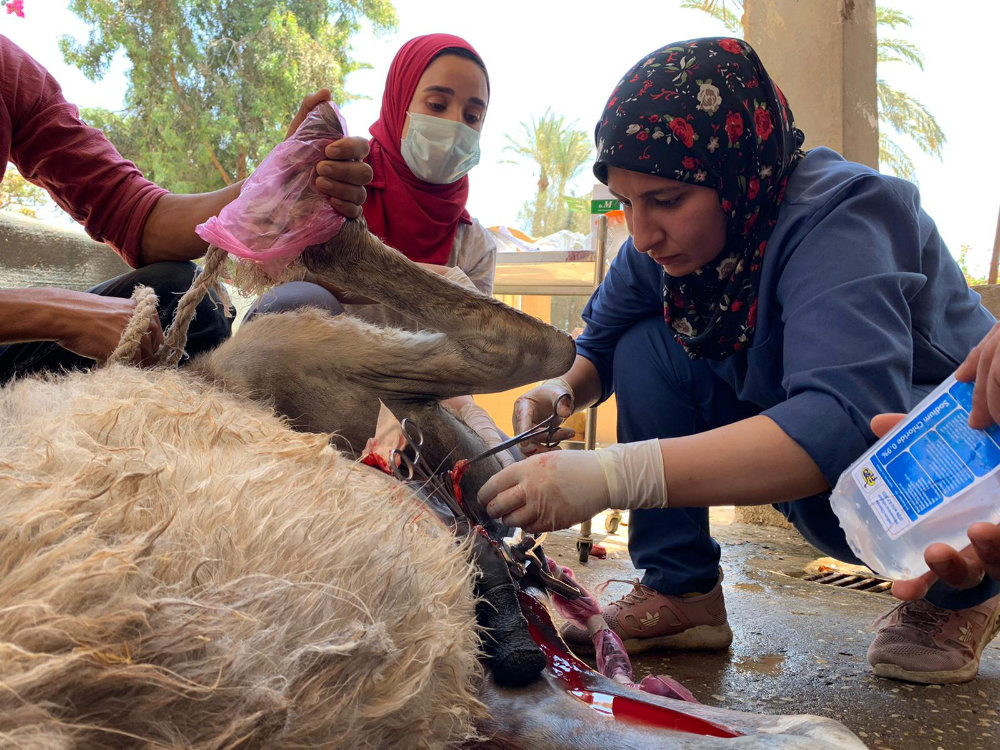


Abused horses and donkeys in Egypt find a champion in Egypt Equine Aid. (Supplied)

There, the couple established Egypt Equine Aid (EEA), a non-profit organization that rescues horses, donkeys and mules from maltreatment and gives them a better life. Horses and donkeys are particularly vulnerable to abuse, often overworked and with few facilities to guard their welfare.

“Treating sick animals at the local farms has a strong impact on the family businesses and animal welfare,” said Muriel Sacks, EEA’s veterinary technical director, who is originally from Switzerland.

EEA provides medical treatment to sick and injured animals on a non-profit basis. Arrangements are available for finding a new home (rehoming) for animals whose owners can no longer look after them. EEA also provides training for veterinarians and schemes for local workers in farriery (equine hoof care), medical care and equestrian skills.

“Local owners of donkeys and horses are shown how to treat, feed and work their (helpers) in the most sustainable way to keep them strong and healthy,” Sacks said.

The organization currently employs four veterinarians, four assistants and eight support staff, including grooms and administrators. It also has its own farrier team, trained by EEA, to work in the community.

FASTFACT

Egypt Equine Aid (EEA) rescues horses, donkeys and mules from maltreatment and gives them a better life.

“By offering jobs and education, we provide young men and women of the local community with an opportunity to have a reliable salary and strengthen the workforce,” Sacks said.

While initially self-funded, EEA has since received grants from the Australian Embassy in Cairo and is recognized among an international community of supporters and horse-lovers who send donations.

“We rely on our social media pages and other media to spread the word about our work,” Sacks said.

Now Barton and her team are looking to expand the reach of their project. Their future plans include increasing the capacity of the existing hospital to treat more animals.

In the mid- to long-term, they look forward to building a whole new hospital and fitting it with advanced technologies for specialist diagnostics, prolonged general anesthetics (medications that cause anesthesia) and more complex surgical procedures.


This report is being published by Arab News as a partner of the Middle East Exchange, which was launched by the Mohammed bin Rashid Al Maktoum Global Initiatives to reflect the vision of the UAE prime minister and ruler of Dubai to explore the possibility of changing the status of the Arab region.


US presses missile issue as new Iran talks to open in Geneva

Updated 2 min 45 sec ago
Follow

US presses missile issue as new Iran talks to open in Geneva

  • New round of negotiations in Geneva comes after the US carried out a massive military build-up in the region
  • Iran’s president reiterates Tehran is not seeking nuclear weapons in line with policy

GENEVA: The United States and Iran are set to hold indirect talks in Switzerland on Thursday aiming to strike a deal to avert fresh conflict and bring an end to weeks of threats.
The new round of negotiations in Geneva comes after the US carried out a massive military build-up in the region and President Donald Trump repeatedly threatened to strike Iran if a deal is not reached.
In his State of the Union address on Tuesday, Trump accused Iran of “pursuing sinister nuclear ambitions.”
He also claimed Tehran had “already developed missiles that can threaten Europe and our bases overseas, and they’re working to build missiles that will soon reach the United States of America.”
The Iranian foreign ministry called these claims “big lies.”

Iran president says ahead of US talks not seeking nuclear weapon ‘at all’

TEHRAN: Iran’s President Masoud Pezeshkian reiterated on Thursday that Tehran was not seeking nuclear weapons in line with the policy set by the country’s supreme leader.

“Our Supreme Leader has already stated that we will not have nuclear weapons at all,” Pezeshkian said in a speech.

“Even if I wanted to move in that direction, I could not — from a doctrinal standpoint, I would not be permitted.” — AFP


The maximum range of Iran’s missiles is 2,000 kilometers according to what Tehran has publicly disclosed. However the US Congressional Research Service estimates they top out at about 3,000 kilometers — less than a third of the distance to the continental United States.
The dispute between the countries mostly revolves around Iran’s nuclear program, which the West believes is aimed at building an atomic bomb but Tehran insists is peaceful.
However the US has also been pushing to discuss Iran’s ballistic missile program, as well as Tehran’s support for armed groups hostile toward Israel.
Secretary of State Marco Rubio warned that Iran must also negotiate on its missile program, calling Tehran’s refusal to discuss ballistic weapons “a big, big problem” on the eve of the talks.
He followed up by saying “the president wants diplomatic solutions.”
Iran has taken anything beyond the nuclear issue off the negotiating table and has demanded that the US sanctions crippling its economy be part of any agreement.
‘Neither war nor peace’
Iranian President Masoud Pezeshkian said on Wednesday he had a “favorable outlook for the negotiations” that could finally “move beyond this ‘neither war nor peace’ situation.”
Foreign Minister Abbas Araghchi, who is leading the Iranian delegation at the talks, has called them “a historic opportunity,” adding that a deal was “within reach.”
In a foreign ministry statement that followed a meeting with his Oman counterpart, Araghchi said the success of the US negotiations depend “on the seriousness of the other side and its avoidance of contradictory behavior and positions.”
The US will be represented by envoy Steve Witkoff and Jared Kushner, who is married to Trump’s daughter Ivanka.
The two countries held talks earlier this month in Oman, which is mediating the negotiations, then gathered for a second round in Geneva last week.
A previous attempt at negotiations collapsed when Israel launched surprise strikes on Iran last June, beginning a 12-day war that Washington briefly joined to bomb Iranian nuclear sites.
In January, fresh tensions between the US and Iran emerged after Tehran engaged in a bloody crackdown on widespread protests that have posed one of the greatest challenges to the Islamic republic since its inception.
Trump has threatened several times to intervene to “help” the Iranian people.
Emile Hokayem, senior fellow for Middle East security at the International Institute for Strategic Studies, said that “the region seems to expect a war at this point.”
In January, there was “a big push by a number of Middle Eastern states to convince the US not to” strike Iran.
“But there’s a lot of apprehension at this point, because the expectation is that this time” a war would be “bigger” than the one in June.
Tehran residents who spoke to AFP were divided as to whether there would be renewed conflict.
Homemaker Tayebeh noted that Trump had “said that war would be very bad for Iran.”
“There would be famine and people would suffer a lot. People are suffering now, but at least with war, our fate might be clear,” the 60-year-old said.