

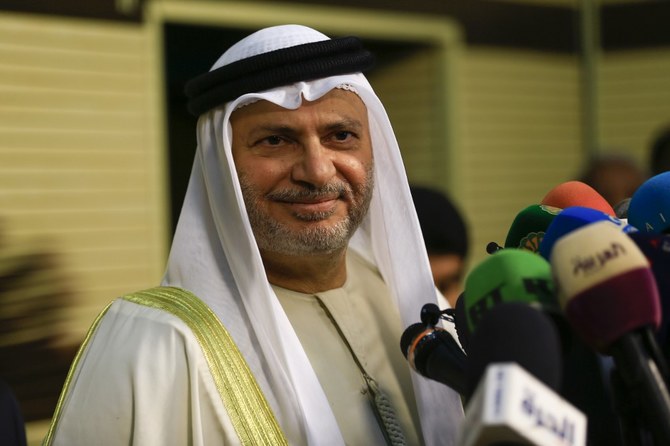

JEDDAH: The UAE Minister for Foreign Affairs Dr. Anwar Gargash has told Arab News that the GCC is “collectively in agreement with any threat towards its security” from Iran.
In a virtual press conference on Thursday, the minister addressed the 41st GCC summit held in AlUla where an agreement was signed to mend relations with Qatar, stressing the importance of solidarity, unity and security among the Gulf states.
He said that some differences remained in how to address major security issues in light of Doha’s recent relationship with Tehran.
Since 2017, Qatar has warmed its relationships with Iran and Turkey, which the four nations saw as undermining regional security. Relations with Iran and Turkey strengthened the quartet’s views of Qatar as a threat and increased tensions, especially over their support for Islamist groups, harboring extremists and interference with internal affairs.
The minister said that the UAE’s views on both Iran and Turkey are one of the same, highlighting that it is not just a Gulf issue but an Arab issue. He noted that Turkey is one of the largest trade partners in the Middle East and one that should respect Arab sovereignty and interests.
“We understand that the geostrategic consideration will take some time and we need to work together on these issues and I’m sure there’s a Qatari perspective there”
“The more the GCC is closer together, the more collectively it agrees on geo-strategic issues,” he said, adding that their target is to work towards closing the gap on these issues.
Gargash also announced that trade, transport and resumption of full diplomatic ties with Qatar will take place within a week after the signing of the AlUla Declaration.
“The declaration is a significant step at resolving a difficult and painful crisis within the GCC and the Gulf,” he said, adding: “I’m glad this is coming to an end but this crisis will also depend on the transparency and constructive approach that we deal with as we move forward.”
He noted that the resumption of trade, transport, investment and financial transactions will be easier to achieve compared to some of the other challenges as “confidence building measures will take a while.”
The minister added: “We realize that some issues are easier to fix. Some will take longer.”
To reach an agreement, the minister said that the topic of opening air space came up a few months ago but efforts were made by Saudi Arabia to address the more pressing issues and find a solution with the help of the US and gaining the support of the UAE.
He said the four nations “are in this together and we have to exit together.”
The minister emphasized efforts made by Kuwait and the US, noting that the rift has to run its course as this is an issue that is “within the family” and they will be working on rebuilding confidence between the two states.
Gargash said that the GCC will now “retool internally” and improve on issues of security, economy, science and more, adding that “a more stable and connected region is within our interest.”
Addressing the issue of the state-owned Al-Jazeera Arabic news channel, the minister said that the challenge will be the government’s perception of neutrality in the next coming period and is an internal matter that the Qataris have to face but “will depend on bilateral agreements between the states.”
On the topic of Israel, the minister said that he hopes the UAE’s support and signing of the Abraham Accords will change the sentiment in the region and “we hope to change the reality in the region,” but highlighted each country has its own sovereign decision towards the accords.
“This is not the first crisis in the GCC but the sharpest, and it is within our interest to not return to any small or large crisis,” said Gargash.
He stressed that “any crisis will leave issues of trust” noting that the 2017 crisis will push members to quickly address any future problems as “we genuinely want to restart and own what took place in AlUla.”

keywords


