Tanghdar: Shells and bullets are hurtling thicker and faster than ever between Indian and Pakistani forces across Kashmir’s cease-fire line, killing and maiming at a rate not seen in the entrenched conflict for two decades.
Zameer Ahmad was building a community bunker on the Indian side of the Himalayan region’s disputed frontier — officially known as the Line of Control (LoC) — when a sniper round fired from Pakistani-controlled territory struck the ground nearby.
Ahmad and co-worker Sadakat Hussain took cover behind a wall in the village of Simari. “We finally decided to try to run but we both got hit,” the 26-year-old told AFP.
Ahmad took a bullet in the stomach and now has to wear a colostomy bag. Hussain, 23, walks with a limp because of his wounded foot.
“It is scary, we just don’t know why the firing starts,” said Hussain, speaking during a visit to the frontier zone organized by the Indian military.
Similar stories are told on both sides of the 344-kilometer (213-mile) partition amid ever-tougher talk between the nuclear-armed neighbors, who have fought two wars over the region in the past seven decades.
Scores of civilians have been killed this year, and a UN observer mission car was struck by a bullet in December.
India says at least 10 of its forces have been killed by artillery shells or sniper fire from Pakistani-controlled Kashmir since the start of November.
It claims Pakistan violated a 2003 cease-fire accord more than 5,000 times last year — the highest since it started.
About 20 civilians were killed over the year, and incidents included drones dropping grenades into Indian territory.
Pakistan, in turn, accuses India of more than 3,000 violations in 12 months, leaving 29 dead, 250 civilians wounded, and hundreds of buildings destroyed or damaged.
Jura, just four kilometers from the LoC in the Neelum Valley, has been worst hit on the Pakistani side, authorities say.
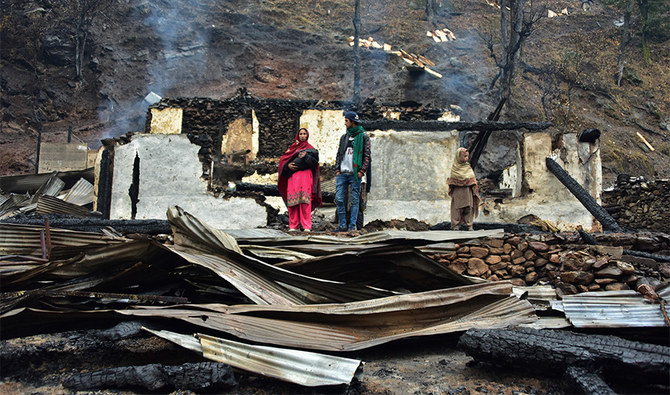
The shelling can last for hours or days, the town’s residents told AFP. Half the homes have blast damage and the farmland is pock-marked with craters.
“Most of the time we are shut up in our house. It is a war on us,” Amna Bibi, 40, said while washing clothes outside her home.
In the nearby village of Chilyana, the 500 inhabitants also rarely stray outside.
“When we leave in the morning to open our shop, we don’t know if we will return home,” Khawaja Zubair Ahmad said.
With each side blaming the other, the firing is at dangerous levels, according to observers.
Residents say tensions have risen since February 2019 when India staged an air attack on Pakistani territory after a suicide bomber killed 40 Indian troops in Kashmir.
Pakistan has been incensed by India’s revoking of Muslim-majority Kashmir’s semi-autonomous status in 2019 — “a move that Islamabad regarded as a particularly serious provocation,” said Michael Kugelman, a South Asia specialist at the Wilson Center think tank in Washington.
Residents on the Indian side say Pakistan deliberately cut off their water supply for farms. Pakistan bemoans the closure of a bridge that until last year was used to bring divided families together.
Khaleel ul Rahman, village head in Sudhpura on the Indian side, rushes to his cow shed and stays with the animals when a midnight barrage starts.
Sudhpura suffers badly even by Kashmir’s violent standards. It is surrounded on three sides by Pakistan-administered Kashmir and a third of the village is on the Pakistan side.
Shells also fall when markets are open and children are in school. “People just panic. It is like a stampede,” said local school principal Mansoor Ahmad.
Observers say though that neither India nor Pakistan is in a rush to find a solution.
“The history of India-Pakistan relations has had many more lows than highs, and right now we’re experiencing a particularly ugly, prolonged low,” said Kugelman. “There is little incentive on either side to dial down tensions.”
Rival prime ministers Narendra Modi and Imran Khan both offered better relations on taking office — Modi even visited Pakistan — but their gestures were rejected by the other.
Modi boasted last year that Pakistan would “bite the dust” in seven to 10 days if it started a new war. Khan replied last month that India would get a “befitting” response if it tried anything.


![]()

Unprecedented killing and maiming on the out-of-control line between India and Pakistan
Short Url
https://arab.news/ynwf2
Unprecedented killing and maiming on the out-of-control line between India and Pakistan
- Shells and bullets are hurtling thicker and faster than ever between Indian and Pakistani forces across Kashmir’s cease-fire line
- India claims Pakistan violated a 2003 cease-fire accord more than 5,000 times last year, Pakistan accuses India of more than 3,000 violations in 12 months
Latest updates


© 2026 SAUDI RESEARCH & PUBLISHING COMPANY, All Rights Reserved And subject to Terms of Use Agreement.