

Saudi Arabian Airlines reaffirms commitment to inclusivity on World Braille Day

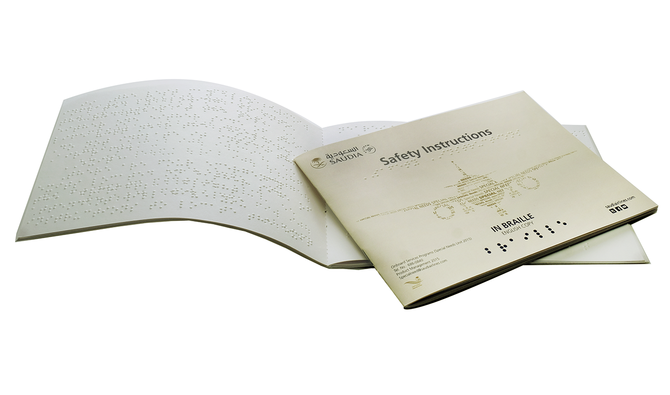
Saudia’s safety manual in Braille.
Short Url
Updated 06 January 2021
Follow

Saudi Arabian Airlines reaffirms commitment to inclusivity on World Braille Day

Saudi Arabian Airlines (Saudia), the national flag carrier of the Kingdom, observed World Braille Day on Jan. 4, reaffirming its commitment to providing services and products onboard for all visually impaired guests.

The airline’s cuisine options, as well as inflight entertainment, provide convenience and choice for guests who require Braille offerings. Inflight entertainment options include audio descriptive movies and content onboard. 

Guests can select a Braille cuisine option at the time of booking through the airline’s website or by calling Saudia.

The airline provides services such as elevators, special meals and menus, safety procedures and magazines printed in Braille for guests.

Saudia prints all material in-house with its full-spectrum Braille printer in order to transform all materials and applications in Braille for inflight use. 

Chief Executive Officer of Saudia Captain Ibrahim S. Koshy said: “Saudia is committed to being an inclusive airline, providing amenities, services and support for all guests. We take pride in making our very best efforts to provide a comfortable, welcoming and hospitable experience at each point of the journey.”

He added: “We invite all of our guests to explore the various options and flexible choices available to customize the travel experience and tailor requests to suit our guests’ requirements.”

In 2015, Saudia became the world’s first airline to introduce a comprehensive flight guide in Braille for visually impaired and blind passengers.

Saudi Arabia’s national flag carrier is an award-winning airline, and is one of the first carriers to be established in the Middle East region. Saudia has recently been ranked as a “Five-Star Global Airline” by the Airline Passenger Experience Association (APEX).

In recent years, the airline has invested significantly in its fleet of 145 narrow and widebody aircraft and operates one of the youngest fleets in the skies, with an average aircraft age of five years. 

The airline route network includes more than 95 destinations across four continents to all 28 domestic airports in the Kingdom.

Deep-cleaning sanitization protocols are in full effect after every flight.


More crop per drop: NADEC and EF Polymer deploy breakthrough technology to cut agricultural water use by 40%

Updated 14 January 2026
Follow

More crop per drop: NADEC and EF Polymer deploy breakthrough technology to cut agricultural water use by 40%

Following a strategic technology-scouting framework led by Universal Materials Incubator, the National Agricultural Development Company has entered into a partnership to launch large-scale field trials of EF Polymer, marking a significant step in deploying deep-technology solutions to strengthen the Kingdom’s food and water security.

The collaboration initiates field trials of EF Polymer’s proprietary solution — a 100 percent organic, biodegradable powder that performs like a “soil battery” upcycled from food waste. Engineered to address water scarcity in arid and semi-arid regions, the material can absorb up to 50 times its own weight in water and gradually release moisture directly to plant roots. This mechanism has the potential to reduce irrigation water use by up to 40 percent, while enhancing crop yield and long-term agricultural productivity.

Beyond water efficiency, EF Polymer improves nutrient retention by minimizing fertilizer leaching, thereby reducing overall fertilizer requirements. After approximately one year in the soil, the material fully biodegrades into organic carbon, organic matter, and trace nutrients such as magnesium, calcium, and nitrogen — contributing directly to improved soil health and long-term fertility.

The solution is affordable, easy to apply, and suitable for a wide range of crops, making it viable both for individual farmers and for industrial-scale agricultural operations such as NADEC’s. 

EF Polymer has already achieved significant commercial adoption across multiple global markets, including Japan, the US, India and Turkiye, where it is actively used by farmers and agribusiness operators to improve water efficiency, soil health, and crop resilience under varying climatic conditions.

Its organic credentials are certified by OMRI and Ecocert, reinforcing its alignment with sustainable and regenerative agricultural practices.

The stakes for this alliance are high. By 2030, global freshwater demand is projected to exceed supply by 40 percent. In Saudi Arabia, the challenge is localized but intense: the agricultural sector alone consumes approximately 11.4 billion cubic meters of water annually. This partnership underscores NADEC’s commitment to adopting innovative, scalable technologies that conserve natural resources while supporting resilient food systems across the Kingdom.

Mohamed Al-Rajhi, VP of supply chain sector at NADEC, said: “Strategic agriculture today requires a long-term commitment to soil health and resource circularity. NADEC is leading the shift toward regenerative practices that restore our natural capital rather than merely consuming it. By diversifying our crop portfolio and investing in closed-loop nutrient management, we are insulating our operations against global price volatility and environmental shifts.”

“We are aggressively deploying AI-driven irrigation systems and satellite-based crop monitoring to optimize every drop of water and every hectare of land. This strategic pivot toward agri-digitization allows us to mitigate climate risks in real-time while significantly reducing our carbon footprint. Our commitment to sustainability is our greatest competitive advantage, ensuring that NADEC remains the cornerstone of the Middle East’s agri-food sector for decades to come. These trials focus on strategic scalable crops like wheat and olive trees to ensure the future of the Kingdom’s food security is both sustainable and locally rooted,” he added.

Strategic trial milestones:

  • Wheat: Trials have commenced to demonstrate water retention in this water-intensive crop.
  • Olive and blueberry: Specialized testing is scheduled for March to evaluate yield improvements and nutrient efficiency.

This collaboration supports Saudi Vision 2030 goals of reducing non-renewable groundwater use by 90 percent.