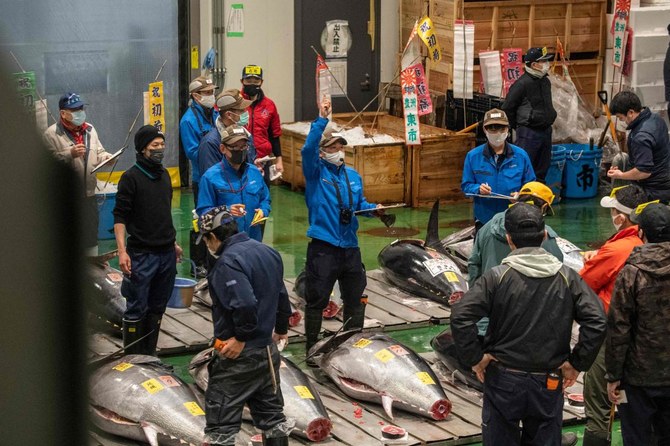
TOKYO: Tokyo’s annual New Year tuna auction ended Tuesday without the usual jaw-dropping bidding war, with the country’s “Tuna King” holding back on gunning for the top fish, citing the pandemic woes affecting the restaurant industry.
The most expensive fish of the day — a 208-kilogram (459-pound) bluefin caught off the northern Aomori region of Japan, known for its quality tuna — was bought by another bidder for $202,000.
That is just a fraction of the millions of dollars that sushi businessman and self-proclaimed “Tuna King” Kiyoshi Kimura has shelled out in recent years to secure the bragging rights that come with buying the auction’s top tuna.
Last year, Kimura paid $1.8 million for a 276-kilogram (608-pound) bluefin, and in 2019 he paid a record $3.1 million for a 278-kilogram (613-pound) fish.
But Kimura said he wanted to show restraint this year as the raging pandemic has caused so much suffering to restaurants and other businesses.
“I didn’t go for the highest bid this year because this is the time for self-control,” Kimura told journalists who gathered to see him after the pre-dawn auction at the Toyosu fish market.
“I didn’t think it was appropriate to go all festive this time,” he said.
Kimura usually uses his purchases to secure national news coverage for himself and his successful sushi chain.
Normally, after winning the annual bidding war and taking his expensive investment back to one of his restaurants, he fillets the fish with a sword-like blade, creates sushi out of it and serves it to customers at no extra charge, all in front of an army of television cameras.
The most expensive tuna this year was acquired jointly by a famous wholesaler named Yukitaka Yamaguchi, a frequent guest on television shows who supplies top sushi restaurants, and a major food business, according to local media.
For this year’s auction, fish wholesalers wore masks and sanitized their hands as they examined the texture of tail meat from fresh and frozen tuna by touching, smelling and sometimes tasting pieces of it.
Spectators were not allowed to attend the event, now held at a market called Toyosu after the city’s world-famous fish market relocated there from its old site, Tsukiji, in 2018.

Coronavirus pandemic overshadows Japan’s New Year tuna auction
https://arab.news/rauna
Coronavirus pandemic overshadows Japan’s New Year tuna auction
- The most expensive fish of the day was bought for $202,000
- Spectators were not allowed to attend the event, now held at a market called Toyosu
Arts festival’s decision to exclude Palestinian author spurs boycott
- A Macquarie University academic who researches Islamophobia and Palestine, Abdel-Fattah responded saying it was “a blatant and shameless act of anti-Palestinian racism and censorship,” with her lawyers issuing a letter to the festival
SYDENY: A top Australian arts festival has seen the withdrawal of dozens of writers in a backlash against its decision to bar an Australian Palestinian author after the Bondi Beach mass shooting, as moves to curb antisemitism spur free speech concerns.
The shooting which killed 15 people at a Jewish Hanukkah celebration at Sydney’s Bondi Beach on Dec. 14 sparked nationwide calls to tackle antisemitism. Police say the alleged gunmen were inspired by Daesh.
The Adelaide Festival board said last Thursday it would disinvite Randa Abdel-Fattah from February’s Writers Week in the state of South Australia because “it would not be culturally sensitive to continue to program her at this unprecedented time so soon after Bondi.”
FASTFACTS
• Abdel-Fattah responded, saying it was ‘a blatant and shameless act of anti-Palestinian racism and censorship.’
• Around 50 authors have since withdrawn from the festival in protest, leaving it in doubt, local media reported.
A Macquarie University academic who researches Islamophobia and Palestine, Abdel-Fattah responded saying it was “a blatant and shameless act of anti-Palestinian racism and censorship,” with her lawyers issuing a letter to the festival.
Around 50 authors have since withdrawn from the festival in protest, leaving it in doubt, local media reported.
Among the boycotting authors, Kathy Lette wrote on social media the decision to bar Abdel-Fattah “sends a divisive and plainly discriminatory message that platforming Australian Palestinians is ‘culturally insensitive.'”
The Adelaide Festival said in a statement on Monday that three board members and the chairperson had resigned. The festival’s executive director, Julian Hobba, said the arts body was “navigating a complex moment.”
a complex and unprecedented moment” after the “significant community response” to the board decision.
In the days after the Bondi Beach attack, Jewish community groups and the Israeli government criticized Prime Minister Anthony Albanese for failing to act on a rise in antisemitic attacks and criticized protest marches against Israel’s war in Gaza held since 2023.
Albanese said last week a Royal Commission will consider the events of the shooting as well as antisemitism and social cohesion in Australia. Albanese said on Monday he would recall parliament next week to pass tougher hate speech laws.
On Monday, New South Wales state premier Chris Minns announced new rules that would allow local councils to cut off power and water to illegally operating prayer halls.
Minns said the new rules were prompted by the difficulty in closing a prayer hall in Sydney linked to a cleric found by a court to have made statements intimidating Jewish Australians.
The mayor of the western Sydney suburb of Fairfield said the rules were ill-considered and councils should not be responsible for determining hate speech.
“Freedom of speech is something that should always be allowed, as long as it is done in a peaceful way,” Mayor Frank Carbone told Reuters.


