Record $3.1 million paid in New Year’s tuna auction at Japan’s new market

1 / 3
Kiyomura Co’s President Kiyoshi Kimura, center, who runs a chain of sushi restaurants Sushi Zanmai, poses with a 278kg bluefin tuna, priced with a ¥333.6 million bid at the Toyosu fish market’s first tuna auction this year. (Reuters)
2 / 3
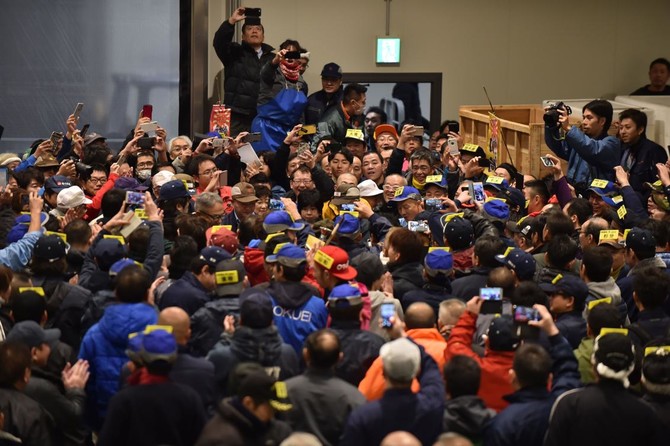
Wholesalers participate in the new year’s first auction of tuna at the Toyosu Market in Tokyo on January 5. (AFP)
3 / 3
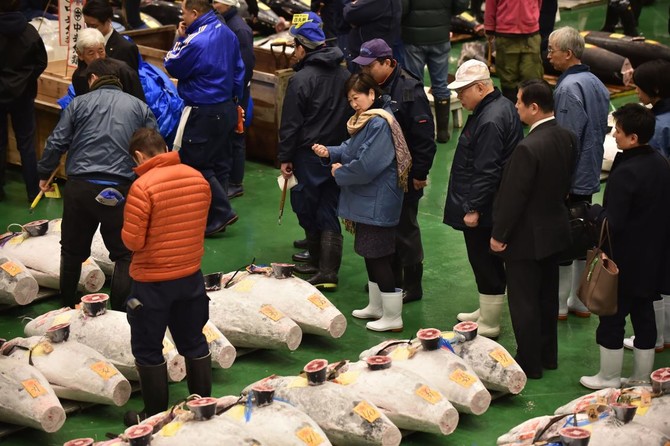
Tokyo Governor Yuriko Koike, center, inspects the new year’s first auction of frozen tuna at the Toyosu Market in Tokyo on January 5. (AFP)
Updated 05 January 2019
Follow

Record $3.1 million paid in New Year’s tuna auction at Japan’s new market

  • ‘It’s the best tuna. I was able to buy a delicious, super fresh tuna’
  • Japan consumers a large portion of the global bluefin catch

TOKYO: A Japanese sushi entrepreneur paid a record $3.1 million for a giant tuna Saturday as Tokyo’s new fish market, which replaced the world-famous Tsukiji late last year, held its first pre-dawn New Year’s auction.
Bidding stopped at a whopping ¥333.6 million for the enormous 278-kilogram fish — an endangered species — that was caught off Japan’s northern coast.
Self-styled “Tuna King” Kiyoshi Kimura paid the top price, which doubled the previous record of 155 million yen also paid by him in 2013.
“It’s the best tuna. I was able to buy a delicious, super fresh tuna,” the sushi restaurant chain owner proudly told reporters.
“The price was higher than originally thought, but I hope our customers will eat this excellent tuna,” Kimura said after the auction.
Tsukiji — the world’s biggest fish market and a popular tourist attraction in an area packed with restaurants and shops — moved in October to Toyosu, a former gas plant a bit further east.
Opened in 1935, Tsukiji was best known for its pre-dawn daily auctions of tuna, caught from all corners of the world, for use by everyone from top Michelin-star sushi chefs to ordinary grocery stores.
Especially at the first auction of the new year, wholesalers and sushi tycoons have been known to pay eye-watering prices for the biggest and best fish.
Despite the relocation, the auction ritual remained intact: before dawn, buyers in rubber boots were inspecting the quality of the giant fresh and frozen tunas by examining the neatly cut tail end with flashlights and rubbing slices between their fingers.
At 5:10 am, handbells rang to signal the auction was underway and the air filled with the sound of auctioneers yelling prices at buyers, who raised fingers to indicate interest.
In a roar of wholesalers surrounding the day’s best tuna, an auctioneer hammered the top price as the Kimura side outbid his rival wholesaler in a thrilling head-to-head battle.
Japan consumers a large portion of the global bluefin catch, a highly prized sushi ingredient known in Japan as “kuro maguro” (black tuna) and dubbed by sushi connoisseurs as the “black diamond” because of its scarcity.
A single piece of “otoro,” or the fish’s fatty underbelly, can cost dozens of dollars at high-end Tokyo restaurants.
The new market has already opened its auction warehouse to visitors to witness the organized pre-dawn chaos from a balcony, hoping to take over a must-see spot for tourists from Tsukiji.
“Finally, the first New Year auction was held at Toyosu market,” said Yoshihiko Otaki, a market official.
“We have a lot of tuna here like we did in Tsukiji,” he said.
Tokyo governor Yuriko Koike, wearing white rubber boots, said: “I sincerely hope this market will be loved by many people.”
The relocation was a lengthy and controversial process.
Few would contest the fact that Tsukiji was past its prime, and there were concerns about outdated fire regulations and hygiene controls.
In contrast, the new market, located around two kilometers to the east at Toyosu, boasts state-of-the-art refrigeration facilities and is nearly twice as big again as Tsukiji.
But Toyosu is located on the site of a former gas plant and the soil was found to be contaminated, forcing local authorities to spend millions of dollars to clean it up and delaying the move.


How TV shows like ‘Mo’ and ‘Muslim Matchmaker’ allow Arab and Muslim Americans to tell their stories

(Clockwise) Hoda Abrahim, founder and CEO of, "Love, Inshallah,", Actor Ramy Youssef, Mohammed Amer and Yasmin Elhady. (AP)
Updated 28 December 2025
Follow

How TV shows like ‘Mo’ and ‘Muslim Matchmaker’ allow Arab and Muslim Americans to tell their stories

  • In addition to “Mo,” shows like “Muslim Matchmaker,” hosted by matchmakers Hoda Abrahim and Yasmin Elhady, connect Muslim Americans from around the country with the goal of finding a spouse

COLUMBUS, Ohio: Whether it’s stand-up comedy specials or a dramedy series, when Muslim American Mo Amer sets out to create, he writes what he knows.
The comedian, writer and actor of Palestinian descent has received critical acclaim for it, too. The second season of Amer’s “Mo” documents Mo Najjar and his family’s tumultuous journey reaching asylum in the United States as Palestinian refugees.
Amer’s show is part of an ongoing wave of television from Arab American and Muslim American creators who are telling nuanced, complicated stories about identity without falling into stereotypes that Western media has historically portrayed.
“Whenever you want to make a grounded show that feels very real and authentic to the story and their cultural background, you write to that,” Amer told The Associated Press. “And once you do that, it just feels very natural, and when you accomplish that, other people can see themselves very easily.”
At the start of its second season, viewers find Najjar running a falafel taco stand in Mexico after he was locked in a van transporting stolen olive trees across the US-Mexico border. Najjar was trying to retrieve the olive trees and return them to the farm where he, his mother and brother are attempting to build an olive oil business.
Both seasons of “Mo” were smash hits on Netflix. The first season was awarded a Peabody. His third comedy special on Netflix, “Mo Amer: Wild World,” premiered in October.
Narratively, the second season ends before the Hamas attack in Israel on Oct. 7, 2023, but the series itself doesn’t shy away from addressing Israeli-Palestinian relations, the ongoing conflict in Gaza or what it’s like for asylum seekers detained in US Immigration and Customs Enforcement detention centers.
In addition to “Mo,” shows like “Muslim Matchmaker,” hosted by matchmakers Hoda Abrahim and Yasmin Elhady, connect Muslim Americans from around the country with the goal of finding a spouse.
The animated series, “#1 Happy Family USA,” created by Ramy Youssef, who worked with Amer to create “Mo,” and Pam Brady, follows an Egyptian American Muslim family navigating life in New Jersey after the 9/11 terrorists attack in New York.
Current events have an influence
The key to understanding the ways in which Arab or Muslim Americans have been represented on screen is to be aware of the “historical, political, cultural and social contexts” in which the content was created, said Sahar Mohamed Khamis, a University of Maryland professor who studies Arab and Muslim representation in media.
After the 9/11 attacks, Arabs and Muslims became the villains in many American films and TV shows. The ethnic background of Arabs and the religion of Islam were portrayed as synonymous, too, Khamis said. The villain, Khamis said, is often a man with brown skin with an Arab-sounding name.
A show like “Muslim Matchmaker” flips this narrative on its head, Elhady said, by showing the ethnic diversity of Muslim Americans.
“It’s really important to have shows that show us as everyday Americans,” said Elhady, who is Egyptian and Libyan American, “but also as people that live in different places and have kind of sometimes dual realities and a foot in the East and a foot in the West and the reality of really negotiating that context.”
Before 9/11, people living in the Middle East were often portrayed to Western audiences as exotic beings, living in tents in the desert and riding camels. Women often had little to no agency in these media depictions and were “confined to the harem” — a secluded location for women in a traditional Muslim home.
This idea, Khamis said, harkens back to the term “orientalism,” which Palestinian American academic, political activist and literary critic Edward Said coined in his 1978 book of the same name.
Khamis said, pointing to countries like Britain and France, the portrayal in media of people from the region was “created and manufactured, not by the people themselves, but through the gaze of an outsider. The outsiders in this case, he said, were the colonial/imperialist powers that were actually controlling these lands for long periods of time.”
Among those who study the ways Arabs have been depicted on Western television, a common critique is that the characters are “bombers, billionaires or belly dancers,” she said.
The limits of representation
Sanaz Alesafar, executive director of Storyline Partners and an Iranian American, said she has seen some “wins” with regard to Arab representation in Hollywood, noting the success of “Mo,” “Muslim Matchmaker” and “#1 Happy Family USA.” Storyline Partners helps writers, showrunners, executives and creators check the historical and cultural backgrounds of their characters and narratives to assure they’re represented fairly and that one creator’s ideas don’t infringe upon another’s.
Alesafar argues there is still a need for diverse stories told about people living in the Middle East and the English-speaking diaspora, written and produced by people from those backgrounds.
“In the popular imagination and popular culture, we’re still siloed in really harmful ways,” she said. “Yes, we’re having these wins and these are incredible, but that decision-making and centers of power still are relegating us to these tropes and these stereotypes.”
Deana Nassar, an Egyptian American who is head of creative talent at film production company Alamiya Filmed Entertainment, said it’s important for her children to see themselves reflected on screen “for their own self image.” Nassar said she would like to see a diverse group of people in decision-making roles in Hollywood. Without that, it’s “a clear indication that representation is just not going to get us all the way there,” she said.
Representation can impact audiences’ opinions on public policy, too, according to a recent study by the Institute for Social Policy and Understanding. Results showed that the participants who witnessed positive representation of Muslims were less likely to support anti-democratic and anti-Muslim policies compared to those who viewed negative representations.
For Amer, limitations to representation come from the decision-makers who greenlight projects, not from creators. He said the success of shows like his and others are a “start,” but he wants to see more industry recognition for his work and the work of others like him.
“That’s the thing, like just keep writing, that’s all it’s about,” he said. “Just keep creating and keep making and thankfully I have a really deep well for that, so I’m very excited about the next things,” he said.