

Italy allows ship to bring migrants ashore

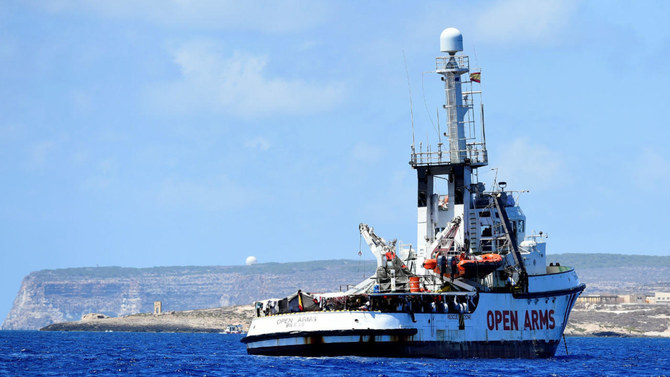
Spanish migrant rescue ship Open Arms with the Door to Europe monument in the background, Lampedusa, Italy, August 16, 2019. (Reuters)
Short Url
Updated 04 January 2021
Follow

Italy allows ship to bring migrants ashore

  • Spanish NGO’s Open Arms vessel rescued 169 people in the Mediterranean on Dec. 31 and 96 on Jan. 2
  • The migrants will be taken to a quarantine ship moored off Porto Empedocle

ROME: Italy has authorised a boat operated by the Spanish NGO Open Arms to disembark 265 migrants, including 63 minors, in Porto Empedocle, on the southern Sicilian coast.

The NGO’s vessel rescued 169 people in the Mediterranean on Dec. 31 and 96 on Jan. 2. They include at least fourteen women, one of them nine months pregnant, and 40 unaccompanied teenagers. The migrants will be taken to a quarantine ship moored off Porto Empedocle.

“Most of the migrants are Eritreans, but they also come from other countries such as Sudan, Bangladesh and Ethiopia. Those people are fleeing from Libyan detention centers, where they have been subjected to violence. All these men and women bear on their bodies the signs of the months, some of them even years, which they spent in those places, where they were held in inhumane conditions,” Monica Alfonsi, Open Arms representative in Italy told Arab News.

The rescued migrants had been waiting nearly four days on the Spanish humanitarian ship for a European country to authorise them to land, amid worsening sea conditions. Malta had refused permission for the migrants to disembark.

Most of the people aboard set off in dinghies from the Libyan city of Sabratha, about 60 kilometres west of Tripoli, on the morning of Dec. 30.

“They had a very difficult time because the weather conditions were very bad, with waves one and a half meters high and pouring rain,” Alfonsi said.

A total of 34,134 migrants arrived in Italy in 2020, almost three times as many as in the previous year, according to data published by the Italian Ministry of the Interior.

The Italian government has repeatedly asked the EU to launch a joint management plan for the migrants in the waters of the Central Mediterranean.

Italian Foreign Minister Luigi Di Maio yet again requested this week that the European Commission show courage to approve “a common response to the issue of immigration” and cease to be “immobile” while tens of thousands of people flee their home countries and try to reach Europe.

Australia to deploy long-range reconnaissance plane to Gulf

Updated 5 sec ago
Follow

Australia to deploy long-range reconnaissance plane to Gulf

  • The government says there are about 115,000 Australian nationals across the Middle East, of whom about 2,600 have returned home.

SYDNEY: Australia will deploy a long-range military reconnaissance plane to the Gulf to protect civilians, Prime Minister Anthony Albanese said Tuesday.
An E-7A Wedgetail aircraft and supporting defense force personnel will be sent for an initial period of four weeks to help “protect and secure the airspace above the Gulf,” Albanese told a news conference.
Australia also plans to provide advanced, medium-range air-to-air missiles to the United Arab Emirates “in response to a request,” the prime minister said.
The UAE, in which there are an estimated 24,000 Australians, has shot down more than 1,500 rockets and drones fired by Iran in reprisal following US-Israeli strikes, he said.
Albanese said he decided to send the advanced radar surveillance plane to the Gulf following a discussion with UAE President Mohammed bin Zayed Al Nahyan.
“The first priority of my government is, and always will be, to keep Australians safe,” the prime minister said.
“Helping Australians means also helping the UAE and other Gulf nations to defend themselves against what are unprovoked attacks,” he added.
“My government has been clear that we’re not taking offensive action against Iran, and we’ve been clear that we are not deploying Australian troops on the ground in Iran.”
The government says there are about 115,000 Australian nationals across the Middle East, of whom about 2,600 have returned home.
“Significant challenges remain, and further work is underway to support those still seeking to leave,” Albanese said.
Australia said last week it had deployed a heavy transport plane and a fuel transport plane to the Middle East as part of plans to get its citizens out of the region.
Canberra has been careful to make clear that its forces are not engaging in offensive operations against Iran.
On Friday, Albanese revealed that Australian military personnel were aboard an American submarine that sank an Iranian navy ship off Sri Lanka.
The personnel were on the submarine as part of training arrangements under AUKUS, a multi-decade defense pact with Britain and the United States, he said, stressing that they did not take part in the attack.