

In landmark ruling, Pakistan court outlaws invasive test for rape victims

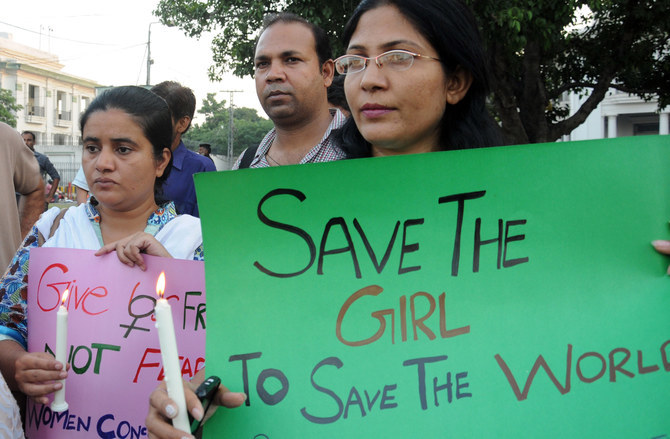
In this file photo, Pakistani NGOs workers carry placards during a protest against the rape of a five year old girl, in Lahore on September 19, 2013. (File/ AFP)
Short Url
Updated 05 January 2021
Follow

In landmark ruling, Pakistan court outlaws invasive test for rape victims

  • Verdict comes after two petitions against 'virginity testing' in Punjab province this year in a bid to stop a practice that dates back to British colonial rule
  • The United Nations and women rights activists have for years said the test is painful, inaccurate and a violation of human rights

ISLAMABAD: A court in Pakistan's most populous province of Punjab on Monday banned an outdated medical procedure in which rape victims are subjected to an invasive virginity examination, commonly referred to as the two‐finger and hymen test.

The United Nations and women rights activists have for years said the test is painful, inaccurate and a violation of human rights, with no place in modern society. The World Health Organization has declared the test "unscientific, medically unnecessary and unreliable." Neighbouring India banned the test in 2013 and Bangladesh in 2018.

The Lahore High Court announced its judgment in two public interest petitions challenging virginity testing in Punjab province, home to about 110 million people.

"In the detailed judgement authored by Justice Ayesha Malik, it has been held that the practice of virginity testing is unscientific and has no forensic value in cases of sexual violence," the petitioners said in a statement released after the verdict. "These virginity tests have been declared unconstitutional, against the right to life and dignity and
discriminatory and therefore contrary to Articles 9, 14, and 25 of the Constitution."

"The government of Punjab has been directed to take necessary steps to ensure that virginity tests are not carried out in medico‐legal examination of victims of rape and sexual abuse and to devise appropriate medico‐legal protocols and guidelines, along with standard operating procedures, in line with international practices," the statement said. 

Supporters of the test have argued it can evaluate a woman's promiscuity and her "honour" but backlash to the test has been growing for years, with critics saying it provides no useful information and is traumatic for survivors of sexual violence.

Punjab health authorities admitted in September the test held "limited evidentiary value." 


Pakistan deputy PM directs authorities to monitor food prices ahead of Ramadan 

Updated 27 January 2026
Follow

Pakistan deputy PM directs authorities to monitor food prices ahead of Ramadan 

  • Prices of essential food items surge during holy month of Ramadan due to hoarding, profiteering by traders
  • Deputy PM Ishaq Dar directs authorities to prevent artificial price hikes, exploitation of consumers in Ramadan

ISLAMABAD: Pakistan’s Deputy Prime Minister Ishaq Dar on Tuesday directed authorities to monitor prices of essential food items ahead of Ramadan to prevent artificial price hikes and consumers from getting exploited, his office said. 

Pakistani increasingly shop for essential food items during the holy month of Ramadan, as millions across the country fast from dawn till sunset. Prices of essential food items surge during the holy month every year as traders often indulge in hoarding and profiteering. 

Dar chaired a meeting to review the availability and prices of essential commodities across the country on Tuesday, his office said. 

“DPM/FM [foreign minister] directed federal & provincial authorities to continue close monitoring, particularly in view of the approaching month of Ramazan, to prevent any artificial price hike or exploitation of consumers by unscrupulous elements,” Dar’s office said in a statement.

A central moon sighting committee in Pakistan, the Ruet-e-Hilal Committee, determines when Ramadan begins. The Islamic month is expected to start this year after mid-February, around Feb. 17 or Feb. 18.

Pakistan’s government also announces subsidies for the masses during the holy month to lower the prices of essential food items. 

In 2024, the Shehbaz Sharif-led government announced a Ramadan package comprising a subsidy of $26.8 million (Rs7.5 billion) to lower the prices of essential items for over 30,96,00,000 families.