

US aircraft carrier to stay in Gulf: Pentagon

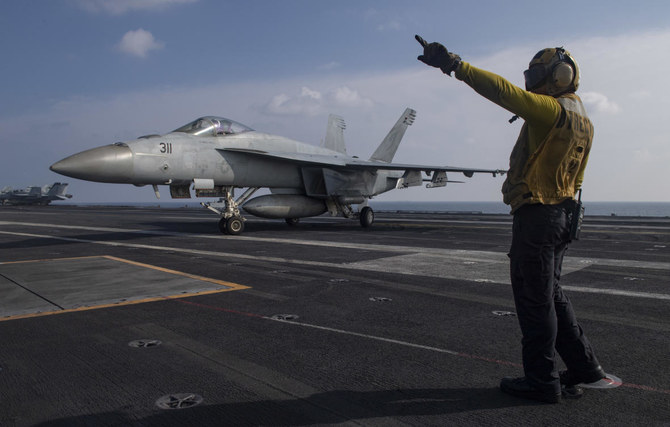
The USS Nimitz will remain in the Arabian Gulf as a “de-escalatory” measure amid high Iran-US tensions. (File/AP)
Short Url
Updated 04 January 2021
Follow

US aircraft carrier to stay in Gulf: Pentagon

  • 'No one should doubt the resolve of the United States of America': US acting defence secretary
  • Iran-US tensions are high due in part to the one-year anniversary of the death of Iranian commander Qassem Soleimani

WASHINGTONG: The US reversed a decision to bring an aircraft carrier home from the Gulf Sunday, with the Pentagon saying that due to “recent threats” by Iran the USS Nimitz would stay in position.

The Nimitz has been patrolling Gulf waters since late November, but in a statement issued on December 31, acting US defense secretary Christopher C. Miller ordered the vessel to “transit directly home to complete a nearly 10-month deployment.”
The New York Times, quoting US officials, said this move was part of a “de-escalatory” signal to Tehran to avoid a conflict in President Donald Trump’s last days in office.
However, Miller issued a new statement changing course on Sunday.
“Due to the recent threats issued by Iranian leaders against President Trump and other US government officials, I have ordered the USS Nimitz to halt its routine redeployment,” he said.
“The USS Nimitz will now remain on station in the US Central Command area of operations. No one should doubt the resolve of the United States of America.”
He did not elaborate on the threats involved.
His statement came one year after a US drone strike in Baghdad killed Iran’s revered commander Qasem Soleimani and his Iraqi lieutenant Abu Mahdi Al-Muhandis.
Thousands of Iraqi mourners chanted “revenge” and “no to America” on Sunday.
The anniversary of the Baghdad drone strike was also marked in recent days across Iran and by supporters in Syria, Lebanon, Yemen and elsewhere.
Trump unilaterally withdrew the US from a landmark nuclear deal with Iran and world powers in 2018 and launched a “maximum pressure” campaign against Tehran, reimposing and reinforcing crippling sanctions.
The two countries have twice come to the brink of war since June 2019, especially following the killing of Soleimani.
Days after the Soleimani assassination, Iran launched a volley of missiles at Iraqi bases housing US and other coalition troops, with Trump refraining from any further military response.


Syrian government says it controls prison in Raqqa with Daesh-linked detainees

Updated 23 January 2026
Follow

Syrian government says it controls prison in Raqqa with Daesh-linked detainees

  • Prison holds detainees linked to Daesh, and witnessed ⁠clashes in its vicinity between advancing Syrian government forces and Kurdish fighters

Syria’s Interior Ministry said on Friday it had taken over Al-Aktan prison in the city of Raqqa ​in northeastern Syria, a facility that was formerly under the control of Kurdish-led Syrian Democratic Forces (SDF).

The prison has been holding detainees linked to the militant group Daesh, and witnessed clashes in its vicinity this week between advancing Syrian government forces and the SDF.

It ‌was not ‌immediately clear how many ‌Daesh ⁠detainees ​remain in Al-Aktan ‌prison as the US military has started transferring up to 7,000 prisoners linked to the militant Islamist group from Syrian jails to neighboring Iraq. US officials say the detainees are citizens of many countries, including in Europe.

“Specialized teams were ⁠formed from the counter-terrorism department and other relevant authorities to ‌take over the tasks of guarding ‍and securing the prison ‍and controlling the security situation inside it,” ‍the Interior Ministry said in a statement.

Under a sweeping integration deal agreed on Sunday, responsibility for prisons housing Daesh detainees was meant to be transferred to ​the Syrian government.

The SDF said on Monday it was battling Syrian government forces near ⁠Al-Aktan and that the seizure of the prison by the government forces “could have serious security repercussions that threaten stability and pave the way for a return to chaos and terrorism.”

The US transfer of Daesh prisoners follows the rapid collapse of Kurdish-led forces in northeast Syria. Concerns over prison security intensified after the escape on Tuesday of roughly 200 low-level Daesh fighters from Syria’s ‌Shaddadi prison. Syrian government forces later recaptured many of them.