

Israel may try to provoke war with attacks on US forces in Iraq: Iran’s Zarif

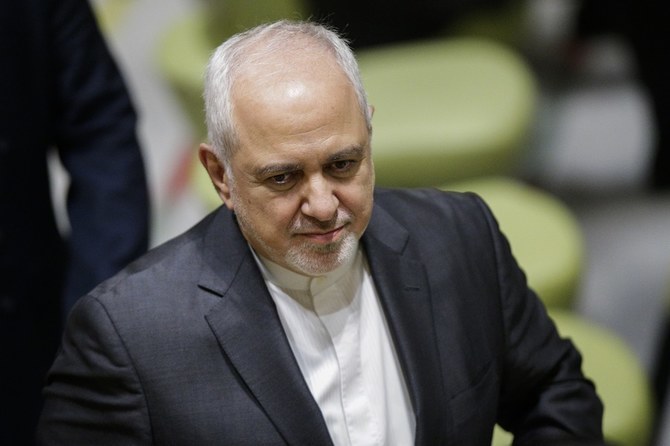
 Iran's Foreign Minister Mohammad Javad Zarif claimed on Saturday that in Iraq “Israeli agent-provocateurs are plotting attacks against Americans.” (AFP/File Photo)
Short Url
Updated 02 January 2021
Follow

Israel may try to provoke war with attacks on US forces in Iraq: Iran’s Zarif

  • Tensions have been building in the run-up to the anniversary of Qassem Soleimani's killing

TEHRAN: Iran’s Foreign Minister Mohammad Javad Zarif claimed on Saturday that in Iraq “Israeli agent-provocateurs are plotting attacks against Americans (to put) Trump in a bind with a fake casus belli.”

His comments came after he accused on Thursday outgoing US President Donald Trump of aiming to fabricate a "pretext for war" after Trump blamed Tehran for a rocket strike on the US embassy in Baghdad on December 20.

“Be careful of a trap,” Zarif tweeted at Trump, saying that “any fireworks will backfire badly, particularly against your same BFFs.”

Iran’s Revolutionary Guards chief Hossein Salami also vowed Saturday to respond to any “action the enemy takes,” on the eve of the first anniversary of the US killing of top Iranian military commander Qassem Soleimani in a Baghdad drone strike on January 3, 2020.

Tensions have been building in the run-up to the anniversary of Soleimani's killing, with two US B-52 bombers recently flying over the region.

The aircraft carrier USS Nimitz has also been patrolling Gulf waters since late November, but US media reported this week that acting US defence secretary Christopher C. Miller had ordered the vessel to return home.

The New York Times, quoting US officials, said the move was a "de-escalatory" signal to Tehran to avoid conflict in Trump's last days in office.

Trump oversaw a sharp toughening of US policy, abandoning a landmark nuclear deal between Iran and world powers in 2018 and reimposing crippling unilateral sanctions.

The two countries have twice come to the brink of war since June 2019.

Days after Soleimani's assassination, Iran launched a volley of missiles at Iraqi bases housing US and allied troops, with Trump refraining from any further military response.

* With AFP


UN chief appoints Finland’s Haavisto as personal envoy for Sudan

Updated 15 sec ago
Follow

UN chief appoints Finland’s Haavisto as personal envoy for Sudan

  • Former Finnish FM has extensive experience in mediation in the Horn of Africa and Middle East
  • Haavisto was Finland’s minister of foreign affairs from 2019-23

NEW YORK: UN Secretary-General Antonio Guterres has appointed Pekka Haavisto, the former Finnish foreign minister, as his personal envoy for Sudan, UN spokesman Stephane Dujarric said on Tuesday.
Haavisto succeeds Ramtane Lamamra of Algeria and brings more than 40 years of experience in politics and international affairs to the role, having previously held ministerial positions in Finland’s government as well as senior positions with the EU and UN. He is currently a member of the Finnish parliament.
Haavisto was Finland’s minister of foreign affairs from 2019-23. From 2016-19, he was president of the European Institute of Peace. He has also held the ministerial portfolios of development cooperation, state ownership, and the environment. Haavisto was elected to the Finnish parliament in 1987.
The new personal envoy has broad experience in mediation and negotiation processes in the Horn of Africa and the Middle East, and has worked extensively with the UN, said Dujarric.
From 2009-17, he was special representative to the Finnish foreign minister for mediation and crisis management in Africa. Between 2005 and 2007, Haavisto was the EU special representative for Sudan, where he took part in the Darfur peace negotiations. During that period, he also acted as a UN senior adviser to the Darfur peace process.
Haavisto worked for the UN Environment Programme from 1999 to 2005, including assignments in Iraq, the Palestinian territories, Liberia, and Sudan.
Asked why Lamamra had stepped down, Dujarric said that it was a “joint decision” between the Algerian envoy and the secretary-general.