

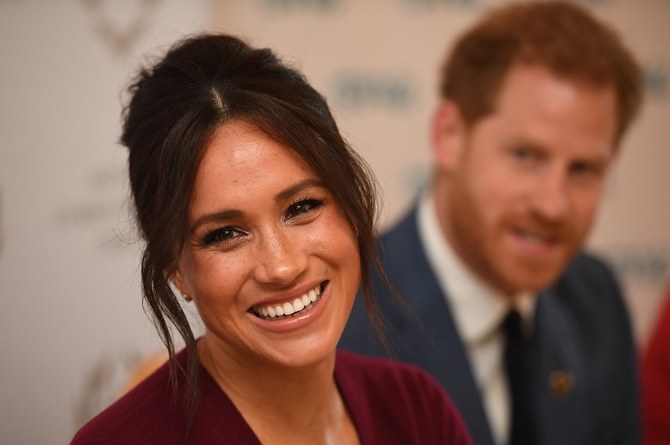
Meghan and Harry end their eventful 2020 with first podcast
Updated 30 December 2020
AP
LOS ANGELES: The Duke and Duchess of Sussex have dropped their first podcast.
Prince Harry and Meghan Markle and guests from Elton John to their son, Archie, appear on the royal couple’s first audio release Tuesday for Spotify, a 34-minute special featuring reflections on 2020.
The couple who stepped down from their royal duties in spring invited friends and people they admire to record audio diaries that were excerpted for the show.
“It’s been a year, and we really we want to honor the compassion and kindness that has helped so many people get through it,” the Duke of Sussex says to introduce the podcast.
“And, at the same time, to honor those who’ve experienced uncertainty and unthinkable loss,” the Duchess of Sussex adds.
John, 73, was among the many musical artists who was in the middle of a tour when the pandemic struck. “All of the sudden we ground to a halt,” he says in his audio diary.
Other contributors include tennis player Naomi Osaka, who won the US Open in 2020 and calls it “the year that I became more grateful for the things and the people around me.”
Stacey Abrams, whose push for voter registration helped put Georgia at the political center of the United States, calls 2020 a year that “saw horror and meanness surge, and justice fight back.”
Despite the coronavirus pandemic dominating headlines, Meghan and Harry managed to make major news at the end of March when they stepped down from their royal duties and soon moved to California, settling in the coastal community of Montecito.
Tuesday’s podcast is their first under a multi-year deal between their production company Archewell Audio and Spotify.
With some coaching from his parents, 1-year old Archie ends the podcast with a “Happy New Year!”
Akio Fujimoto discusses RSIFF Golden Yusr winner ‘Lost Land’
The Japanese filmmaker on his groundbreaking Rohingya-language feature
Updated 19 sec ago
Shyama Krishna Kumar
JEDDAH: Some stories demand to be told. Not just as narratives, but as acts of witness.
Japanese filmmaker Akio Fujimoto’s “Lost Land” is one such story. Billed as the first feature film in the Rohingya language, the movie took home the top prize — the Golden Yusr — at this year’s Red Sea International Film Festival.
“Lost Land” — which premiered in the Horizons section at this year’s Venice Film Festival, where it won the special jury prize — follows two young Rohingya siblings, Somira and Shafi, fleeing persecution in Myanmar as they undertake a perilous journey d to join their uncle in Malaysia.
Shomira Rias Uddin (R) and Muhammad Shofik Rias Uddin in 'Lost Land.' (Supplied)
Presenting the Golden Yusr to Fujimoto, RSIFF jury head, the US filmmaker Sean Baker, said the film “confronts the plight of displaced children with unflinching empathy and poetic urgency.”
Fujimoto’s journey to this film is a profound narrative of personal reckoning. Having worked in Myanmar for more than a decade, he recognized the unspoken tensions surrounding discussions about refugee experiences but never spoke out himself due to fear of persecution. The 2021 military coup in Myanmar, he said, forced him to confront a lingering sense of guilt about his previous silence on the subject.
“Looking back on my decade of work, I realized I had been avoiding topics I wanted to focus on as a filmmaker,” Fujimoto said in an interview with Arab News at RSIFF.
That self-reflection became the catalyst for “Lost Land,” transforming personal hesitation into a powerful act of cinematic storytelling.
Eschewing traditional casting methods, Fujimoto discovered his lead actors through serendipity during community fieldwork. Shomira Rias Uddin and Muhammad Shofik Rias Uddin, real-life siblings who play the film’s young leads, were found walking near interview locations, compelling the filmmaker to reshape the entire script around their natural chemistry. While the original script was written with two teenage brothers in mind, the discovery of the Rias Uddin siblings led Fujimoto to alter the script significantly.
Communication between the cast and crew became an intricate dance of translation and cultural bridge-building. With Fujimoto speaking primarily Japanese and some Burmese, the team relied on Sujauddin Karimuddin, a Rohingya translator who did far more than linguistic conversion. “He wasn’t just translating words but conveying messages, creating trust, and establishing a collaborative atmosphere,” said Watanabe, Fujimoto’s translator.
One of the most remarkable aspects of “Lost Land” is its linguistic significance. Beyond being a narrative, the film serves as a critical instrument of cultural preservation. Karimuddin, who is also a producer on the film, approached his role like a linguistic curator. “As a Rohingya myself, I had the privilege of choosing words carefully, trying to instill poetry, capturing linguistic nuances that are slowly disappearing. So, the film is very important when it comes to the preservation of a people’s language. It was a privilege for me to contribute to it,” he said.
As they were making the first fiction film focused on Rohingya experiences, the team felt an immense responsibility. “Lost Land” aims to humanize a community often reduced to statistics, giving voice and complexity to individual experiences.
Shomira Rias Uddin and Muhammad Shofik Rias Uddin (R) in 'Lost Land.' (Supplied)
“In our film, we had around 200 people — including extras — who were all part of the Rohingya community. I felt in order to show their feelings and their voice; it was really important to bring in the Rohingya people and tell the story together with them,” said Fujimoto.
For Fujimoto, whose previous films include “Passage of Life” (2017) and “Along the Sea” (2020), the film represents more than an artistic achievement. It’s a form of personal and collective redemption. “I can now clearly talk about these people without hesitation,” he said.
The filmmaker’s future ambitions involve expanding on this project. He sees “Lost Land” as a crucial first step, and hopes to support Rohingya filmmakers in telling their own stories directly.
“The next phase is bringing narratives from the Rohingya perspective, directed by Rohingya filmmakers,” he said.