MOUNT MAUNGANUI, New Zealand: Captain Mohammad Rizwan helped Pakistan weather the second session better than the first Monday on the third day of the first cricket test against New Zealand.
Pakistan lost four wickets in the first session to slump from 30-1 overnight to 62-5 at lunch, replying to New Zealand’s first innings of 431.
The tourists lost only one wicket in the second session, thanks to Rizwan who batted between lunch and tea to be 29 not out at the break. Faheem Ashraf was 21, the pair had added 32 for the seventh wicket and Pakistan had recovered a little to 112-6.
The session was shortened by a 20-minute rain delay then by a heavy hailstorm which caused players to dash from the field and tea to be taken early.
Scoring was painfully slow in the first session but picked up a little in the second as Pakistan added 50 runs from 21 overs for the loss of one wicket.
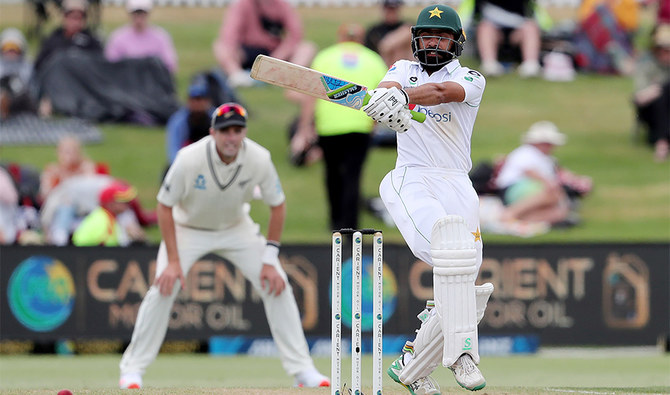
Fawad Alam was the only man out, caught by wicketkeeper B.J. Watling from the bowling of Neil Wagner when Pakistan was 80-6. Wagner was bowling despite suffering a broken toe while batting on the second day.
He tested Fawad and Rizwan with a series of short deliveries before Fawad played a rash hook shot and feathered a fine top edge to Watling.
During the first session New Zealand captured the wickets of Abid Ali for 25, nightwatchman Mohammad Abbas for 5, Azhar Ali for 5 and Haris Sohail for 3 as the Pakistan top order crumbled.
Kyle Jamieson set the collapse in motion by removing Abid. He first troubled the batsman with a ball which reared disconcertingly off a length, then bowled him with a full delivery, angled in on off stump as Abid hovered on his crease.
Captain Kane Williamson immediately brought back Trent Boult who bowled around the wicket to Abbas and had him caught at slip by Ross Taylor with the last ball of his new over. Taylor claimed his 150th catch in tests.
Abbas came to the crease late on the first day and defied the New Zealand bowlers for 79 minutes. He took 37 balls to get off the mark but he did his job, making New Zealand’s bowlers work hard for his wicket.
As wickets tumbled the Pakistan batsmen became focused on survival and the scoring rate all but ground to a halt — only 32 runs were scored from 26 overs in the first session. That mindset made them more vulnerable, causing batsmen to become too tentative in their footwork, more reluctant to leave outside off stump.
Azhar (5) dangled his bat at a ball from Tim Southee which was wide off, angling away. His faint edge to Watling wasn’t heard by the umpire but couldn’t deceive the television replay.
Four balls later Southee dismissed Haris Sohail (3) who drove at a slower ball which may have swung late. Without using his feet, he made poor contact and skewed the ball to Henry Nicholls in the gully.

New Zealand 431; Pakistan 112-6 at tea on day 3 of 1st test
https://arab.news/8m4js
New Zealand 431; Pakistan 112-6 at tea on day 3 of 1st test
- The tourists lost only one wicket in the second session, thanks to Rizwan who batted between lunch and tea to be 29 not out at the break
- The session was shortened by a 20-minute rain delay then by a heavy hailstorm which caused players to dash from the field and tea to be taken early
Pakistan orders four-day workweek, shuts schools to save fuel amid Middle East oil crisis
- The development comes as ongoing US-Israeli strikes on Iran disrupt oil supplies in Strait of Hormuz, push prices past $119 a barrel
- Islamabad bans government purchases, cuts fuel allocation for vehicles as well as workforce in public and private offices by 50 percent
ISLAMABAD: Prime Minister Shehbaz Sharif on Monday announced austerity measures, including a four-day work week, cuts in government expenditures and closure of schools, to offset the impact of rising global oil prices due to an ongoing conflict in the Middle East.
Global fuel supply lines have been disrupted in the Strait of Hormuz, which supplies nearly a fourth of world oil consumption, after Tehran blocked it following United States-Israeli strikes on Iran and counterattacks against US interests in the Gulf region.
Oil prices surged more than 25 percent globally on Monday to $119.50 a barrel, the highest levels since mid-2022, as some major producers cut supplies and fears of prolonged shipping disruptions gripped the market due to the expanding US-Israeli war with Iran.
In his televised address on Sunday night, Sharif said global oil prices were expected to rise again in the coming days but vowed not to let the people bear their brunt, announcing austerity measures to lessen the impact of fuel price hikes.
“Fifty percent staff in public and private entities will work from home,” he announced, adding this would not be applicable to essential services. “Offices will remain open for four days a week. One-day additional off is being given to conserve oil, but it would not be applicable to banks.”
Sharif didn’t specify working days of the week and the government was likely to issue a notification in this regard.
He said a decrease of 50 percent was being made in fuel allocation for government vehicles immediately for the next two months, but they would not include ambulances and public buses.
“Cabinet members, advisers and special assistants will not draw salaries for the next two months, 25 percent salaries of parliamentarians are being deducted, two-day salaries of Grade 20 and above officers, or those who are paid Rs300,000 ($1,067) a month, are being deducted for public relief,” he said.
Similarly, there will be 20 percent reduction in public department expenses and a complete ban on the purchase of cars, furniture, air conditioners and other goods, according to the prime minister.
Foreign trips of ministers and other government officials will also be banned along with government dinners and iftar buffets, while teleconferences and online meetings will be given priority.
“All schools will be off for two weeks, starting from the end of this week, and all higher education institutions should immediately begin online classes,” he said.
Sharif’s comments were aired hours after Pakistani authorities said the country had “comfortable levels” of petroleum stocks and the supply chains were functioning smoothly, despite intensifying Middle East conflict.
Petroleum Minister Ali Pervaiz Malik said three oil shipments were due to reach Pakistan this week, state media reported.
Meanwhile, Pakistan Navy (PN) launched ‘Operation Muhafiz-ul-Bahr’ to safeguard national energy shipments, the Pakistani military said on Monday, amid disruptions to critical sea lanes due to the conflict.
The navy is conducting escort operations in close coordination with the Pakistan National Shipping Corporation (PNSC), according to the Inter-Services Public Relations (ISPR), the military’s media wing. It is fully cognizant of the prevailing maritime situation and is actively monitoring and controlling the movement of merchant vessels to ensure their safe and secure transit.
“With approximately 90 percent of Pakistan’s trade conducted via sea, the operation aims to ensure that vital sea routes remain safe, secure, and uninterrupted,” the ISPR said on Monday. “Currently, PN ships are escorting 2 x Merchant Vessels, one of which is scheduled to arrive Karachi today.”


