

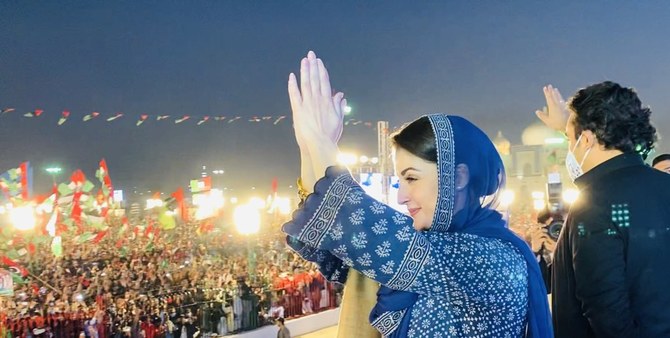
Opposition leaders rally in Bhutto home-ground for Benazir’s death anniversary

Opposition leaders Bilawal Bhutto Zardari (R) and Maryam Nawaz (L) of Pakistan Democratic Movement (PDM) arrive to attend an anti-government rally in Garhi Khuda Bux in Larkana on December 27, 2020.  (Photo Courtesy: Social Media)
Short Url
Updated 27 December 2020
Follow

Opposition leaders rally in Bhutto home-ground for Benazir’s death anniversary

  • Opposition leader Maryam Nawaz of the PML-N arrived in Larkana a day earlier and addressed gathering
  • It has been 13 years since Benazir Bhutto was assassinated in a gun and bomb attack

ISLAMABAD: Major opposition leaders gathered in a Sindh village on Sunday to hold an anti-government rally while commemorating the 13th death anniversary of Pakistan’s former Prime Minister Benazir Bhutto, who was assassinated in a gun and bomb attack in 2007.

The political leaders, who have joined hands under the banner of the 11-party Pakistan Democratic Movement (PDM), gathered in Garhi Khuda Bux in Larkana, where the Bhutto family mausoleum and graveyard is located, and where a large crowd came out in support, waving PDM flags in the audience.

Opposition leader Maryam Nawaz of the Pakistan Muslim League-Nawaz addressed the crowd at the rally, and hit out at Prime Minister Imran Khan for inflation and for underestimating a new generation of leaders at Pakistan Peoples Party (PPP) and PML-N, while referring to herself and PPP chairman Bilawal Bhutto Zardari.

Bilawal addressed the gathering and said the leaders of PDM were ‘on the same page.’
“Today we have to vow to fulfil Benazir Bhutto’s promise and save Pakistan,” he added.

He said if Prime Minister Imran Khan did not resign the prime ministership by January 31, the opposition would stage a long march to the capital, Islamabad.

Government leaders dismissed the opposition gathering in Larkana on television as ‘political theater.’

Former President Asif Ali Zardari addressed the gathering via video link.


World Bank approves $700 million for Pakistan’s economic stability

Updated 20 December 2025
Follow

World Bank approves $700 million for Pakistan’s economic stability

  • Of this, $600 million will go for federal programs and $100 million will ⁠support a provincial program in Sindh
  • The results-based design ensures that resources are only disbursed once program objectives are achieved

ISLAMABAD: The World Bank has approved $700 million in ​financing for Pakistan under a multi-year initiative aimed at supporting the country’s macroeconomic stability and service delivery, the bank said on Friday.

The funds will be released under the bank’s Public ‌Resources for Inclusive ‌Development — Multiphase ‌Programmatic ⁠Approach (PRID-MPA) that ‌could provide up to $1.35 billion in total financing, according to the lender.

Of this amount, $600 million will go for federal programs and $100 million will ⁠support a provincial program in ‌the southern Sindh province. The results-based design ensures that resources are only disbursed once program objectives are achieved.

“Pakistan’s path to inclusive, sustainable growth requires mobilizing more domestic resources and ensuring they are used efficiently and transparently to deliver results for people,” World Bank country director Bolormaa Amgaabazar said in a statement.

“Through this MPA, we are working with the Federal and Sindh governments to deliver tangible impacts— more predictable funding for schools and clinics, fairer tax systems, and stronger data for decision‑making— while safeguarding priority social and climate investments and strengthening public trust.”

The approval ‍follows a $47.9 ‍million World Bank grant ‍in August to improve primary education in Pakistan’s most populous Punjab province.

In November, an IMF-World Bank ​report, uploaded by Pakistan’s finance ministry, said Pakistan’s fragmented ⁠regulation, opaque budgeting and political capture are curbing investment and weakening revenue.

Regional tensions may surface over international financing for Pakistan. In May, Reuters reported that India would oppose World Bank funding for Pakistan, citing a senior government ‌source in New Delhi.

“Strengthening Pakistan’s fiscal foundations is essential to restoring macroeconomic stability, delivering results and strengthening institutions,” said Tobias Akhtar Haque, Lead Country Economist for the World Bank in Pakistan.

“Through the PRID‑MPA, we are launching a coherent nationwide approach to support reforms that expand fiscal space, bolster investments in human capital and climate resilience, and strengthen revenue administration, budget execution, and statistical systems. These reforms will ensure that resources reach the frontline and deliver better outcomes for people across Pakistan with greater efficiency and accountability.”

In Sindh, the program is expected to increase provincial revenues, enhance the speed and transparency of payments, and broaden the use of data to guide provincial decision making. The program will directly support the increase of public resources for inclusive development, including more equitable and responsive financing for primary health care facilities and more funding for schools.