

El-Sisi: Renaissance Dam needs binding deal, must preserve Egypt’s rights

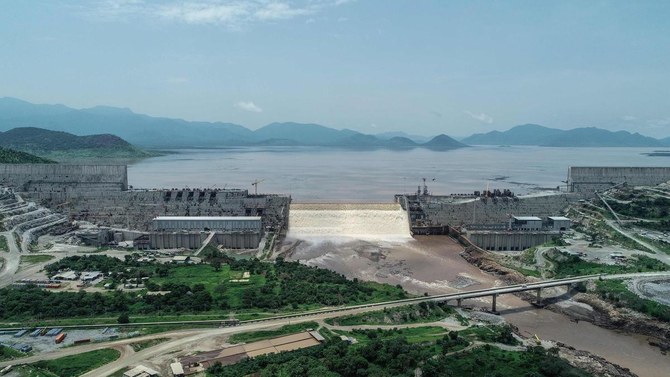
Egypt must preserve its water rights by reaching a binding legal agreement on the Ethiopian Renaissance Dam that includes Egypt, Sudan and Ethiopia, Egyptian President Abdel Fattah El-Sisi has said. (AFP/File Photo)
Short Url
Updated 27 December 2020
Follow

El-Sisi: Renaissance Dam needs binding deal, must preserve Egypt’s rights

CAIRO: Egypt must preserve its water rights by reaching a binding legal agreement on the Ethiopian Renaissance Dam that includes Egypt, Sudan and Ethiopia, Egyptian President Abdel Fattah El-Sisi has said.

During a phone conversation with South African counterpart Cyril Ramaphosa, El-Sisi made the comments while referring to the development of the dam, which is taking place under the auspices of the African Union, headed by South Africa.

Spokesman for the Egyptian Presidency Bassam Rady said that the Egyptian leader received a call from the South African president.

He said El-Sisi confirmed Egypt’s position on formulating a binding legal agreement that preserves Egyptian water rights and includes the three countries. The agreement should define the rules for filling and operating the dam, as the Nile waters represent an “existential issue” for Egypt and its people, he added.

Ramaphosa praised Egypt’s efforts to reach a solution on the issue.

He also called for coordination during the coming period to work on reaching a fair and balanced agreement.

The Sudanese government announced in mid-December an agreement with Ethiopia to resume negotiations on the disputed dam. It came after Khartoum boycotted negotiation sessions, labeling them an “old approach” that “would not work.” Sudan called for a greater role for experts to contribute to resolving the crisis.

Egypt, Ethiopia and Sudan resumed talks headed by the water ministers of the three countries early last month when Sudan took over organization of the meeting.

Ethiopia began construction of the Renaissance Dam on the Blue Nile in 2011, but Egypt fears it will affect its share of water, which amounts to 55.5 billion cubic meters annually, most of it from the Blue Nile.

Despite the signing of a declaration of principles between Egypt, Sudan and Ethiopia in March 2015 which encouraged dialogue and negotiation, an agreement on the dam has yet to be reached.


UN rights chief Shocked by 'unbearable' Darfur atrocities

Updated 6 sec ago
Follow

UN rights chief Shocked by 'unbearable' Darfur atrocities

  • Mediation efforts have failed to produce a ceasefire, even after international outrage intensified last year with reports of mass killings, rape, and abductions during the RSF’s takeover of El-Fasher in Darfur

PORT SUDAN: Nearly three years of war have put the Sudanese people through “hell,” the UN’s rights chief said on Sunday, blasting the vast sums spent on advanced weaponry at the expense of humanitarian aid and the recruitment of child soldiers.
Since April 2023, Sudan has been gripped by a conflict between the army and the paramilitary Rapid Support Forces that has left tens of thousands of people dead and around 11 million displaced.
Speaking in Port Sudan during his first wartime visit, UN Human Rights commissioner Volker Turk said the population had endured “horror and hell,” calling it “despicable” that funds that “should be used to alleviate the suffering of the population” are instead spent on advanced weapons, particularly drones.
More than 21 million people are facing acute food insecurity, and two-thirds of Sudan’s population is in urgent need of humanitarian aid, according to the UN.
In addition to the world’s largest hunger and displacement crisis, Sudan is also facing “the increasing militarization of society by all parties to the conflict, including through the arming of civilians and recruitment and use of children,” Turk added.
He said he had heard testimony of “unbearable” atrocities from survivors of attacks in Darfur, and warned of similar crimes unfolding in the Kordofan region — the current epicenter of the fighting.
Testimony of these atrocities must be heard by “the commanders of this conflict and those who are arming, funding and profiting from this war,” he said.
Mediation efforts have failed to produce a ceasefire, even after international outrage intensified last year with reports of mass killings, rape, and abductions during the RSF’s takeover of El-Fasher in Darfur.
“We must ensure that the perpetrators of these horrific violations face justice regardless of the affiliation,” Turk said on Sunday, adding that repeated attacks on civilian infrastructure could constitute “war crimes.”
He called on both sides to “cease intolerable attacks against civilian objects that are indispensable to the civilian population, including markets, health facilities, schools and shelters.”
Turk again warned on Sunday that crimes similar to those seen in El-Fasher could recur in volatile Kordofan, where the RSF has advanced, besieging and attacking several key cities.
Hundreds of thousands face starvation across the region, where more than 65,000 people have been displaced since October, according to the latest UN figures.