

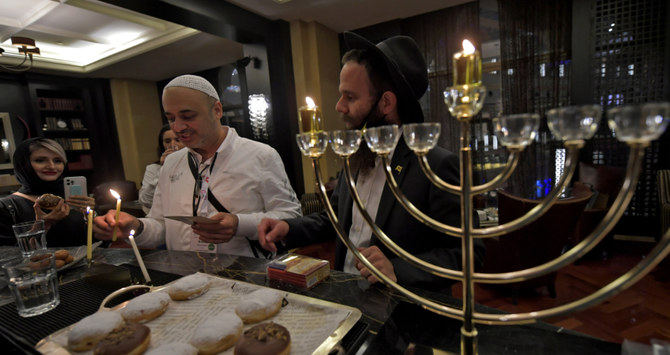

DUBAI: On Dec. 11, the second day of Hanukkah — the Jewish holiday also known as the Festival of Lights or Miracles — Dubai’s iconic Burj Khalifa lit up to mark the celebration of the first night of Hanukkah in the UAE, and the first time the holiday is being celebrated openly in the country since the signing of the historic Abraham Accords with Israel. Events were celebrated all over Dubai and Abu Dhabi.
For Jews, the message behind Hanukkah is to spread light over darkness, and in many ways the normalization of ties between the UAE and Israel ends decades of metaphorical and figurative cultural and economic darkness between Israel and many of its Arab neighbors.
Hanukkah commemorates the recovery of Jerusalem and subsequent rededication of the Second Temple at the beginning of the Maccabean revolt against the Seleucid Empire during the 2nd century BC.
Traditionally, it is celebrated by the lighting of the menorah, eating traditional foods, playing games and giving gifts.
This is not the first year that Hanukkah is being celebrated in the UAE. Rather, it is the first time it is being acknowledged and feted openly, and with the broader UAE public.
“I have wonderful memories of lighting the Hanukkah menorah in the desert,” said Ross Kriel, the current and first president of the Jewish Council of the Emirates.
“This gave us privacy but still allowed for a communal lighting. Many of us slept in the desert, and in the morning a caravan of camels might pass behind the menorah,” added Kriel, an Oxford-educated lawyer practicing in Dubai and originally from South Africa.
“We often felt that our exotic Hanukkah experience was a perfect expression of the idea of Hanukkah — that Jewish identity prevails through the simple devotion of Jews kindling lights wherever they may be. This miracle occurred in the UAE over many years going back to 2010.”
This year, says Kriel, the Jewish Council of the Emirates held its event in the heart of Dubai at a smart hotel on the Palm Jumeirah.
“We received expressions of support from Isaac Herzog, chairman of the Jewish Agency, and there were dignitaries and Israeli academics including the director of the Moshe Dayan Center, Prof. Uzi Rabi,” Kriel told Arab News.
“Our new Senior Rabbi Abadie, who is Lebanese-born, led the service, and we called on one of our dear Emirati friends to light one of the candles. In this moment, we felt a deep sense of ease and naturalness in being ‘public’ as a Jewish community,” he added.
“Dubai and the UAE have an extraordinary capacity to assimilate and lead change through the broad vision of its founders. Dubai is a city of lights in all senses.”
Elli Kriel, founder of Elli’s Kosher Kitchen — which now supplies numerous hotels and restaurants in the UAE with kosher food, and is planning to open a kosher restaurant — said this year, Hanukkah is particularly special as Jews in Dubai can celebrate the holiday publicly.
“We always celebrated Hanukkah in a quiet and modest way in the UAE, not knowing how public we could be about our identity and traditions,” Elli told Arab News.
“But now, post-normalization, everything is completely different and we got to celebrate Hanukkah publicly this year.”
Elli explained how Jews in Dubai were able to eat kosher meals at restaurants in the UAE and light candles in public.
“We welcomed Israelis and many other Jewish guests, and I felt very much at ease and comfortable to be following our traditions in the UAE,” she said.
“There’s been so much excitement. The Israelis I’ve met with were over the moon to be here. It’s been overwhelming,” she added.
“There’s been a tremendous amount of excitement and a very high level of emotion for months around this. Sometimes I have to pinch myself because at the beginning of the year we had no idea that the normalization deal would take place.”
There have been noticeable changes in the UAE since the Gulf nation’s normalization with Israel was announced in August and officially signed on Sept. 15 in Washington DC.
Hebrew can be heard in shopping malls, restaurants, on beaches and in Dubai’s many luxury hotels.
The Times of Israel newspaper recently reported that more than 70,000 Israelis have already visited the UAE since the peace treaty was signed.
A particularly large number of Israelis was seen during the Hanukkah period, many of whom traveled to the UAE to celebrate their festivities there.
“It might sound cliché, but what’s happening in the UAE is like Hanukkah, a moment of miracles of light,” said Ruth Wasserman Lande, founder and executive director of Ruth Strategic Consultancy, and former senior advisor to the late Israeli President Shimon Peres.
“There’s something really beautiful about what’s happening in the UAE. It’s an enlightening, a breaking down of barriers and walls so that people — Arabs and Jews — can get to know each other,” added Lande, who visited Dubai for the first time during Gitex Technology Week at the beginning of December.
“That’s what has come out of the Abraham Accords … It was so wonderful to be greeted at the airport as Israeli, and to see that the Emiratis weren’t ashamed or embarrassed to have us here.”


