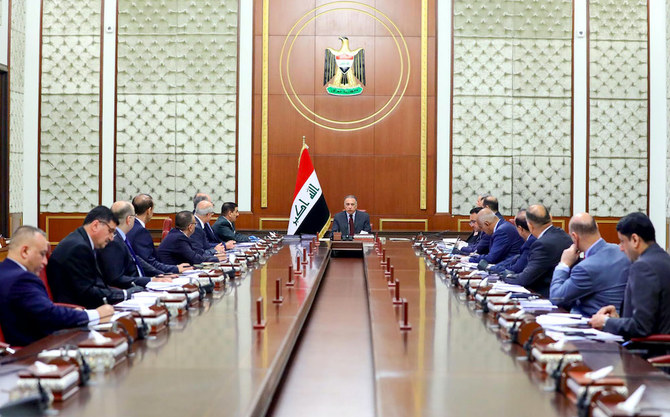
BAGHDAD: Iraq’s cabinet on Monday approved a 2021 draft budget of 150 trillion Iraqi dinars ($103 billion) as the country wrestles with an economic and financial crisis due to low crude prices.
The budget deficit would be estimated at 63 trillion dinars ($43 billion), two government sources said.
The draft 2021 budget is based on a world oil price of $42 a barrel and expected oil exports of 3.25 million barrels per day (bpd), including 250,000 bpd from the Kurdish region, the officials said.
But despite approval of the budget, which should be referred to parliament for final approval, disputes between the central government and semi-autonomous Kurdish region are still unresolved, a government senior economic adviser said.
“Differences between Baghdad and Kurdish delegates are still persisting over Kurdish oil exports and the region’s debts. It’s too complicated for now to reach an agreement,” said a senior government adviser.
Hit by squeezed revenues, Iraq’s central bank on Saturday increased the sale price of US dollars to banks and currency exchanges to 1,460 dinars, from 1,182 dinars, seeking to close the gap of widened 2021 budget inflation after a collapse in global oil prices, a major source of Iraq’s financial resources.
The finance ministry supplies the central bank with dollars based on a price of 1,450 dinars against the dollar, Central Bank chief Mustafa Ghalib said in a statement.
Iraq has the world’s fourth-largest oil reserves and depends on oil revenues to fund 95 percent of its national budget.
($1 = 1.45 Iraqi dinars)

Iraq’s cabinet approves 2021 draft $103 billion budget
Short Url
https://arab.news/9erxu
Iraq’s cabinet approves 2021 draft $103 billion budget
- The budget deficit would be estimated at $43 billion
- The draft 2021 budget is based on a world oil price of $42 a barrel
Lebanon ex-central bank chief's corruption case being sent to top court, officials say
BEIRUT: The corruption case of Lebanon's former central bank governor, who is widely blamed for the country’s economic meltdown, has been transferred to the country's highest court, judicial officials told The Associated Press on Tuesday.
Riad Salameh was released on $14 million bail in September after a year in prison while awaiting trial in Lebanon on corruption charges, including embezzlement and illicit enrichment.
The trial of Salameh, 75, and his two legal associates, Marwan Khoury and Michel Toueini, will now be heard at the Court of Cassation, according to a copy of the notice obtained by the AP. Salameh and the others will be issued with arrest warrants if they don't show up for trial at the court.
No trial date has been set yet. Salameh denies the charges. The court’s final ruling can't be appealed, according to the four officials who spoke on condition of anonymity, because they weren't authorized to speak with the media.
In September 2024, he was charged with the embezzlement of $42 million, with the court later adding charges of illicit enrichment over an apartment rented in France, supposedly to be a substitute office for the central bank if needed. Officials have said that Salameh had rented from his former romantic partner for about $500,000 annually.
He was once celebrated for steering Lebanon’s economic recovery, after a 15-year civil war, upon starting his long tenure in 1993 and keeping the fragile economy afloat during long spells of political gridlock and turmoil.
But in 2023, he left his post after three decades with several European countries investigating allegations of financial crimes. Meanwhile, much of the Lebanese blame his policies for sparking a fiscal crisis in late 2019 where depositors lost their savings, and the value of the local currency collapsed.
On top of the inquiry in Lebanon, he is being investigated by a handful of European countries over various corruption charges. In August 2023, the United States, United Kingdom and Canada imposed sanctions on Salameh.
Salameh has repeatedly denied allegations of corruption, embezzlement and illicit enrichment. He insists that his wealth comes from inherited properties, investments and his previous job as an investment banker at Merrill Lynch.
Lebanon’s current central bank governor, Karim Souaid, announced last week that he's filing legal complaints against a former central bank governor and former banking official who diverted funds from the bank to what he said were four shell companies in the Cayman Islands. He didn't name either individual.
But Souaid said that Lebanon's central bank would become a plaintiff in the country's investigation into Forry Associates. The U.S. Treasury, upon sanctioning Salameh and his associates, described Forry Associates as “a shell company owned by Raja (Salameh’s brother) in the British Virgin Islands” used to divert about $330 million in transactions related to the central bank.
Several European countries, among them France, Germany, and Luxembourg, have been investigating the matter, freezing bank accounts and assets related to Salameh and his associates, with little to no cooperation from the central bank and Lebanese authorities.
Souaid said that he will travel later this month to Paris to exchange “highly sensitive” information as France continues its inquiries.
Riad Salameh was released on $14 million bail in September after a year in prison while awaiting trial in Lebanon on corruption charges, including embezzlement and illicit enrichment.
The trial of Salameh, 75, and his two legal associates, Marwan Khoury and Michel Toueini, will now be heard at the Court of Cassation, according to a copy of the notice obtained by the AP. Salameh and the others will be issued with arrest warrants if they don't show up for trial at the court.
No trial date has been set yet. Salameh denies the charges. The court’s final ruling can't be appealed, according to the four officials who spoke on condition of anonymity, because they weren't authorized to speak with the media.
In September 2024, he was charged with the embezzlement of $42 million, with the court later adding charges of illicit enrichment over an apartment rented in France, supposedly to be a substitute office for the central bank if needed. Officials have said that Salameh had rented from his former romantic partner for about $500,000 annually.
He was once celebrated for steering Lebanon’s economic recovery, after a 15-year civil war, upon starting his long tenure in 1993 and keeping the fragile economy afloat during long spells of political gridlock and turmoil.
But in 2023, he left his post after three decades with several European countries investigating allegations of financial crimes. Meanwhile, much of the Lebanese blame his policies for sparking a fiscal crisis in late 2019 where depositors lost their savings, and the value of the local currency collapsed.
On top of the inquiry in Lebanon, he is being investigated by a handful of European countries over various corruption charges. In August 2023, the United States, United Kingdom and Canada imposed sanctions on Salameh.
Salameh has repeatedly denied allegations of corruption, embezzlement and illicit enrichment. He insists that his wealth comes from inherited properties, investments and his previous job as an investment banker at Merrill Lynch.
Lebanon’s current central bank governor, Karim Souaid, announced last week that he's filing legal complaints against a former central bank governor and former banking official who diverted funds from the bank to what he said were four shell companies in the Cayman Islands. He didn't name either individual.
But Souaid said that Lebanon's central bank would become a plaintiff in the country's investigation into Forry Associates. The U.S. Treasury, upon sanctioning Salameh and his associates, described Forry Associates as “a shell company owned by Raja (Salameh’s brother) in the British Virgin Islands” used to divert about $330 million in transactions related to the central bank.
Several European countries, among them France, Germany, and Luxembourg, have been investigating the matter, freezing bank accounts and assets related to Salameh and his associates, with little to no cooperation from the central bank and Lebanese authorities.
Souaid said that he will travel later this month to Paris to exchange “highly sensitive” information as France continues its inquiries.
© 2026 SAUDI RESEARCH & PUBLISHING COMPANY, All Rights Reserved And subject to Terms of Use Agreement.