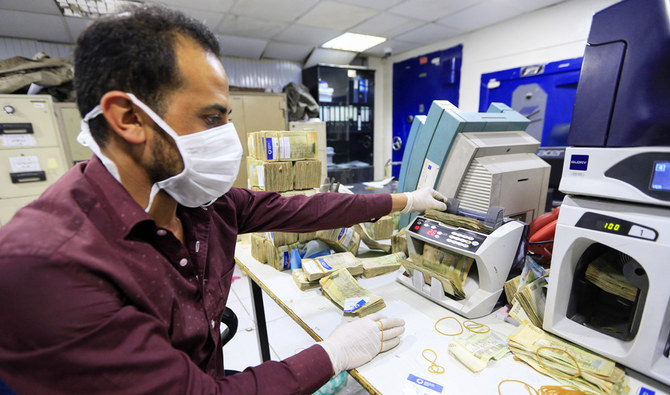

AL-MUKALLA: The Yemeni riyal has recovered by 20 percent after positive news about the implementation of the Riyadh Agreement and the formation of a new government, giving a long-awaited boost to the chaotic exchange market.
Local moneychangers told Arab News on Sunday that the Yemeni riyal bounced to 750 against the US dollar in the government-controlled areas, rising from 925 about 10 days ago, and reviving hopes about bringing the market under the government’s control.
The riyal’s rebound began on Dec. 11 when the Arab coalition announced the Yemen’s internationally recognized government and the separatist Southern Transitional Council agreed to withdraw their forces from Aden and Abyan.
The exchange market was given another positive boost last week when Yemeni President Abed Rabbo Mansour Hadi issued a presidential decree announcing the formation of a new government of 24 ministers, equally represented by southerners and northerners, including the separatists.
The formation of the government has ended more than a year of political wrangling and deadlock related to the implementation of the Riyadh Agreement, which was designed to defuse hostilities between the Yemeni government and the separatists.
The devolution of the Yemeni riyal during the past couple of years has pushed up prices of basic commodities and fueled public anger against the country’s political establishment that had failed to address the problem.
At the same time, Yemen’s new prime minister, Maeen Abdul Malik Saeed, said on Sunday that his government would return to Aden within a week after swearing in before the Yemeni president and winning a vote of confidence from parliament. Saeed told Al-Ayyam daily newspaper that his government would work “as hard as it could” to alleviate the suffering of the Yemenis and bring to life crumbled government bodies.
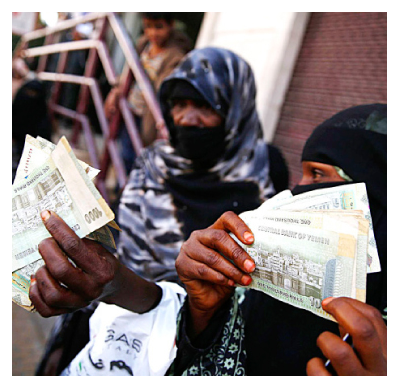
The Yemeni riyal recovers by 20 percent giving hopes about bringing the market under the government’s control. (AP)
In southern Yemen, local officials and military commanders said on Sunday that government troops and separatists that had withdrawn from contested areas in Abyan and Aden began trickling into battlefields with the Iran-backed Houthis in the southern provinces of Abyan, Dhale and Lahj.
HIGHLIGHT
The riyal’s rebound began on Dec. 11 when the Yemen’s internationally recognized government and the separatist Southern Transitional Council agreed to withdraw their forces from Aden and Abyan.
Fuad Jabari, Dhale front spokesperson, told Arab News that military forces that withdrew from Abyan have joined flashpoints in the province to reinforce fighters who fight off relentless attacks by the Houthis.
“The withdrawing forces have entered Dhale province accompanied by Saudi military officers. More military forces are on their way to the battlefields,” Jabari said, adding that the Houthis have escalated attacks on southern resistance forces in the province since warring sides agreed to pull out of Aden and Abyan.
“The Houthis are using more advanced weapons nowadays. They replaced bomb drones with modern drones that fire missiles and moved back to their areas,” he said.
People in Aden, the Yemeni city that had borne the brunt of sporadic deadly fighting between government troops and separatists, and other Yemeni cities voiced their optimism with the formation of a new government and urged new ministers to fix services and create jobs.
Hanan Al-Ameri, an activist from Aden, told Arab News that the new government should immediately return to Aden to address corruption in state bodies, long power cuts, severe shortages of drinking water and skyrocketing prices.
“Regarding our demands, we want the government to fix services and then give jobs to young people and empower them in local authorities. We demand a decent life, services and protecting our violated rights,” Hanan said.
Yemeni politicians and experts echoed the same optimism about the implantation of the Riyadh Agreement and the formation of a new government, arguing that the government has unified the Yemeni forces against the Houthis and ended enmities that ruined anti-Houthi forces.
Najeeb Ghallab, undersecretary at Yemen’s Information Ministry and a political analyst, told Arab News on Sunday that the Riyadh Agreement has managed to turn antagonism between warring factions into partnership.
“Riyadh Agreement has rebuilt the forces and sent reassurances to political parties that they would not be left out. It enables the Yemeni government to assert its control over the land, have unified military forces and speak with one voice with the international community,” Ghallab said, adding that the Riyadh Agreement proved that the Arab coalition is able to bring Yemenis together if they cut off ties with foreign forces such as Iran.
“It sends a message that Saudi Arabia and the UAE can bring peace to Yemen provided the Houthis sever ties with Iran,” he said.