

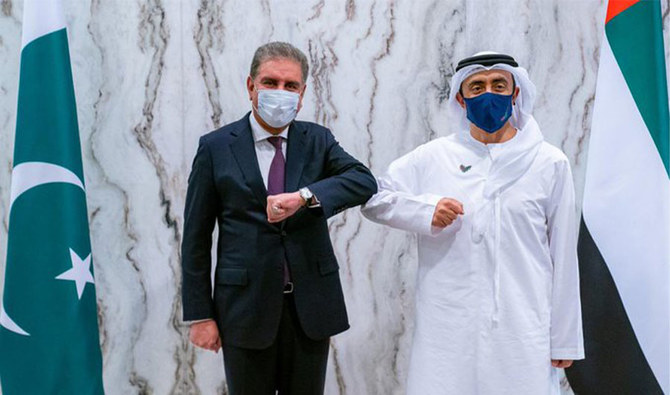

ISLAMABAD: Pakistani Foreign Minister Shah Mahmood Qureshi met Sheikh Abdullah bin Zayed Al Nahyan, Foreign Minister of the United Arab Emirates, on Thursday, and discussed the “welfare” of Pakistanis living in the UAE and agreed to enhance trade and investment ties.
The foreign minister’s visit comes at a time when international media has reported that the UAE had stopped issuing new visas to citizens of 13 mostly Muslim-majority countries, including Pakistan.
However, Pakistani officials, including Prime Minister Imran Khan’s Special Assistant on Overseas Pakistanis, Sayed Zulfiqar Bukhari, have denied the reports, saying there was “no ban on export of Pakistani workforce.”
The UAE is home to 1.2 million Pakistanis and the second largest host to overseas Pakistani workers and source of foreign remittances, after Saudi Arabia.
“Praising the hard work and dedication of Pakistani professionals and workers in the UAE, Foreign Minister Qureshi acknowledged their positive contribution toward progress and development of the UAE as well as Pakistan,” the foreign office said in a statement. “He discussed with his counterpart matters pertaining to Pakistani diaspora’s welfare and stressed the need to further strengthen people to people linkages between the two brotherly countries.”
During the meeting, Qureshi thanked the UAE for its consistent support to Pakistan, particularly during the coronavirus pandemic and underscored the “significance accorded by Pakistan to its fraternal relations with the UAE — a brotherly country and an important regional partner.”
The two foreign ministers reviewed all aspects of bilateral relations and exchanged views on regional and global issues, including disputed Kashmir, and ongoing peace talks in Afghanistan.
“Both Foreign Ministers agreed to enhance existing strong bilateral ties, in particular in the areas of economy, trade and investment,” the foreign office said.
Qureshi also invited Al Nahyan “to visit Pakistan on mutually convenient dates in the near future which he graciously accepted.”
In a meeting on Thursday with Sheikh Mohammed bin Rashid Al Maktoum, the vice president and prime minister of the United Arab emirates and the ruler of the Emirate of Dubai, Qureshi had pressed for a “speedy solution” to the problems of Pakistanis living in the Emirates.
“Millions of Pakistanis living in the UAE have been playing a vital role in building and developing the UAE for decades,” Qureshi said in his meeting with the ruler of Dubai.
“The Foreign Minister apprised Prime Minister Sheikh Mohammed bin Rashid Al Maktoum of the difficulties faced by Pakistanis residing in the UAE and stressed the need for a speedy solution,” the foreign office said in a statement.


