

Egypt welcomes UAE joining Eastern Mediteranean Gas Forum

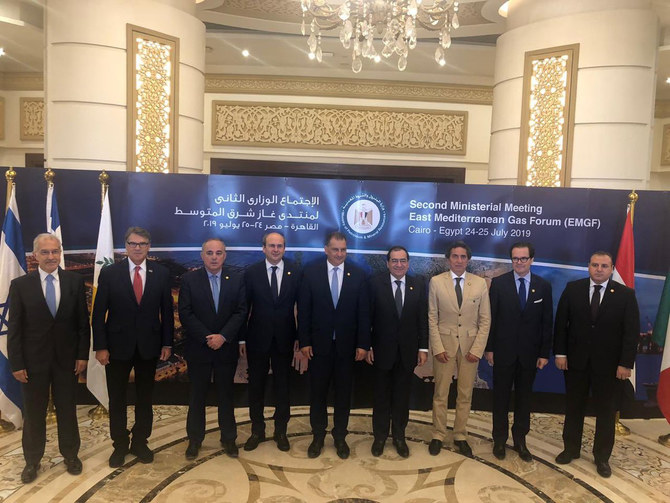
The energy ministers of Egypt, Greece, Italy, Jordan, the Palestinian Authority, Israel, Cyprus join a photo session during the first ministerial forum of the Eastern Mediterranean Natural Gas Forum on Jan. 15, 2019. (Twitter photo)
Short Url
Updated 17 December 2020
Follow

Egypt welcomes UAE joining Eastern Mediteranean Gas Forum

  • Turkey, seen by many Arab states as a troublemaker, is not a member of the forum

CAIRO: Egypt has welcomed the UAE’s entry into the Eastern Mediterranean Gas Forum (EMGF), according to a spokesman for President Abdel Fattah El-Sisi.

Bassam Radi said the Egyptian leader had also expressed the importance of the added value that the UAE would bring to the group.

“The president welcomes the UAE's accession to the Eastern Mediterranean Gas Forum as an observer, along with the founding member states, expressing the importance of the added value that the UAE will contribute to the forum’s activities to serve strategic interests and enhance cooperation and partnership between the forum countries,”  said Radi.

Talks were held on Wednesday between the Egyptian president and Abu Dhabi Crown Prince Sheikh Mohammed bin Zayed to discuss issues in the region and issues of cooperation between the two countries.

A high-level EMGF working group held its eighth meeting to discuss organizational matters to activate the forum's activities, including reviewing the position of the headquarters agreement to be concluded between Egypt and the forum, and procedures for adding new members and observers.

The Egyptian Ministry of Petroleum said the meeting also discussed the forum's road map during 2021. It included the work plan of the Gas Industry Advisory Committee and the detailed plans of its three technical, economic and organizational subcommittees.

The meeting approved the requests for two additional members to join the committee, bringing the number of members to 29 from the most important companies and institutions concerned with the region’s gas industry, compared to 16 members when it was launched in November last year.

It was the first meeting to be held after the final signing of the forum's charter by the seven founding countries — Greece, Cyprus, Italy, Israel, Jordan, Palestine and Egypt — in September and its ratification by Egypt’s parliament on Tuesday.

On Sept. 22, the Egyptian Ministry of Petroleum and Mineral Resources announced the signing of a charter to convert the EMGF into a regional organization based in Cairo. The signing was attended by ministers of the forum.

The organization is interested in strengthening cooperation and developing the political dialogue on natural gas in order to contribute to the economic exploitation of the countries' reserves of the resource.

The Turkish Foreign Ministry spokesman, Hami Aksoy, described the EMGF as an anti-Ankara bloc considering its transformation into an international organization.

Turkey is in a dispute with Greece over maritime and energy rights in the eastern Mediterranean.



Gazans fear renewed displacement after Israeli strikes

Updated 2 sec ago
Follow

Gazans fear renewed displacement after Israeli strikes

  • When her children, trembling with fear, ask where the family can go to escape Israel’s continued bombardment in southern Gaza’s Khan Yunis area, Umm Ahmed has no answer
KHAN YUNIS: When her children, trembling with fear, ask where the family can go to escape Israel’s continued bombardment in southern Gaza’s Khan Yunis area, Umm Ahmed has no answer.
In her small, devastated village near Khan Yunis city, recent Israeli drone and artillery strikes shattered the tenuous sense of peace delivered by a ceasefire that has largely held since October 10.
Residents say the strikes have targeted neighborhoods east of the so-called Yellow Line — a demarcation established under the truce between Israel and Hamas.
The Israeli military says its troops are deployed in the area in accordance with the ceasefire framework, accusing Hamas militants of “crossing the Yellow Line and carrying out terrorist activities.”
More than two years after Hamas’s October 7 attack on Israel sparked a devastating war, tens of thousands of Gazans still live in tents or damaged homes in these areas, where the Israeli army maintains control and operates checkpoints.
Now, many fear being forced from their homes, compelled to move west of the Yellow Line.
“We don’t sleep at night because of fear. The bombardments in the east are relentless,” said Umm Ahmed, 40.
“My children tremble at every explosion and ask me, ‘Where can we go?’ And I have no answer.”
Her home in Bani Suheila has been completely destroyed, yet the family has stayed, pitching a tent beside the ruins.
“Staying close to our destroyed home is easier than facing the unknown,” Umm Ahmed said.
Crossing the Yellow Line to Al-Mawasi, west of Khan Yunis, is not an option for them.
There, makeshift camps stretch as far as the eye can see, housing tens of thousands of Palestinians who fled the fighting.
“There is no place left for anyone there, and not enough food or water,” Umm Ahmed said, as Gaza remains trapped in a catastrophic humanitarian crisis.
- ‘We will not leave’ -
The Israeli military blames continued threats from Hamas militants for its actions in the area.
“The IDF’s current operations in Gaza, and their deployment in the Yellow Line area in particular, are carried out to address direct threats from terrorist organizations in Gaza,” the Israeli military said in a statement to AFP.
The war in Gaza began with Hamas’s attack on Israel on October 7, 2023 that resulted in the deaths of 1,221 people, mostly civilians, according to an AFP tally based on official Israeli figures.
Since the war began, more than 70,000 people have been killed in Gaza, according to the Hamas-run territory’s health ministry.
The vast majority of Gaza’s more than two million residents were displaced during the war, many multiple times.
A fragile ceasefire has been in place since October 10, though both sides regularly accuse each other of violations.
Under the truce, Israeli forces withdrew to positions east of the Yellow Line.
Earlier this month, Israeli army chief Lt. Gen. Eyal Zamir described the Yellow Line as the “new border line” with Israel.
“The Yellow Line is a new border line — serving as a forward defensive line for our communities and a line of operational activity,” he said to reserve soldiers in Gaza.
For Palestinian officials, the line is seen as a tool for permanent displacement.
“The objective is to frighten residents, expel them from their areas, and force them west,” said Alaa Al-Batta, mayor of Khan Yunis, denouncing the bombardments as “violations of the ceasefire agreement.”
Mahmud Baraka, 45, from Khuzaa, east of Khan Yunis, described constant artillery fire and home demolitions in the area.
“It feels like we are still living in a war zone,” he said.
“Explosions happen as if they are right next to us. The objective of the occupation is clear: to intimidate us and drive us out, so the region is emptied.”
For now, residents feel trapped between bombardment and displacement, uncertain how long they can endure.
Despite the danger, Abdel Hamid, 70, refuses to leave his home located north of Khan Yunis, where he lives with his five children.
“We will not leave... this is our land,” he said.
“Moving would not be a solution, but yet another tragedy.”