New agreement needed to revive Iran nuclear deal under Biden, IAEA chief says

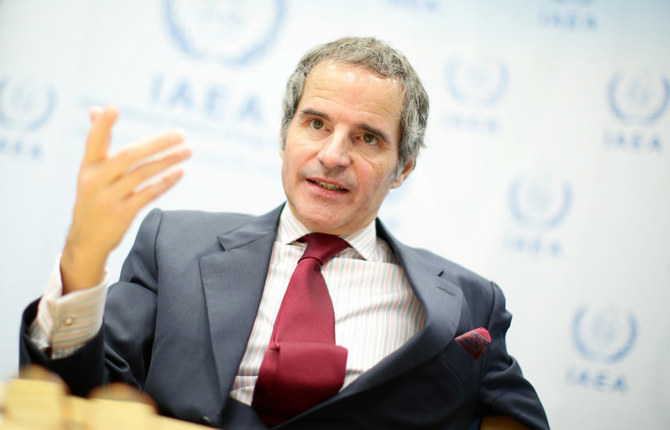
International Atomic Energy Agency (IAEA) Director General Rafael Grossi said said there would need to be a new agreement with Iran to get a nuclear deal back on track. (Reuters)
Short Url
Updated 17 December 2020
Follow

New agreement needed to revive Iran nuclear deal under Biden, IAEA chief says

  • Rafael Grossi said there had been too many breaches for the agreement to snap back into place
  • Iran now has far more enriched uranium than deal allows

VIENNA: Reviving Iran’s nuclear deal under US President-elect Joe Biden would require striking a new agreement setting out how Iran’s breaches should be reversed, UN atomic watchdog chief Rafael Grossi said.
Biden, who takes office on Jan. 20, has said the United States will rejoin the deal “if Iran resumes strict compliance” with the agreement that imposed strict curbs on its nuclear activities in return for the lifting of sanctions.
After President Donald Trump quit the deal and reimposed US sanctions, Iran responded by breaching many of the deal’s restrictions. Tehran says it could quickly reverse those steps if Washington first lifts its sanctions.
In an interview with Reuters, Grossi, who heads the International Atomic Energy Agency that polices Iran’s compliance, said there had been too many breaches for the agreement to simply snap back into place.
“I cannot imagine that they are going simply to say, ‘We are back to square one’ because square one is no longer there,” Grossi said at IAEA headquarters.
“It is clear that there will have to be a protocol or an agreement or an understanding or some ancillary document which will stipulate clearly what we do,” he said.
“There is more (nuclear) material, ... there is more activity, there are more centrifuges, and more are being announced. So what happens with all this? This is the question for them at the political level to decide.”
Iran’s stockpile of enriched uranium is more than 2.4 tons, 12 times the cap set by the deal, though still far below the more than eight tons Iran had before signing it. Iran has been enriching uranium up to 4.5% purity, above the deal’s 3.67% limit though below the 20% it achieved before the deal.
Iran is enriching uranium in places where it is not allowed under the deal, such as at Fordow, a site dug into a mountain. More recently it has started enriching with advanced centrifuges at its underground plant at Natanz, where the deal says it can use only first-generation IR-1 machines.
“What I see is that we’re moving full circle back to December 2015,” Grossi said, referring to the month before the deal’s restrictions were put in place, after which large amounts of material and equipment were swiftly removed.
“If they want to do it (comply), they could do it pretty fast. But for all of those things we had a charted course,” he said.


Medical charity ‘may have to halt Gaza operations in March’

Updated 7 sec ago
Follow

Medical charity ‘may have to halt Gaza operations in March’

  • MSF called this demand a “scandalous intrusion” but Israel says it was needed to stop extremists from infiltrating into humanitarian structures

PARIS: Banned from the Gaza Strip with 36 aid bodies, medical charity Doctors Without Borders said on Saturday it will have to end its operations there in March if Israel does not reverse its decision.

UN Secretary-General Antonio Guterres called on Friday for Israel to end a ban on humanitarian agencies that provided aid in Gaza, saying he was “deeply concerned” at the development.
Israel confirmed on Thursday that it was barring 37 major international humanitarian organizations from entering the Gaza Strip, accusing them 
of failing to provide the list of their employees’ names, which is now officially required for “security” reasons.

FASTFACT

MSF has approximately 40 international staff in the Gaza Strip and employs 800 Palestinian staff across eight hospitals.

MSF called this demand a “scandalous intrusion” but Israel says it was needed to stop extremists from infiltrating into humanitarian structures.
“To work in Palestine, in the occupied Palestinian territories, we have to be registered ... That registration expired on Dec. 31, 2025,” said Isabelle Defourny, a physician and president of MSF France, on France Inter.
“Since July 2025, we have been involved in a re-registration process, and to date, we have not received a response. We still have 60 days during which we could work without being re-registered, and so we would have to end our activities in March,” if Israel maintains its decision, she said.
MSF has approximately 40 international staff in the Gaza Strip and employs 800 Palestinian staff across eight hospitals.
“We are the second-largest distributor of water (in the Gaza Strip). Last year, in 2025, we treated just over 100,000 people who were wounded, burned, or victims of various traumas. We are second in terms of the number of deliveries performed,” the president of MSF France said.
According to her, the Israeli decision is explained by the fact that NGOs “bear witness to the violence committed by the Israeli army” in Gaza.
The UN chief “calls for this measure to be reversed, stressing that international non-governmental organizations are indispensable to life-saving humanitarian work and that the suspension risks undermining the fragile progress made during the ceasefire,” his spokesperson Stephane Dujarric said in the statement.
“This recent action will further exacerbate the humanitarian crisis facing Palestinians,” he added.
Several NGOS have said the requirements contravene international humanitarian law or endanger their independence.
On Thursday, 18 Israel-based left-wing NGOs denounced the decision to ban their international peers, saying “the new registration framework violates core humanitarian principles of independence and neutrality.”
In November, authorities in Gaza said more than 70,000 people had been killed there since the war broke out.
Nearly 80 percent of buildings in Gaza have been destroyed or damaged by the war, according to UN data, leaving infrastructure decimated.
About 1.5 million of Gaza’s more than 2 million residents have lost their homes, said Amjad Al-Shawa, director of the Palestinian NGO Network in Gaza.